iPhone 14
|
iPhone 14
Big and bigger.
| |||||
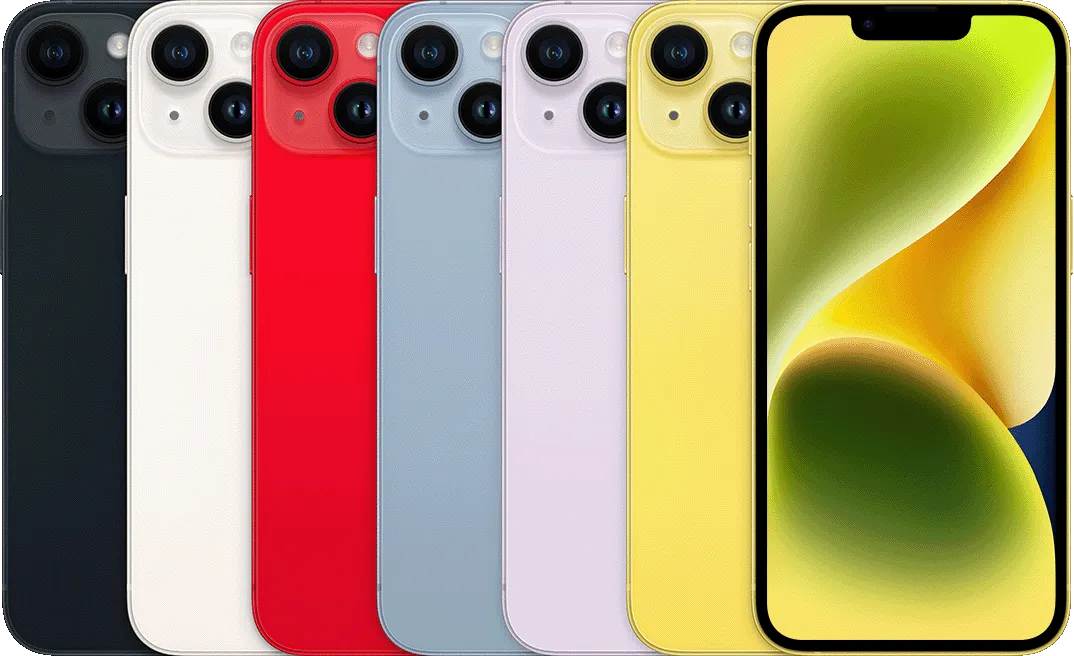
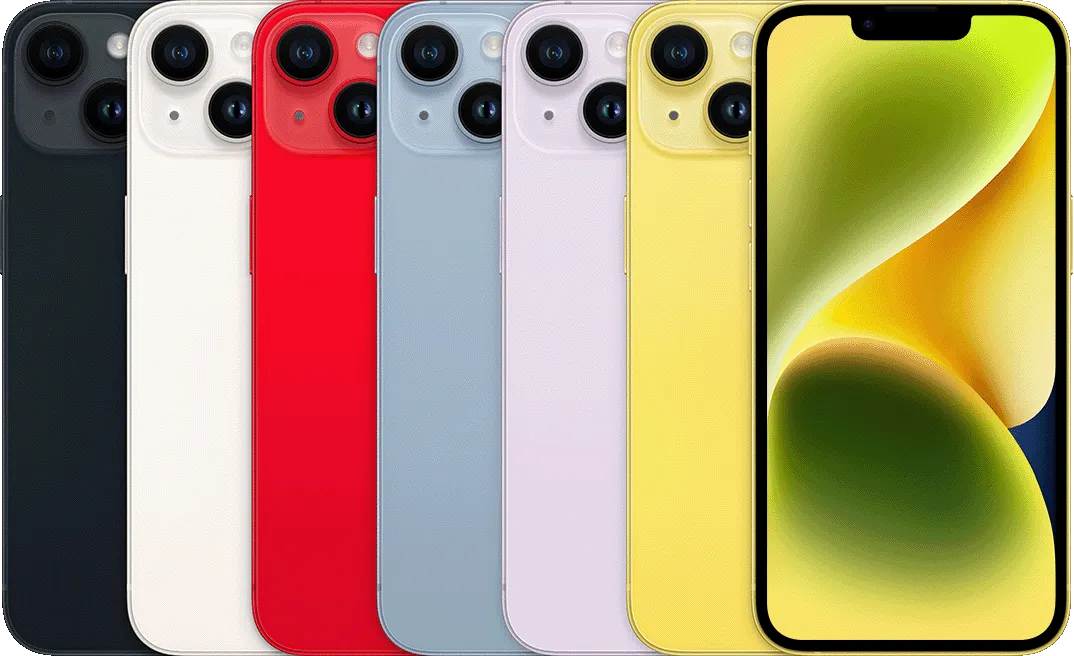
| Midnight | Starlight | RED | Blue | Purple | Yellow |
| iPhone 14 — Technical Specifications (Apple Support) | |||||
[ Show / Hide ]
| ||||||||||||||||||||||||||||||||||||||||||||||||

The iPhone 14 is a smartphone designed and marketed by Apple, announced on September 7, 2022, and released on September 16, 2022, with the iPhone 14 Plus, iPhone 14 Pro, and iPhone 14 Pro Max. It broke two long-standing conventions quietly: the base model kept the previous year's chip (the iPhone 13 Pro's five-GPU A15 rather than the Pros' new A16 — the first silicon split between tiers since the Plus era), and in the United States it shipped with no SIM tray at all, moving American iPhones to eSIM only.
Its genuinely new features pointed at emergencies: Crash Detection, fusing a high-g accelerometer with the barometer and microphone to call for help after a car accident, and Emergency SOS via satellite, letting the phone text emergency services from outside cellular coverage entirely — a capability no mainstream phone had shipped.
Otherwise the 14 was a 13 refined — same design and display, a better main sensor and the Photonic Engine pipeline, the front camera gaining autofocus — a resemblance reviews dwelt on. It sold on the lineup's momentum regardless, and served until 2024.
1 Design✎
Visually the iPhone 13's flat aluminum design continued — same 6.1-inch Super Retina XDR panel with the smaller notch, 172 g — with internal serviceability its hidden redesign: the back glass became separately removable, cutting Apple's own repair price for it by more than half, a change iFixit called the most significant iPhone design shift in years. Five launch colors (Midnight, Starlight, RED, Blue, Purple) with Yellow following in March; Ceramic Shield; IP68; MagSafe.
2 Hardware✎
| Developer | Apple |
|---|---|
| Generation | 16th |
| Announced | September 7, 2022 |
| Released | September 16, 2022 |
| Discontinued | September 9, 2024 |
| Predecessor | iPhone 13 |
| Related | iPhone 14 Plus · iPhone 14 Pro · iPhone 14 Pro Max |
| Successor | iPhone 15 |
| Display | 6.1-inch Super Retina XDR OLED 2532 × 1170 (460 ppi) HDR · True Tone · Ceramic Shield |
| Chip | Apple A15 Bionic (5-core GPU) — carried from the 13 Pro |
| RAM | 6 GB |
| Storage | 128 GB · 256 GB · 512 GB |
| Rear cameras | 12 MP wide, f/1.5, sensor-shift OIS (larger sensor) + 12 MP ultra-wide, f/2.4 Photonic Engine · Action mode video |
| Front camera | 12 MP TrueDepth, f/1.9, autofocus |
| Safety | Crash Detection Emergency SOS via satellite |
| Battery | 3,279 mAh · MagSafe 15 W · Qi |
| Connectivity | 5G · Wi-Fi 6 · Bluetooth 5.3 US models: eSIM only (no SIM tray) |
| Colors | Midnight · Starlight · (PRODUCT)RED · Blue · Purple (+ Yellow from March 2023) |
| Launch price | $799 (128 GB) · $899 (256 GB) · $1,099 (512 GB) |
| OS | iOS 16.0 ~ current |
The five-GPU A15 remained, in 2022, faster than every Android chip shipping — Apple's tier-split gamble rested on that cushion — with 6 GB of RAM now standard at the base tier. The eSIM-only US models made carrier-switching a software flow and travelers' SIM swapping an adjustment; the satellite hardware connected to Globalstar with two years of free service, later repeatedly extended.
3 Camera✎
The main sensor grew (1.9µ pixels, f/1.5) and the Photonic Engine moved Deep Fusion earlier in the pipeline, claiming up to 2× low-light gains across all cameras. The TrueDepth camera gained autofocus and a faster aperture — the biggest selfie upgrade in years — and Action mode delivered gimbal-grade video stabilization at a crop. The hardware resemblance to the 13 Pro's main camera was strong; the results measured a modest, real step over the iPhone 13.
4 Software✎
Shipped with iOS 16 — the customizable lock screen year — with satellite SOS activating that November via update. Current release train since.
5 Release and reception✎
Reviews were the era's coolest: "the most iterative iPhone ever" takes anchored on the carried-over chip and design, warmed only by the safety features (which early real-world saves — Alaska snowmobilers, canyon crash victims — soon made concrete) and the front camera. The buying advice bifurcated: the iPhone 14 Pro's Dynamic Island and 48 MP camera for enthusiasts, the discounted iPhone 13 for value. The 14 nonetheless held Apple's volume slot through a strong cycle, continued at $699 and $599 under later generations, and was discontinued on September 9, 2024 — the last Lightning-connector base model sold new by Apple.
6 Legacy✎
The 14's real legacies are structural: the chip split it began (base models one silicon generation behind) has governed the lineup ever since — through the current iPhone 17/iPhone 17 Pro divide — and eSIM-only US models began the SIM tray's global sunset. Crash Detection and satellite SOS made "the phone as safety device" a marketing category with a genuine body count of saves behind it, industry-copied within two years. And the 14 closed out Lightning at the base tier, the connector's final volume carrier.