iPhone 5c
|
iPhone 5c
For the colorful.
| ||||
| Green | Blue | Yellow | Pink | White |
| iPhone 5c — Technical Specifications (Apple Support) | ||||
[ Show / Hide ]
| ||||||||||||||||||||||||||||||||||||||||||||||||

The iPhone 5c is a smartphone designed and marketed by Apple. It was announced on September 10, 2013, alongside the iPhone 5s and released with it on September 20, 2013 — the first time Apple launched two new iPhone models simultaneously, and the first time the lineup split into distinct tiers by design rather than by age.
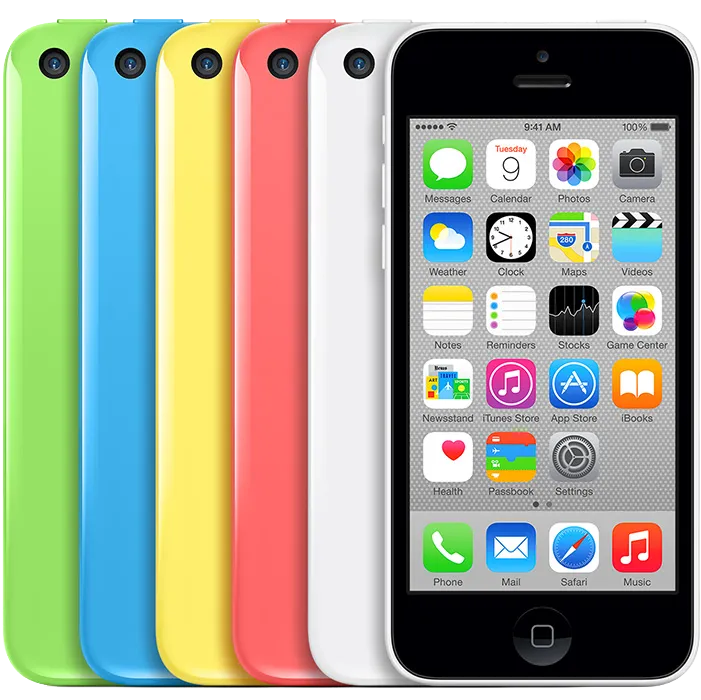
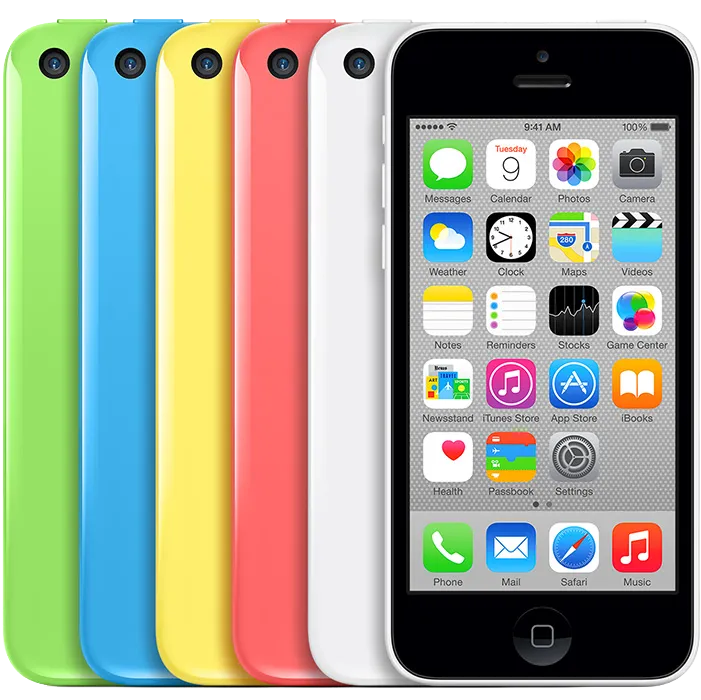
The 5c is, essentially, the iPhone 5 reborn in color: the same A6 chip, 4-inch Retina display, and 8-megapixel camera, wrapped in a hard-coated polycarbonate shell over a steel reinforcement frame that doubled as antenna. It came in green, blue, yellow, pink, and white, with Apple's marketing — "unapologetically plastic," in Jony Ive's launch-film phrase — treating the material as a choice rather than a compromise.
Widely expected to be Apple's long-rumored "cheap iPhone," the 5c launched at $99 on contract ($549 unlocked) — only $100 below the flagship — and its sales disappointed against the runaway iPhone 5s. It nonetheless outsold nearly every competing Android flagship of its generation, an odd footnote for a product remembered as a rare Apple misstep.
1 Design✎
The 5c's single-piece polycarbonate body is molded around a laser-welded steel frame, giving a solidity reviewers consistently contrasted with typical plastic phones; at 132 grams it is noticeably heavier than the aluminum iPhone 5 it replaced. The lacquered finish carried the color through the entire case — scratches revealed more of the same color rather than a different substrate — and iOS 7's wallpapers were tinted to match each shell.
Apple sold $29 silicone cases perforated with a grid of 35 holes, whose tendency to expose fragments of the "iPhone" text on the back ("hone" being a common result) became a minor design scandal of the launch.
The display is the iPhone 5's 4-inch, 1136 × 640 Retina panel unchanged.
2 Hardware✎
| Developer | Apple |
|---|---|
| Generation | 7th (with iPhone 5s) |
| Announced | September 10, 2013 |
| Released | September 20, 2013 |
| Discontinued | September 9, 2015 |
| Predecessor | iPhone 5 |
| Successor | iPhone 6 |
| Display | 4-inch Retina IPS LCD 1136 × 640 (326 ppi) |
| Chip | Apple A6 (dual-core Swift, 1.3 GHz) |
| RAM | 1 GB |
| Storage | 16 GB · 32 GB (8 GB variant from 2014) |
| Rear camera | 8 MP backside-illuminated, f/2.4 1080p video at 30 fps |
| Front camera | 1.2 MP (720p FaceTime HD) |
| Battery | 1,510 mAh built-in |
| Connectivity | LTE (more bands than iPhone 5) Wi-Fi 802.11a/b/g/n · Bluetooth 4.0 |
| Colors | Green · Blue · Yellow · Pink · White |
| Launch price | $99 (16 GB) · $199 (32 GB) with 2-year contract (U.S.) |
| OS | iOS 7.0 ~ 10.3.3 |
Under the shell the 5c improves on the iPhone 5 in only small ways: a slightly larger 1,510 mAh battery, additional LTE bands for broader international coverage, and a marginally better front-camera sensor. The A6 and 1 GB of RAM carried over intact — which meant the mid-tier 2013 iPhone matched the 2012 flagship, a positioning Apple has repeated in various forms since.
3 Software✎
The 5c shipped with iOS 7, whose flat, color-saturated redesign seemed drawn for the product — Apple's launch imagery leaned hard on shell-matched wallpapers and translucent interface layers. It received iOS 8, 9, and 10, ending at iOS 10.3.3 alongside its 32-bit sibling the iPhone 5. As with the 5, the A6's 32-bit architecture drew the line at iOS 11.
4 Release and reception✎
Apple's decision to keep the 5c's pricing near-flagship rather than chase the mid-market confounded the "cheap iPhone" narrative that had built for a year. Reviewers liked the phone itself — the build was widely judged the best plastic construction in the industry, and the internals were proven — but the value equation was awkward: $100 more bought the 5s's 64-bit A7, Touch ID, and camera improvements.
Buyers agreed. Supply-chain reports through late 2013 described cut 5c orders while the 5s ran supply-constrained; Tim Cook conceded the mix had "been different than we thought." An 8 GB variant in spring 2014 tried to stretch the price floor. The 5c stayed on as the entry model until September 9, 2015 — outliving the 5s in the lineup by staying cheap — but the experiment was not repeated: the following "budget" iPhone, the SE, reused flagship aluminum instead.
The 5c also holds a curious place in security history: the phone at the center of the 2016 FBI–Apple encryption dispute, over unlocking a 5c used by the San Bernardino attacker, made the model briefly the most argued-about iPhone in the world years after its discontinuation.
5 Legacy✎
The 5c taught Apple — and the industry watching — that iPhone buyers would not accept a visibly "lesser" iPhone at a barely-lesser price, a lesson that shaped every subsequent attempt at lineup segmentation, from the aluminum-bodied SE through the iPhone 16e and iPhone 17e of the current era. Its unapologetic colors, though, aged well: bright multi-color lineups returned across Apple's products, and the current iPhone 17 generation's pastel palette owes the 5c a visible debt.