iPhone 11
|
iPhone 11
Just the right amount of everything.
| |||||
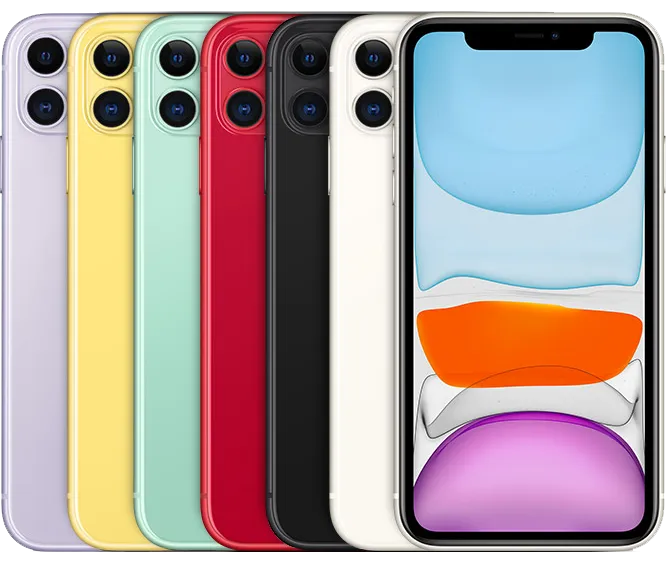
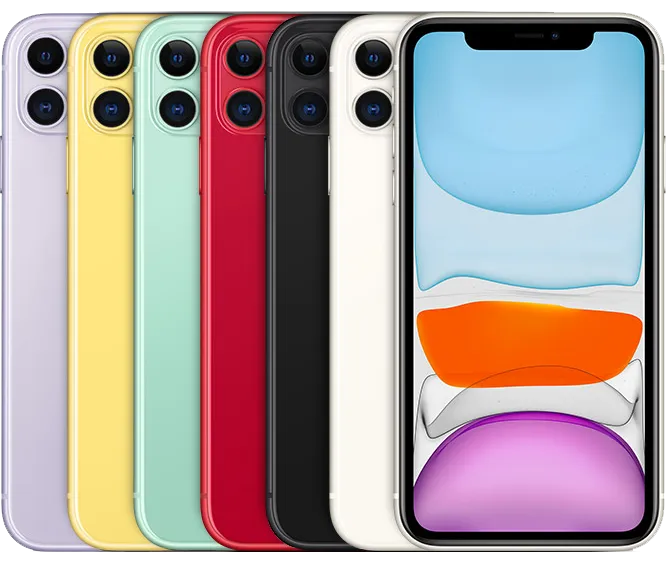
| Purple | Yellow | Green | Black | White | RED |
| iPhone 11 — Technical Specifications (Apple Support) | |||||
[ Show / Hide ]
| ||||||||||||||||||||||||||||||||||||||||||||||||

The iPhone 11 is a smartphone designed and marketed by Apple, announced on September 10, 2019, and released on September 20, 2019, alongside the iPhone 11 Pro and iPhone 11 Pro Max. It is the direct successor to the iPhone XR — same 6.1-inch Liquid Retina LCD, same aluminum-and-glass build, same "the one most people should buy" role — improved exactly where the XR had been dinged and priced $50 lower at $699.
The additions were the year's two big camera features: an ultra-wide second lens opening a 0.5× field of view, and Night mode, Apple's long-awaited answer to computational low-light photography. The A13 Bionic — the fastest mobile chip of its year — a 12-megapixel TrueDepth camera with slow-motion selfies, and another hour of battery rounded out the update, in six new pastel-leaning colors.
The formula repeated the XR's result exactly: the iPhone 11 was the world's best-selling smartphone of 2020, and it stayed in the lineup as the budget tier until September 2022 — the last LCD iPhone Apple sold.
1 Design✎
The 11 reuses the XR's chassis — anodized aluminum band, glass faces, 6.1-inch notched LCD at 1792 × 828 — with the back glass now a single milled piece whose square camera bump rises from the glass itself, the generation's shared design signature. The six finishes shifted softer: Purple and Green pastels joined Yellow, Black, White, and (PRODUCT)RED. Water resistance doubled to two meters (still IP68's junior sibling at the base tier), and at 194 g it matched the XR exactly.
2 Hardware✎
| Developer | Apple |
|---|---|
| Generation | 13th |
| Announced | September 10, 2019 |
| Released | September 20, 2019 |
| Discontinued | September 7, 2022 |
| Predecessor | iPhone XR |
| Related | iPhone 11 Pro · iPhone 11 Pro Max |
| Successor | iPhone 12 |
| Display | 6.1-inch Liquid Retina IPS LCD 1792 × 828 (326 ppi) True Tone · Haptic Touch |
| Chip | Apple A13 Bionic (2 + 4 cores · 8-core Neural Engine) |
| RAM | 4 GB |
| Storage | 64 GB · 128 GB · 256 GB |
| Rear cameras | 12 MP wide, f/1.8, OIS + 12 MP ultra-wide, f/2.4 (0.5×) Night mode · 4K 60 fps |
| Front camera | 12 MP TrueDepth · 4K 60 · slofies |
| Battery | 3,110 mAh · Qi wireless charging |
| Durability | IP68 (2 m / 30 min) · aluminum frame |
| Colors | Purple · Yellow · Green · Black · White · (PRODUCT)RED |
| Launch price | $699 (64 GB) · $749 (128 GB) · $849 (256 GB) |
| OS | iOS 13.0 ~ current |
The A13 Bionic carried the same chip-parity guarantee that had made the XR a phenomenon: identical silicon to the $1,099 Pro Max, 20% faster than the A12 in both CPU and Neural Engine, with machine-learning accelerators feeding the new camera pipeline. The $699 price — $50 under the XR's launch — was Apple's quiet concession that the value tier was now the volume engine of the whole line.
3 Camera✎
The ultra-wide lens gave the base iPhone its second camera — a 120-degree 0.5× view for landscapes, architecture, and cramped rooms — with the camera interface previewing beyond the frame edges to advertise it. Night mode, activated automatically, fused long-exposure frames into bright, low-noise shots that finally matched Google's Night Sight, and reviewers judged the 11's low-light output a generational leap over the XR. QuickTake — holding the shutter to start video — and the 12-megapixel front camera with 4K and slow-motion ("slofie," a coinage Apple trademarked and reviewers mocked) completed the refresh.
4 Software✎
The 11 shipped with iOS 13 — Dark Mode, the overhauled Photos app, Sign in with Apple — in a famously bumpy launch that stabilized by 13.1. Its A13 has kept it on the current release train ever since: seven years of updates and counting, through the present major version.
5 Release and reception✎
Reviews replayed the XR's verdict at higher volume: the one to buy. The camera additions erased the single-lens objection, the price cut undercut the criticism of LCD-in-2019, and battery life again led the class. The 11 topped worldwide sales charts for 2020 as the XR had for 2019, weathered the pandemic year as Apple's volume anchor, dropped to $599 and then $499 as the 12 and 13 arrived above it, and was discontinued on September 7, 2022.
6 Legacy✎
The 11 perfected the value-flagship formula the XR invented and proved it repeatable — two consecutive years of the world's best-selling phone at the "cheap" tier reshaped how Apple structures the lineup to this day. It was also an ending: the last new LCD iPhone, closing the display technology that had defined the line since 2007. Its role lives on in the numbered base models through the current iPhone 17.