iPhone Air
|
iPhone Air
The thinnest iPhone ever. With the power of pro inside.
| |||
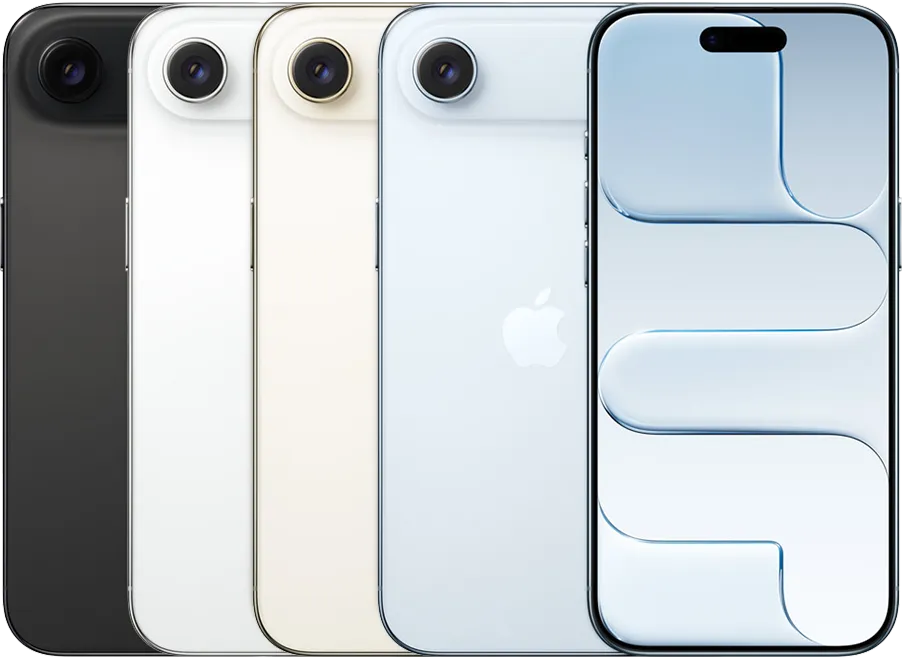
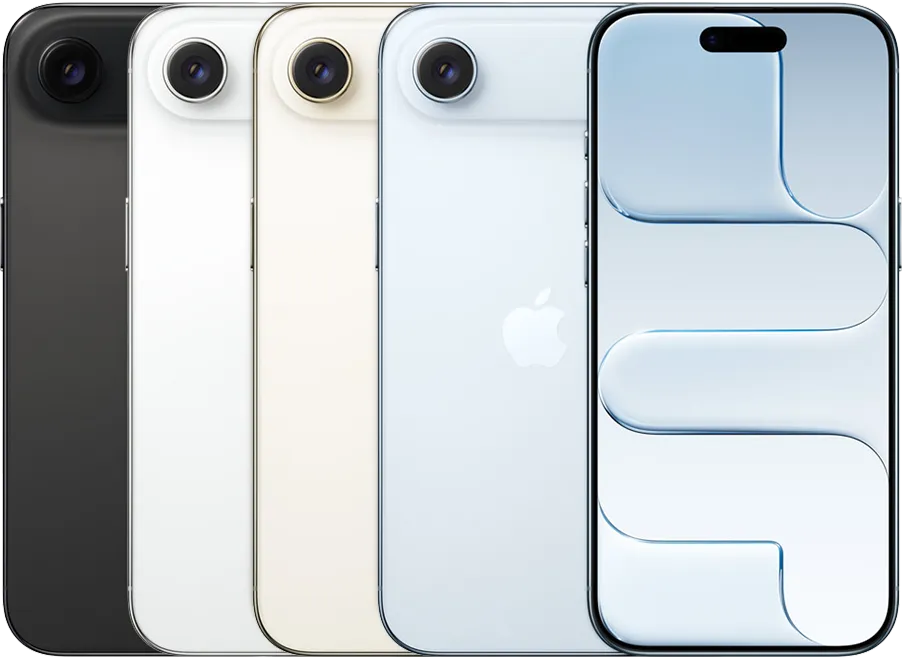
| Space Black | Cloud White | Light Gold | Sky Blue |
| Official site for iPhone Air | |||
[ Show / Hide ]
| ||||||||||||||||||||||||||||||||||||||||||||||||

The iPhone Air is a smartphone designed and marketed by Apple, announced on September 9, 2025, and released on September 19, 2025, alongside the iPhone 17 and the 17 Pro models. It opened a new product category in the lineup — the name borrowed from the MacBook Air playbook — replacing the Plus tier with a different trade entirely: at 5.64 mm, the thinnest iPhone ever made, a titanium-framed 6.5-inch flagship that weighs less than the base iPhone 17 while carrying the Pro-class A19 Pro chip and 12 GB of RAM.
Thinness set every other spec. A single 48-megapixel Fusion camera sits in a full-width plateau; the phone is eSIM-only worldwide — the SIM tray physically doesn't fit — and its radios are Apple silicon end-to-end: the C1X modem and the N1 networking chip (Wi-Fi 7, Bluetooth 6, Thread), making the Air the most Apple-silicon iPhone shipped. The battery, the design's obvious hostage, lands closer to adequate than heroic, with a matching MagSafe battery pack sold as the tacit accessory.
At $999 between the 17 and 17 Pro, the Air is the lineup's style flagship — and, by wide consensus, the dress rehearsal for a folding iPhone's thin halves. It remains on sale as of 2026.
1 Design✎
A 5.64 mm slab — thinner than the camera plateau that interrupts it — in polished grade-5 titanium around Ceramic Shield front and back (the rear's first Ceramic Shield), at 165 g for a 6.5-inch device. Space Black, Cloud White, Light Gold, and Sky Blue. The full-width plateau holds the camera, flash, and the relocated speaker; the frame carries Action Button and Camera Control despite the thickness budget. Apple's launch demo bent it on stage on purpose — the titanium structure's answer to the bendgate ghost — and IP68 held.
2 Hardware✎
| Developer | Apple |
|---|---|
| Generation | 19th |
| Announced | September 9, 2025 |
| Released | September 19, 2025 |
| Discontinued | — (on sale) |
| Predecessor | — (new category; lineup slot of iPhone 16 Plus) |
| Related | iPhone 17 · iPhone 17 Pro · iPhone 17 Pro Max |
| Display | 6.5-inch Super Retina XDR OLED 2736 × 1260 (460 ppi) ProMotion 120Hz · Always-On 3,000 nits peak · Dynamic Island |
| Chip | Apple A19 Pro (5-core GPU) · 16-core Neural Engine |
| Radios | Apple C1X modem (5G, sub-6) Apple N1: Wi-Fi 7 · Bluetooth 6 · Thread |
| RAM | 12 GB |
| Storage | 256 GB · 512 GB · 1 TB |
| Rear camera | 48 MP Fusion, f/1.6, OIS (2× crop tier) |
| Front camera | 18 MP Center Stage (square sensor) |
| Body | 5.64 mm — thinnest iPhone · 165 g titanium frame · Ceramic Shield front and back · IP68 |
| Battery | 3,149 mAh · MagSafe · Qi2 (companion MagSafe Battery accessory) |
| Connectivity | USB-C · eSIM only (all regions) |
| Colors | Space Black · Cloud White · Light Gold · Sky Blue |
| Launch price | $999 (256 GB) · $1,199 (512 GB) · $1,399 (1 TB) |
| OS | iOS 26 ~ current |
The A19 Pro (a five-GPU-core bin of the Pro silicon) with 12 GB of RAM gives the Air genuine Pro-class performance within a thermal envelope that throttles sooner under sustained load — the thinness tax, alongside the 3,149 mAh cell and a single speaker whose quality drew the launch cycle's sharpest criticism at the price. The all-Apple radio stack (C1X + N1) debuted here ahead of the rest of the line.
3 Camera✎
One lens, deliberately: the 48 MP Fusion main with sensor-crop 2×, Night mode, Dolby Vision 4K — the iPhone 17's primary camera without its ultra-wide sibling. The 18 MP square-sensor Center Stage front camera (shared with the 17 generation) frames landscape selfies from a portrait grip. The missing ultra-wide and telephoto are the price sticker of the 5.64 mm figure; buyers photographing at 0.5× or 5× were pointed at the Pros.
4 Software✎
Shipped with iOS 26 (the Liquid Glass redesign year, version numbering unified across platforms); Apple Intelligence full-featured on its 12 GB. Current release train since.
5 Release and reception✎
The Air drew the launch's longest hands-on lines and its most divided reviews: the thinness and weight registered as genuinely new in a way spec bumps had not for years — "the first iPhone in a decade that feels different" — against pointed criticism of the single camera, single speaker, and day-long-but-no-longer battery at $999. Early sales reporting sketched a familiar pattern: strong launch curiosity, then a settling into the style-buyer niche while the Pros carried volume. The consensus reading — the Air as public beta for the folding iPhone's engineering — was strengthened by the strikethrough entry on every 2026 roadmap: iPhone Duo.
6 Legacy✎
Whatever the Air's own sales trajectory, its parts list is the future the lineup announced: Apple's complete radio independence (C1X + N1), Ceramic Shield backs, and the sub-6 mm structural engineering a folding phone requires. It retired the Plus tier's screen-per-dollar formula in favor of desirability-per-gram — the first time since the iPhone 5c that Apple aimed a lineup slot at want over need, and this time at the premium end.