Loading history…
iPhone 13
This is r1 (the current revision), saved by jack. Full history
|
iPhone 13
Your new superpower.
| |||||
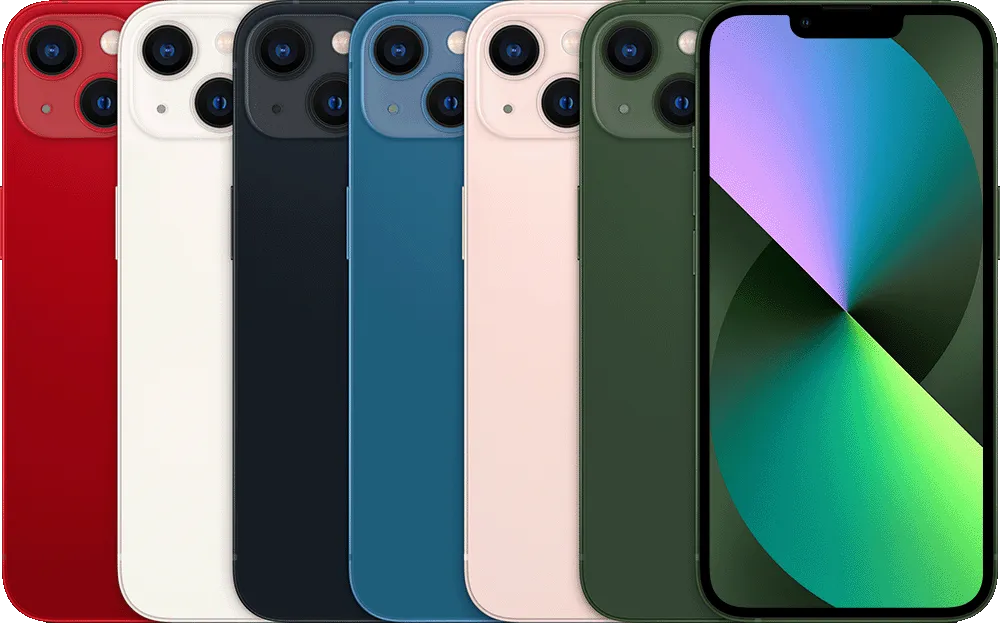
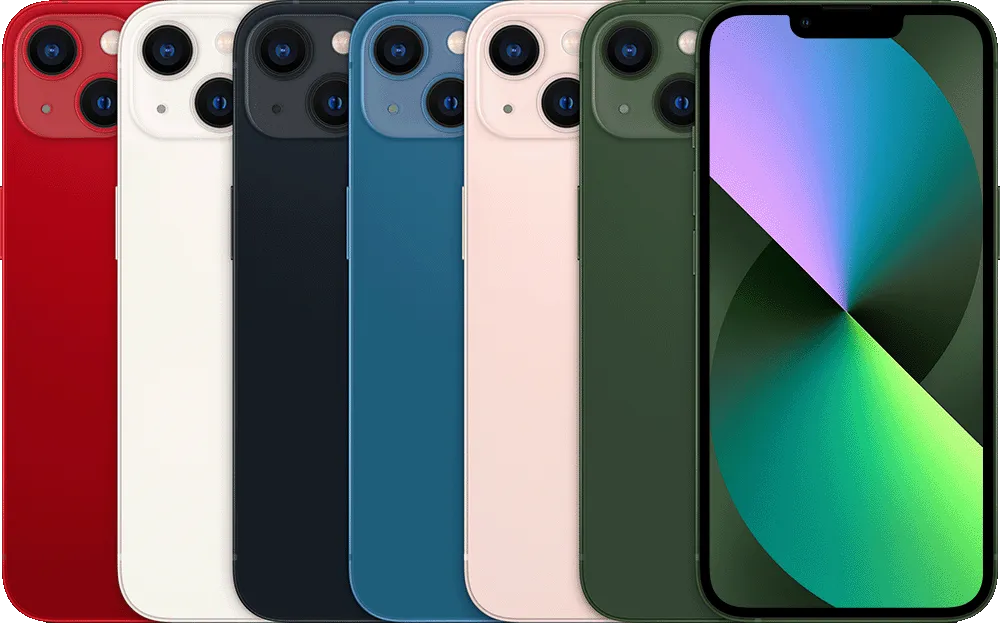
| RED | Starlight | Midnight | Blue | Pink | Green |
| iPhone 13 — Technical Specifications (Apple Support) | |||||
[ Show / Hide ]
| ||||||||||||||||||||||||||||||||||||||||||||||||

The iPhone 13 is a smartphone designed and marketed by Apple, announced on September 14, 2021, and released on September 24, 2021, with the iPhone 13 mini, iPhone 13 Pro, and iPhone 13 Pro Max. A refinement year by design, it took the iPhone 12's new platform and fixed its costs: batteries grew across the generation (two and a half claimed hours here), the notch shrank 20%, base storage doubled to 128 GB, and the main camera inherited the iPhone 12 Pro Max's large sensor and sensor-shift stabilization — the previous year's headline Pro exclusive, standard on the $799 model twelve months later.
The A15 Bionic and two video-first features — Cinematic mode's editable rack focus and Photographic Styles — completed a package reviewers summarized as "the iPhone 12, debugged." It became the world's best-selling smartphone of 2022 and held the lineup's budget tiers until 2024, the last of the three-year base models.
1 Design✎
Visually a 12 with two tells: the 20% narrower notch and the rear lenses set diagonally to clear the big stabilized sensor. Same flat aluminum-and-glass build at 174 g (10 heavier, all battery), Ceramic Shield, IP68, MagSafe. The palette warmed — Pink and Starlight replacing the 12's cooler tones alongside Midnight, Blue, and RED, with Green arriving in March.
2 Hardware✎
| Developer | Apple |
|---|---|
| Generation | 15th |
| Announced | September 14, 2021 |
| Released | September 24, 2021 |
| Discontinued | September 9, 2024 |
| Predecessor | iPhone 12 |
| Related | iPhone 13 mini · iPhone 13 Pro · iPhone 13 Pro Max |
| Successor | iPhone 14 |
| Display | 6.1-inch Super Retina XDR OLED 2532 × 1170 (460 ppi) HDR · True Tone · Ceramic Shield |
| Chip | Apple A15 Bionic (2 + 4 cores · 4-core GPU · 16-core Neural Engine) |
| RAM | 4 GB |
| Storage | 128 GB · 256 GB · 512 GB |
| Rear cameras | 12 MP wide, f/1.6, sensor-shift OIS (1.7µ pixels) + 12 MP ultra-wide, f/2.4 Cinematic mode · Photographic Styles |
| Front camera | 12 MP TrueDepth |
| Battery | 3,240 mAh · MagSafe 15 W · Qi |
| Connectivity | 5G · Wi-Fi 6 · Bluetooth 5.0 |
| Colors | (PRODUCT)RED · Starlight · Midnight · Blue · Pink (+ Green from March 2022) |
| Launch price | $799 (128 GB) · $899 (256 GB) · $1,099 (512 GB) |
| OS | iOS 15.0 ~ current |
The A15 Bionic — five-nanometer, with the fastest single-core scores of its year — arrived amid the global chip shortage that made the 13 generation's on-time, in-stock launch itself an achievement. The battery gains were the spec that mattered: a 13% larger cell plus display and modem efficiency delivered the two-plus hours Apple claimed, verified widely, converting the 12's weakest review line into the 13's strongest.
3 Camera✎
Trickle-down did the work: the 12 Pro Max's 1.7µ sensor-shift main camera became the base camera, improving low light by nearly half a stop with rock-steady handheld Night mode. Cinematic mode brought rack-focus video — the phone tracking subjects and shifting focus cinematically, all editable afterward — in 1080p Dolby Vision, more tech demo than tool at launch but a genuine preview of computational video. Photographic Styles let users bias warmth and contrast permanently without wrecking skin tones.
4 Software✎
Shipped with iOS 15 — Focus modes, Live Text, FaceTime links — and remains current. Its long lineup life means the 13 spans more iOS versions on sale than any base model before it.
5 Release and reception✎
"Boring in the best way" ran the review consensus: no new direction, every 12 complaint addressed, the best value in the lineup. Pre-orders and the holiday quarter set records despite the supply-chain year; the 13 was 2022's best-selling phone globally by most trackers. It then worked down the price ladder — $699, then $599 — anchoring Apple's mid-tier until September 9, 2024, one of the longest-serving base models ever.
6 Legacy✎
The 13 cemented the modern cadence: platform year, then refinement year, with last year's Pro camera hardware flowing down. Its record sales in a shortage year proved the strategy's resilience, its battery fix set the endurance baseline the base tier has held since, and Cinematic mode opened the computational-video track that later generations built into a real filmmaking feature. The value-refinement role it perfected belongs today to the iPhone 17.
Content available under CC BY-SA 4.0