Loading history…
iPhone X
This is r1 (the current revision), saved by jack. Full history
|
iPhone X
Say hello to the future.
| |
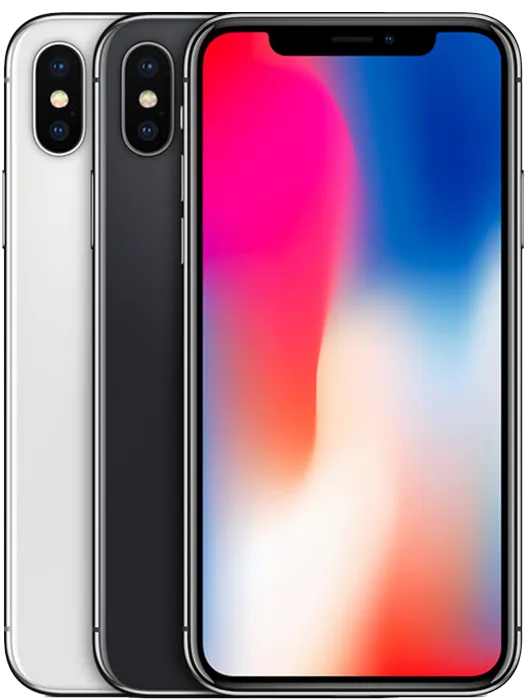
| Silver | Space Gray |
| iPhone X — Technical Specifications (Apple Support) | |
[ Show / Hide ]
| ||||||||||||||||||||||||||||||||||||||||||||||||

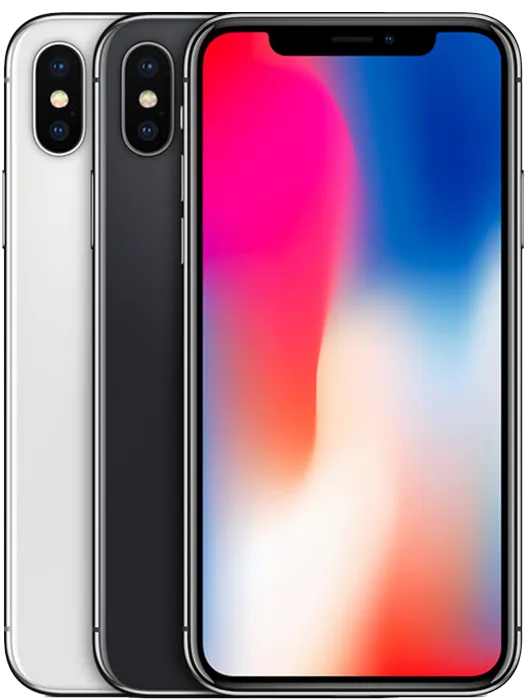
The iPhone X (pronounced "ten") is a smartphone designed and marketed by Apple, announced on September 12, 2017, as the tenth-anniversary iPhone and released on November 3, 2017. Tim Cook introduced it as "the biggest leap forward since the original iPhone," and for once the billing held: the X deleted the Home button that had defined the product since 2007, stretched a 5.8-inch OLED across the entire front — interrupted only by the sensor notch — and replaced Touch ID with Face ID, unlocking the phone by mapping thirty thousand infrared dots onto its owner's face.
Everything about how an iPhone is operated changed here: swipe up to go home, swipe and hold for multitasking, swipe down from the corners for controls, glance to unlock. The stainless-steel-framed glass body, vertical dual camera, and $999 starting price — the industry's first four-figure flagship psychology — completed the break with precedent.
The X sold ahead of Apple's internal expectations despite doomsaying about its price, was named gadget of the year across the technology press, and was discontinued after a single year in Apple's usual anniversary-model fashion — by which time every phone maker on earth was shipping notched, gesture-driven, face-unlocking mimics of it.
1 Design✎
The X compressed a display larger than the iPhone 8 Plus's into a body barely bigger than the iPhone 8's: a 5.8-inch panel filling the face edge-to-edge, wrapped in a polished surgical-grade stainless steel band between glass panes, at 174 g. The notch — housing the TrueDepth camera system — was the design's one visible compromise, mocked in launch-week commentary and copied industry-wide within six months. Silver and Space Gray were the only finishes, the Silver model's mirror-chrome band the anniversary flourish.
With no Home button, the bottom of the display carries only the gesture indicator bar; the side button grew and took over Siri and Apple Pay duties.
2 Display✎
The Super Retina display was the first OLED on an iPhone — 2436 × 1125 at 458 ppi, the line's highest density ever — with true blacks, a 1,000,000:1 contrast ratio, HDR playback in Dolby Vision and HDR10, True Tone, and 3D Touch. Apple, which had held out on OLED for years citing color and burn-in concerns, declared it "the first OLED great enough to be in an iPhone" (panels supplied, in the era's great irony, by Samsung Display). Reviewers measured it among the most accurate displays ever shipped on any device. The rounded display corners and notch cutout required software to treat the screen as a shape, not a rectangle — a first.
3 Face ID✎
Face ID replaced the fingerprint with a face: the TrueDepth system floods the face with infrared light, projects 30,000 structured dots, and the Neural Engine matches the resulting depth map against the enrolled face — adapting to beards, glasses, and hats, requiring attention (open eyes looking at the phone) by default, with a claimed false-match rate of one in a million against Touch ID's one in fifty thousand. It also powered Animoji — emoji puppeted by the user's facial muscles — and Portrait selfies with depth.
Skepticism was immediate (an on-stage demo hiccup didn't help), but the system worked: reviews found it slightly slower than second-generation Touch ID and drastically less fussy — wet hands, gloves off, in the dark. Twins and determined mask-makers generated headlines; for practical purposes the balance of security and convenience shifted the industry to face unlock, though rivals' camera-only versions never matched the structured-light security.
4 Hardware✎
| Developer | Apple |
|---|---|
| Generation | 11th (anniversary) |
| Announced | September 12, 2017 |
| Released | November 3, 2017 |
| Discontinued | September 12, 2018 |
| Predecessor | — (new design line) |
| Related | iPhone 8 · iPhone 8 Plus |
| Successor | iPhone XS |
| Display | 5.8-inch Super Retina OLED 2436 × 1125 (458 ppi) HDR · True Tone · 3D Touch |
| Chip | Apple A11 Bionic (2 + 4 cores · Apple GPU · Neural Engine) |
| RAM | 3 GB |
| Storage | 64 GB · 256 GB |
| Rear cameras | 12 MP wide, f/1.8, OIS + 12 MP telephoto, f/2.4, OIS 2× optical zoom · Portrait Lighting |
| Front camera | 7 MP TrueDepth · Face ID Animoji · Portrait selfies |
| Battery | 2,716 mAh · Qi wireless charging |
| Durability | IP67 · stainless steel frame |
| Colors | Silver · Space Gray |
| Launch price | $999 (64 GB) · $1,149 (256 GB) |
| OS | iOS 11.0.1 ~ 16.7.10 |
The A11 Bionic, 3 GB of RAM, and Qi charging matched the iPhone 8 Plus; the X's exclusives were the screen, the sensors, and the steel. Its vertical dual camera improved on the 8 Plus in one respect — the telephoto gained OIS and a brighter f/2.4 aperture — making it, briefly, the best camera Apple shipped. The battery ran two hours longer than the iPhone 8's, the OLED's efficiency outweighing the extra pixels.
5 Software✎
The X launched on iOS 11.0.1 with an interface rebuilt around gestures and the notch — the swipe-up home gesture, corner-anchored Control Center and notifications, and apps required to respect "safe areas" around the cutout and corners. Developer adaptation took months; the gesture grammar took days for users and has never changed since. Supported through iOS 16 (final: 16.7.10, 2024).
6 Release and reception✎
Released six weeks after the 8 pair to let production of the TrueDepth module catch up, the X drew the longest lines since the iPhone 6 and shipping delays into December. Reviews were the strongest of the smartphone era: the display, build, and rethought interaction earned "best phone ever made" verdicts from most major outlets, with the notch, the price, the relearning curve, and first-generation Face ID misfires the standard reservations. Time put it on its best-inventions list; the $999 gamble became the industry's new flagship anchor within a year.
Apple retired the X on September 12, 2018, when its refined successors — the iPhone XS and iPhone XS Max — took its place, the shortest run of any modern flagship save the iPhone 5.
7 Legacy✎
The iPhone X is the second great reset in the product's history — the moment the iPhone's 2007 interface conventions (button, bezels, fingerprint) were replaced wholesale by the ones still in use: all-screen face, gestures, structured-light face authentication. The notch became the most imitated (and most parodied) design element of its decade before evolving into the Dynamic Island; the $999 price point permanently redefined flagship economics; and every iPhone since — through the current iPhone 17 generation — is recognizably a descendant of this phone rather than of the fifteen models before it.
Content available under CC BY-SA 4.0