Loading history…
iPhone 7 Plus
This is r1 (the current revision), saved by jack. Full history
|
iPhone 7 Plus
This is 7.
| ||||
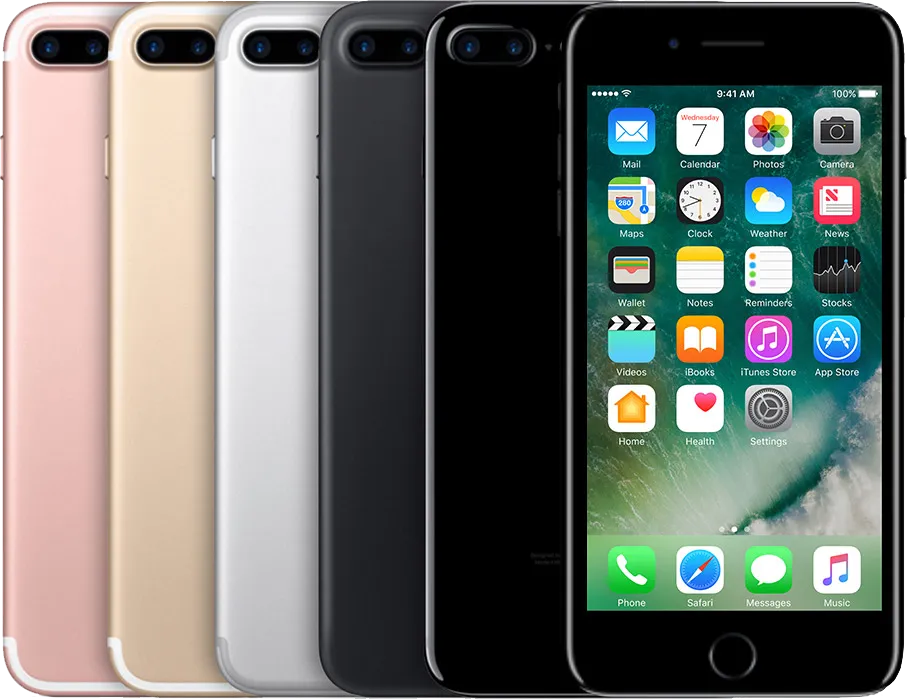
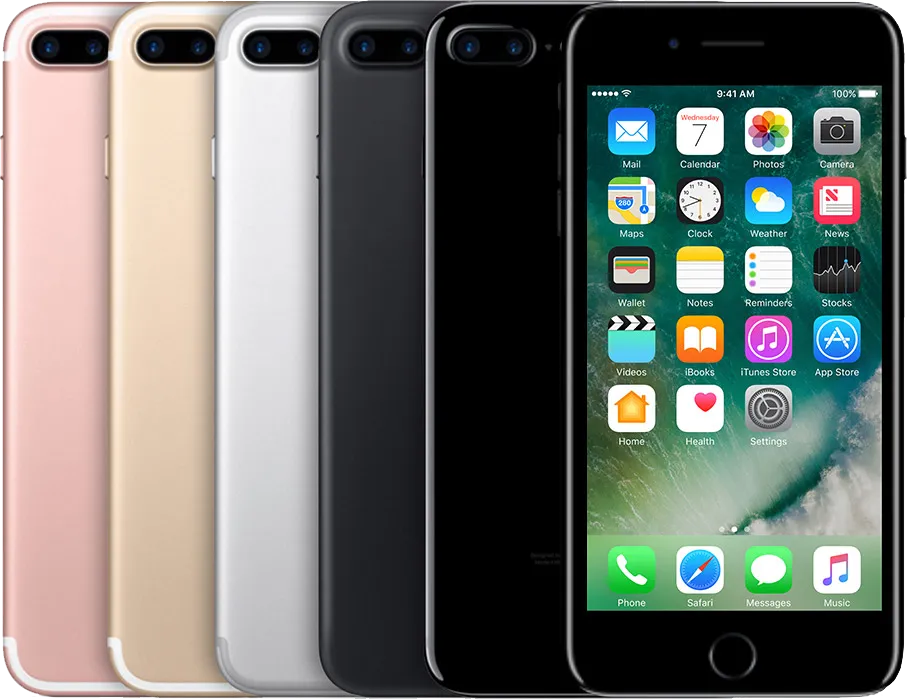
| Rose Gold | Gold | Silver | Black | Jet Black |
| iPhone 7 Plus — Technical Specifications (Apple Support) | ||||
[ Show / Hide ]
| ||||||||||||||||||||||||||||||||||||||||||||||||

The iPhone 7 Plus is a smartphone designed and marketed by Apple, announced on September 7, 2016, and released on September 16, 2016, alongside the iPhone 7. It shares the 7's whole story — the deleted headphone jack, IP67 sealing, solid-state Home button, A10 Fusion, Jet Black — but adds the feature that defined the generation and reshaped phone cameras permanently: a dual-lens rear system pairing the 12-megapixel wide camera with a second 12-megapixel telephoto, delivering 2× optical zoom and, via a software update that fall, Portrait mode's computational background blur.
With 3 GB of RAM (a lineup first, feeding the dual image pipeline) and the generation's larger battery and 1080p display, the 7 Plus was the moment the Plus tier stopped meaning merely "bigger" and started meaning "more capable" — the direct ancestor of the Pro line. It launched with iOS 10, sold out of initial stock before its first weekend ended, and remained on sale until 2019.
1 Design✎
The 7 Plus carries the generation's re-engineered 5.5-inch aluminum body: IP67 gasketing, edge-swept antenna lines, stereo speakers, the Taptic solid-state Home button, and no headphone jack — with Lightning EarPods and the 3.5 mm dongle in the box. At 188 g it is marginally lighter than the 6s Plus. The finishes matched the 7: matte Black and gloss (and scratch-prone) Jet Black replacing Space Gray beside Silver, Gold, and Rose Gold, with (PRODUCT)RED arriving in March 2017. The only new visible feature is the wider pill-shaped camera housing holding two lenses.
2 Hardware✎
| Developer | Apple |
|---|---|
| Generation | 10th |
| Announced | September 7, 2016 |
| Released | September 16, 2016 |
| Discontinued | September 10, 2019 |
| Predecessor | iPhone 6s Plus |
| Related | iPhone 7 |
| Successor | iPhone 8 Plus |
| Display | 5.5-inch Retina HD IPS LCD 1920 × 1080 (401 ppi) · 3D Touch wide color (P3) · 625 nits |
| Chip | Apple A10 Fusion (2 + 2 cores, 2.34 GHz) |
| RAM | 3 GB (lineup first) |
| Storage | 32 GB · 128 GB · 256 GB |
| Rear cameras | 12 MP wide, f/1.8, OIS + 12 MP telephoto, f/2.8 2× optical zoom · Portrait mode 4K video · quad-LED flash |
| Front camera | 7 MP, 1080p |
| Battery | 2,900 mAh built-in |
| Durability | IP67 water and dust resistance |
| Audio | Stereo speakers · no headphone jack |
| Colors | Jet Black · Black · Silver · Gold · Rose Gold (+ (PRODUCT)RED from March 2017) |
| Launch price | $769 (32 GB) · $869 (128 GB) · $969 (256 GB) |
| OS | iOS 10.0 ~ 15.8.4 |
The A10 Fusion's 2+2 heterogeneous cores and the Plus-exclusive third gigabyte of RAM — needed to hold two simultaneous 12-megapixel image pipelines — made the 7 Plus the most powerful iPhone of its generation in practice as well as in name. Battery life extended the Plus tradition, rated an hour or more beyond the 7 in every category.
3 Dual camera and Portrait mode✎
The second lens was the generation's true headline. A 56 mm-equivalent f/2.8 telephoto sat beside the stabilized 28 mm-equivalent wide camera, giving 2× zoom with no resolution loss — tap "2×" and the phone switches lenses — plus digital zoom to 10× that started from twice as close.
Portrait mode followed in the iOS 10.1 update: using the two lenses' parallax to build a nine-layer depth map, the phone kept the subject sharp while progressively blurring the background into a DSLR-like bokeh. Shipped in "beta" and imperfect around hair and glass, it was nonetheless the moment computational photography became a mass-market selling point; within two years a "portrait" toggle was mandatory on every phone at every price. The dual-camera layout itself became the industry's default, and Apple's own Pro line grew directly from this fork.
4 Software✎
The 7 Plus shipped with iOS 10 and its Plus landscape layouts, gained Portrait mode in 10.1 that October, and received updates through iOS 15 — ending at 15.8.4 in 2025, a nine-year run. Depth data captured by the dual cameras later fed Portrait Lighting and third-party depth APIs introduced in iOS 11.
5 Release and reception✎
The 7 Plus sold out of launch inventory before stores opened — Jet Black and Plus models were the fall's scarce commodities — and the model mix shifted noticeably Plus-ward versus prior years, evidence the camera was pulling buyers up-tier. Reviews crowned it the best iPhone and the best phone camera of 2016, with the same generation-wide reservations (familiar design, missing jack) and a new one: Portrait mode's beta softness. Samsung's Note 7 recall that autumn removed its most direct big-phone rival mid-cycle.
It was discontinued on September 10, 2019, alongside the iPhone 7.
6 Legacy✎
The 7 Plus is the origin point of multi-camera smartphone photography as a mainstream expectation: 2× optical zoom and computational bokeh went from its exclusive features to universal defaults in two years. Its 3 GB of RAM began the spec divergence — camera first, memory second — that hardened into the Pro/non-Pro split with the iPhone 11 Pro era and continues through the current iPhone 17 Pro Max. The Plus that was merely bigger became, here, the phone that could do more — and the lineup never went back.
Content available under CC BY-SA 4.0