Loading history…
iPhone 7
This is r1 (the current revision), saved by jack. Full history
|
iPhone 7
This is 7.
| ||||
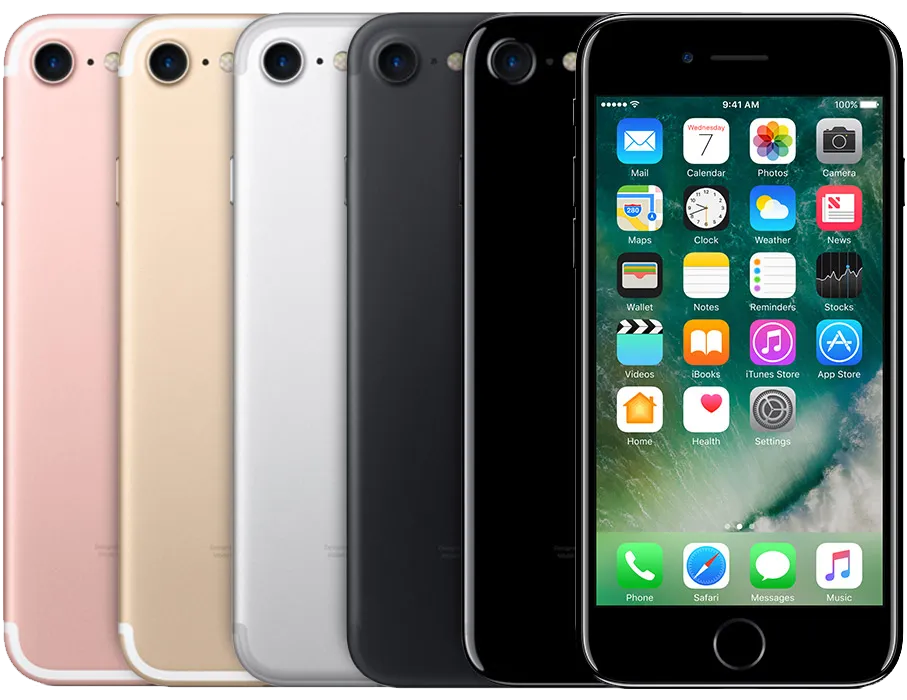
| Rose Gold | Gold | Silver | Black | Jet Black |
| iPhone 7 — Technical Specifications (Apple Support) | ||||
[ Show / Hide ]
| ||||||||||||||||||||||||||||||||||||||||||||||||

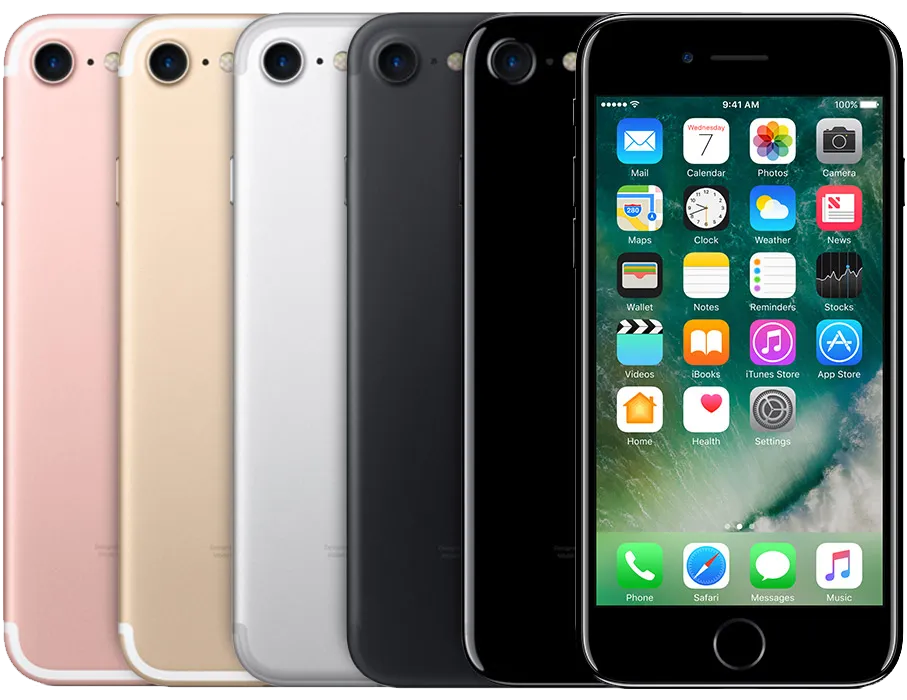
The iPhone 7 is a smartphone designed and marketed by Apple, announced on September 7, 2016, and released on September 16, 2016, alongside the iPhone 7 Plus. The third consecutive generation in the iPhone 6 silhouette, it is remembered above all for what it removed: the 3.5 mm headphone jack, a deletion Apple's marketing chief defended on stage with the word "courage," igniting the loudest peripheral controversy in smartphone history — and previewing the wireless-audio future Apple sold alongside it as AirPods.
What it added was substantial: the first water-resistant iPhone (IP67), a solid-state Home button driven by the Taptic Engine, the A10 Fusion chip with Apple's first big.LITTLE core arrangement, optical image stabilization on the base model at last, a brighter wide-color display, stereo speakers, and 32 GB finally replacing the 16 GB base tier. Two black finishes — matte Black and glossy Jet Black — replaced Space Gray, with (PRODUCT)RED joining in March 2017 as the line's first red iPhone.
The 7 launched with iOS 10, sold in enormous volume despite its familiar body — buoyed in part by Samsung's Galaxy Note 7 recall that fall — and stayed in the lineup until 2019.
1 Design✎
The 7 kept the 6s's aluminum form to the millimeter (though 5 g lighter at 138 g) while re-engineering it for sealing: gaskets throughout, a pressure-vent barometer, and the antenna lines swept to the edges. IP67 water resistance — half a meter for thirty minutes — ended the era of rice-bag phone rescues, though Apple's warranty still excluded liquid damage.
The Home "button" became a fixed disc that no longer moves: the Taptic Engine fakes the click so convincingly that many users never realized, though pressing with a gloved finger or a fingernail now did nothing. Jet Black — a high-gloss finish achieved through a nine-step anodization and polish — looked spectacular, scratched notoriously, and shipped with an Apple footnote recommending a case.
The headphone jack's space went to the larger Taptic Engine and a second (downward-firing) speaker; Lightning EarPods and a 3.5 mm dongle came in the box for the transition.
2 Hardware✎
| Developer | Apple |
|---|---|
| Generation | 10th |
| Announced | September 7, 2016 |
| Released | September 16, 2016 |
| Discontinued | September 10, 2019 |
| Predecessor | iPhone 6s |
| Related | iPhone 7 Plus |
| Successor | iPhone 8 |
| Display | 4.7-inch Retina HD IPS LCD 1334 × 750 (326 ppi) · 3D Touch wide color (P3) · 625 nits |
| Chip | Apple A10 Fusion (2 + 2 cores, 2.34 GHz) |
| RAM | 2 GB |
| Storage | 32 GB · 128 GB · 256 GB |
| Rear camera | 12 MP, f/1.8 · OIS · quad-LED flash 4K video · wide color capture |
| Front camera | 7 MP, 1080p |
| Battery | 1,960 mAh built-in |
| Durability | IP67 water and dust resistance (first iPhone) |
| Audio | Stereo speakers · no headphone jack Lightning EarPods + dongle included |
| Colors | Jet Black · Black · Silver · Gold · Rose Gold (+ (PRODUCT)RED from March 2017) |
| Launch price | $649 (32 GB) · $749 (128 GB) · $849 (256 GB) |
| OS | iOS 10.0 ~ 15.8.4 |
The A10 Fusion introduced heterogeneous computing to the iPhone: two high-performance Hurricane cores paired with two high-efficiency cores, with a hardware controller switching between them by workload — the architecture template every subsequent Apple chip refined. Apple claimed 40% over the A9, and the battery gained up to two hours despite the sealed, speaker-stuffed chassis.
3 Camera✎
The base model finally received optical image stabilization, previously a Plus exclusive, alongside a faster f/1.8 six-element lens and a quad-LED True Tone flash with flicker detection — together nearly doubling low-light capability. The camera captured in the same wide P3 color gamut the display rendered, end to end. The front camera stepped up to 7 megapixels. For two-lens photography — telephoto and Portrait mode — buyers had to move up to the iPhone 7 Plus, the generation's sharpest segmentation yet.
4 The headphone jack✎
Removing the analog jack was framed by Apple as inevitable — space, sealing, and a wireless future — and received as heresy: petitions gathered hundreds of thousands of signatures, and "courage" became a running joke. Apple softened the transition with bundled Lightning EarPods and a dongle, and answered the question it had created with AirPods, announced the same day (shipping that December). Within three years virtually every flagship maker had followed, the dongle had quietly left the box, and true-wireless earbuds — led by AirPods — had become the accessory category of the era. Few Apple decisions have been so mocked and so thoroughly copied.
5 Software✎
The 7 shipped with iOS 10 — rebuilt lock screen and Messages, opened Siri and iMessage to developers — and received updates through iOS 15, ending at 15.8.4 in 2025. The Home button's software dependence produced one quirk: with the button now solid-state, iOS drew an on-screen restart interface if the Taptic Engine ever failed, since there was nothing physical left to press.
6 Release and reception✎
Reviews were the most conflicted of any iPhone to date: near-universal praise for the camera, speed, water resistance, and battery, wrapped in open frustration at the third year of one design and the missing jack. "The best phone you shouldn't buy this year" takes coexisted with sales that broke Apple's quarterly records — helped when Samsung's Note 7, its chief rival, was recalled twice and discontinued mid-cycle over battery fires.
The 7 continued as a mid-tier model after the iPhone 8 and iPhone X launched, and was discontinued on September 10, 2019.
7 Legacy✎
The iPhone 7's deletion of the headphone jack reset the industry's definition of essential — and seeded the AirPods economy that grew larger than most companies. IP-rated water resistance became a permanent baseline expectation, the A10's fusion architecture became the blueprint for a decade of Apple silicon, and (PRODUCT)RED began the mid-cycle color-drop tradition. The line's most controversial subtraction proved its most influential act, echoing through every jackless phone since — including the current iPhone 17 generation.
Content available under CC BY-SA 4.0