Loading history…
iPhone 6 Plus
This is r1 (the current revision), saved by jack. Full history
|
iPhone 6 Plus
Bigger than bigger.
| ||
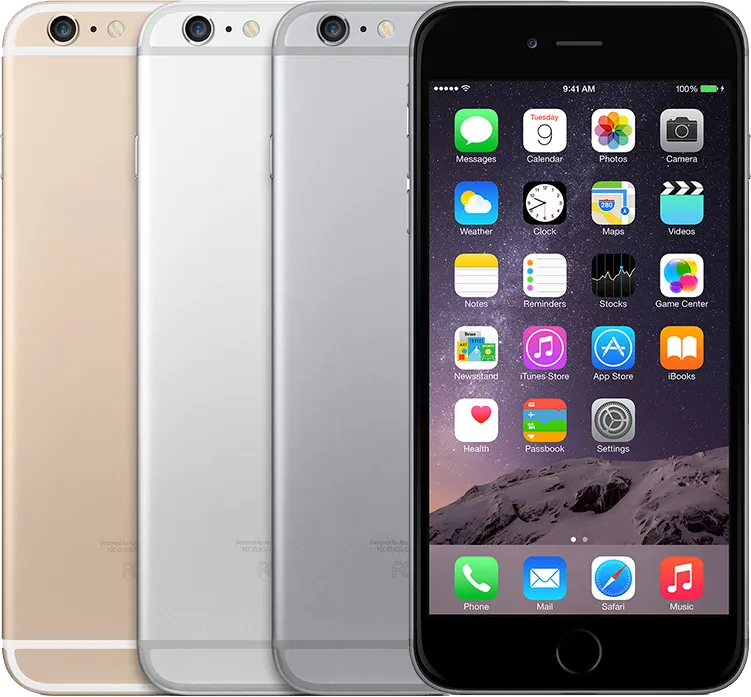
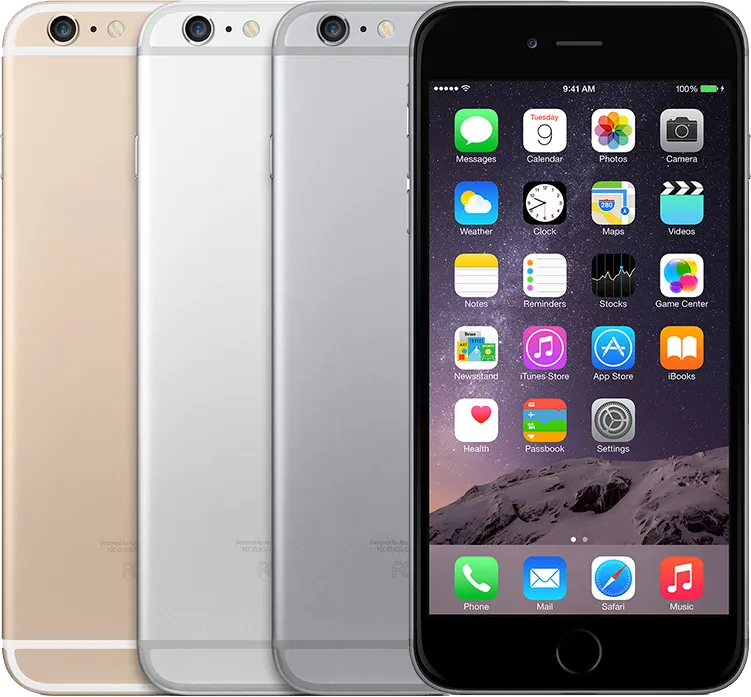
| Gold | Silver | Space Gray |
| iPhone 6 Plus — Technical Specifications (Apple Support) | ||
[ Show / Hide ]
| ||||||||||||||||||||||||||||||||||||||||||||||||

The iPhone 6 Plus is a smartphone designed and marketed by Apple, announced on September 9, 2014, and released on September 19, 2014, alongside the iPhone 6. It was Apple's first phablet: a 5.5-inch, full-HD device aimed squarely at the market segment Samsung's Galaxy Note had built while Apple insisted phones should fit one hand.
The Plus was more than a stretched iPhone 6. Its 1920 × 1080 display was the first iPhone panel past 326 ppi (at 401 ppi), its camera was the only one in the lineup with optical image stabilization, its 2,915 mAh battery set an iPhone endurance record, and iOS treated it almost as a small iPad — landscape mode split apps like Mail and Messages into two panes, and the home screen rotated.
It is also the iPhone that bent: "bendgate" was overwhelmingly a 6 Plus story, and the related long-term "touch disease" defect clustered on the model. Neither stopped the generation from becoming the best-selling iPhone ever, nor the Plus from proving — against years of Apple's own arguments — that a huge iPhone was what much of the market had been waiting for.
1 Design✎
The 6 Plus scales the generation's rounded aluminum unibody to 158.1 × 77.8 × 7.1 mm and 172 grams — the largest and heaviest iPhone to date, though slightly thinner per volume than the 6. The same compromises apply: protruding camera lens, plastic antenna lines, side-mounted sleep/wake button. Silver, Gold, and Space Gray matched the 6.
The size demanded software ergonomics: Reachability slides the screen halfway down on a double-touch of the home button, and the Plus-exclusive landscape orientation turns the home screen, Mail, Messages, and Calendar into two-pane layouts with an iPad-style split keyboard.
2 Display✎
The 5.5-inch Retina HD panel renders 1920 × 1080 — true 1080p — at 401 ppi, the first density increase since the original Retina display of 2010. Like the 6 it uses dual-domain pixels for viewing angles and ion-strengthened, edge-curved cover glass. Internally iOS renders the Plus interface at 3× (2208 × 1242) and downsamples to the panel, a scaling quirk invisible in practice but notable as the line's first non-native rendering.
3 Hardware✎
| Developer | Apple |
|---|---|
| Generation | 8th |
| Announced | September 9, 2014 |
| Released | September 19, 2014 |
| Discontinued | September 7, 2016 |
| Predecessor | iPhone 5s |
| Related | iPhone 6 |
| Successor | iPhone 6s Plus |
| Display | 5.5-inch Retina HD IPS LCD 1920 × 1080 (401 ppi) dual-domain pixels |
| Chip | Apple A8 (dual-core Typhoon, 1.4 GHz) + M8 motion coprocessor |
| RAM | 1 GB |
| Storage | 16 GB · 64 GB · 128 GB |
| Rear camera | 8 MP, f/2.2, Focus Pixels optical image stabilization 1080p at 60 fps · 240 fps slo-mo |
| Front camera | 1.2 MP, f/2.2 (burst selfies) |
| Battery | 2,915 mAh built-in (24 hrs talk time — lineup record) |
| Connectivity | LTE Cat. 4 (150 Mbps) · VoLTE Wi-Fi 802.11ac · Bluetooth 4.0 NFC (Apple Pay) |
| Colors | Silver · Gold · Space Gray |
| Launch price | $299 (16 GB) · $399 (64 GB) · $499 (128 GB) with 2-year contract (U.S.) |
| OS | iOS 8.0 ~ 12.5.7 |
The Plus shares the iPhone 6's silicon — Apple A8, M8 coprocessor with barometer, 1 GB of RAM — and its radio stack, including the NFC hardware behind Apple Pay. What the extra volume buys is battery: 2,915 mAh against the 6's 1,810, rated for 24 hours of talk time and consistently the longest-lasting iPhone in testing, the single most cited reason buyers chose the Plus. The $100 premium over the 6 at each storage tier established the big-model surcharge Apple has maintained ever since.
The 3× rendering pipeline taxed the shared A8 GPU harder than the 6's 2× output, and reviewers occasionally caught the Plus dropping frames where the smaller phone did not — an early lesson in resolution outpacing silicon that Apple corrected in later generations.
4 Camera✎
The Plus carried the generation's sole camera hardware advantage: optical image stabilization. A tiny actuator moves the lens assembly to counter hand shake, compounding with Focus Pixels phase detection and the A8's image processing to noticeably improve low-light shots and steady video. In camera comparisons the 6 Plus routinely edged the 6 in dim conditions, and OIS became a Plus/Pro-tier differentiator in every Apple lineup that followed.
5 Software✎
The Plus shipped with iOS 8 and its landscape-mode exclusives — two-pane apps, rotating home screen, expanded-key keyboard — a treatment acknowledging that a 5.5-inch phone is used differently. It weathered iOS 8.0.1's botched rollout alongside the 6, and received updates through iOS 12, with the final security patch in January 2023. On iOS 11 and 12 the aging 1 GB of RAM and 3× rendering made the Plus the generation's slower half, though iOS 12's performance work granted it a dignified final act.
6 Bendgate and touch disease✎
The 6 Plus was bendgate's protagonist: its length concentrated leverage on a weak point beside the volume buttons, and viral videos showed it deforming under determined hand pressure. Apple's response — nine complaints, tours of its stress-test lab — cooled the story commercially, but independent engineering analyses confirmed the Plus bent at loads notably below competing phablets, and Apple thickened the chassis and moved to stronger 7000-series aluminum in the iPhone 6s Plus.
The same flex had a slower consequence. Years of micro-bending gradually cracked the solder under the touchscreen controller ICs, producing a flickering gray bar and unresponsive touch — christened "touch disease" by repair shops in 2016, and clustered overwhelmingly on the 6 Plus. Apple eventually opened a $149 service program for affected units while class-action suits argued the defect was design-rooted. Between the two controversies, the 6 Plus became a case study in the structural cost of thin-and-large.
7 Release and reception✎
The Plus launched supply-starved — its panels and OIS modules were the constraint in the generation's record four-million-pre-order opening — and carried multi-week shipping delays deep into the fall. Reviews split along a single axis: as a device it was excellent (the battery and camera the generation's best), but its size was polarizing in a way no previous iPhone had been, with reviewers openly sorting readers into "Plus people" and everyone else. It sold in a roughly one-to-three ratio against the 6 in most estimates — tens of millions of units that validated the phablet tier permanently.
It was discontinued with the 6 on September 7, 2016.
8 Legacy✎
The 6 Plus created the two-size iPhone lineup — the Plus/Max tier with the bigger battery and the better camera has anchored Apple's top price point in every generation since, through the current iPhone 17 Pro Max. It vindicated the phablet category Apple had publicly mocked, and its OIS exclusivity began the camera segmentation that now defines Pro models. Its structural failures, meanwhile, taught the industry's most-photographed hardware lesson: thinness, size, and aluminum have a bending point — and the internet will find it within a week of launch.
Content available under CC BY-SA 4.0