Loading history…
iPhone 3G
This is r1 (the current revision), saved by jack. Full history
|
iPhone 3G
Twice as fast. Half the price.
| |
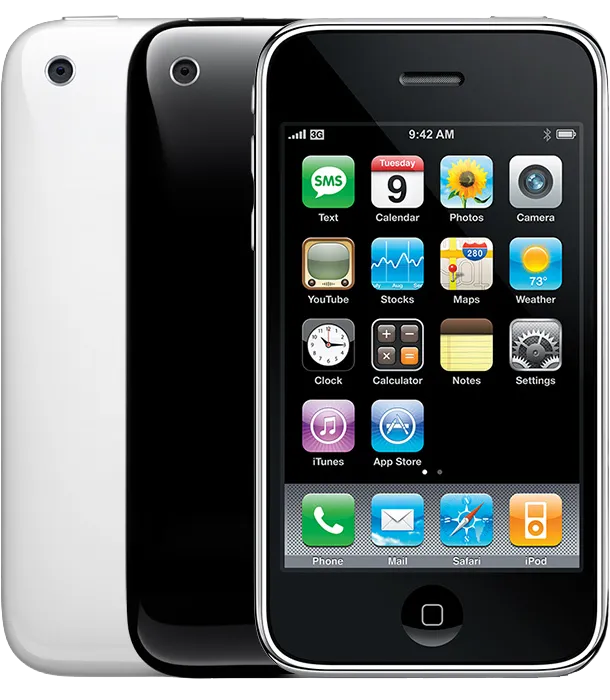
| White | Black |
| iPhone 3G — Technical Specifications (Apple Support) | |
[ Show / Hide ]
| ||||||||||||||||||||||||||||||||||||||||||||||||

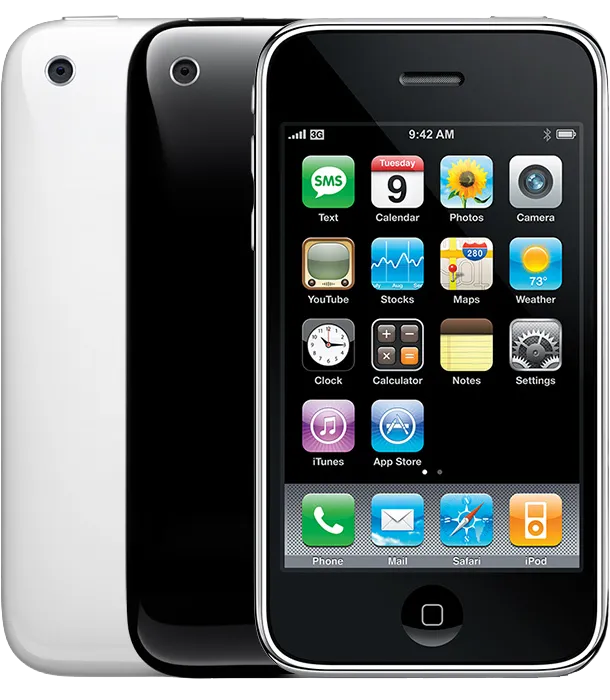
The iPhone 3G is a smartphone designed and marketed by Apple, and the second generation of the iPhone. It was announced by Steve Jobs at Apple's Worldwide Developers Conference on June 9, 2008, and released on July 11, 2008, in 22 countries simultaneously — a dramatic expansion from the original model's staggered, US-first rollout.
As its name states, the phone's headline addition was 3G cellular data, the most requested feature missing from the original iPhone. Assisted GPS was the other major hardware addition. Just as consequential was what launched with it: iPhone OS 2.0 and the App Store, which opened the platform to native third-party software and created the modern mobile app economy. With carrier subsidies factored in, the entry price dropped from $599 to $199 — hence Apple's slogan, "Twice as fast. Half the price."
Internally, however, the iPhone 3G was a modest revision: the processor, memory, display, and camera were essentially unchanged from the original. That conservatism caught up with the device in 2010, when the much heavier iOS 4 release made it infamously sluggish. It was succeeded by the iPhone 3GS in June 2009 and discontinued in June 2010.
1 Design✎
The iPhone 3G replaced the original's aluminum back with a curved polycarbonate plastic shell, which improved cellular reception and lowered manufacturing cost. It is very slightly thicker at its edges than the original (12.3 mm at the thickest point) but lighter, at 133 grams. The recessed headphone jack — a persistent annoyance on the first model — was replaced with a flush port that accepted any standard 3.5 mm plug.
The phone came in black for both storage tiers, while a white back was offered exclusively on the 16 GB model. The plastic housing proved less durable than the original's aluminum: hairline cracks around the case, particularly on white units, became a common complaint.
The 3.5-inch, 320 × 480 display carried over unchanged from the original iPhone.
2 Hardware✎
| Developer | Apple |
|---|---|
| Generation | 2nd |
| Announced | June 9, 2008 |
| Released | July 11, 2008 |
| Discontinued | June 7, 2010 |
| Predecessor | iPhone |
| Successor | iPhone 3GS |
| Display | 3.5-inch TFT LCD 320 × 480 (163 ppi) |
| Chip | Samsung S5L8900 (ARM11 core at 412 MHz) PowerVR MBX Lite graphics |
| RAM | 128 MB |
| Storage | 8 GB · 16 GB |
| Rear camera | 2 MP fixed-focus (no video recording, no flash) |
| Battery | 1,150 mAh built-in |
| Connectivity | Tri-band UMTS/HSDPA 3.6 Quad-band GSM/EDGE Wi-Fi 802.11b/g · Bluetooth 2.0 Assisted GPS |
| Colors | Black (8/16 GB) · White (16 GB only) |
| Launch price | $199 (8 GB) · $299 (16 GB) with 2-year contract (U.S.) |
| OS | iPhone OS 2.0 ~ iOS 4.2.1 |
The iPhone 3G kept the original's Samsung system-on-a-chip — an ARM11 core at 412 MHz with PowerVR MBX Lite graphics — and the same 128 MB of RAM. The new hardware was in the radio stack: tri-band UMTS/HSDPA delivered real-world download speeds several times faster than EDGE, and an assisted-GPS receiver enabled turn-by-turn-style location in Maps.
The battery is slightly smaller than the original's, and 3G radio use proved power-hungry; Apple's software even shipped with a toggle to disable 3G entirely to extend battery life.
3 Camera✎
The rear camera carried over unchanged: 2 megapixels, fixed focus, no flash, no video recording. Geotagging of photos was new, courtesy of the GPS receiver. There is no front-facing camera.
4 Software✎
The iPhone 3G shipped with iPhone OS 2.0 and the App Store — the platform's defining software moment. At launch the store carried about 500 applications; within a year, developers had published tens of thousands, and "there's an app for that" entered the vernacular. Push email and Microsoft Exchange support arrived in the same release, opening the phone to corporate use.
The launch was paired with MobileMe, Apple's replacement for the .Mac online service, whose troubled debut — days of outages and lost email — prompted a public apology and an internal shake-up at Apple.
The phone received iPhone OS 3.0 in 2009 (adding copy and paste and MMS) and iOS 4.0 in June 2010. iOS 4 became notorious on this hardware: with the same 128 MB of RAM as the 2007 original, the device slowed to a crawl, and the update's performance problems drew wide media coverage and even litigation. iOS 4.2.1, released in November 2010, was its final supported version — it never received iOS 4's multitasking, which Apple limited to newer hardware.
5 Release and reception✎
Apple sold one million iPhone 3G units in the first weekend — a pace the original took 74 days to reach. Launch day itself was marred by a worldwide activation meltdown: the in-store iTunes activation servers buckled, leaving many buyers with unactivated phones.
Reviews echoed a consistent theme: 3G and GPS fixed the original's two biggest hardware gaps, the App Store transformed what the device could do, and the new $199 entry price transformed who could buy it. Criticism centered on the unchanged camera, battery life under 3G, and the plastic shell's durability. The subsidized pricing also meant the "half the price" framing came with higher monthly plan costs, which several reviewers flagged.
The iPhone 3G stayed in the lineup as the $99 entry model after the iPhone 3GS launched in June 2009, and was discontinued on June 7, 2010, when the iPhone 4 was announced.
6 Legacy✎
The iPhone 3G's legacy is the App Store it introduced: the shift from a phone with fixed capabilities to a platform defined by third-party software is the model every smartphone ecosystem has followed since. The device itself is also remembered as a cautionary tale about software support outrunning hardware — the iOS 4 slowdown made "will the update ruin my phone?" a recurring question for the industry — and its 22-country simultaneous launch established the global release template Apple still uses, through to the current iPhone 17 generation.
Content available under CC BY-SA 4.0