Loading history…
iPhone 15
This is r1 (the current revision), saved by jack. Full history
|
iPhone 15
New camera. New design. Newphoria.
| ||||
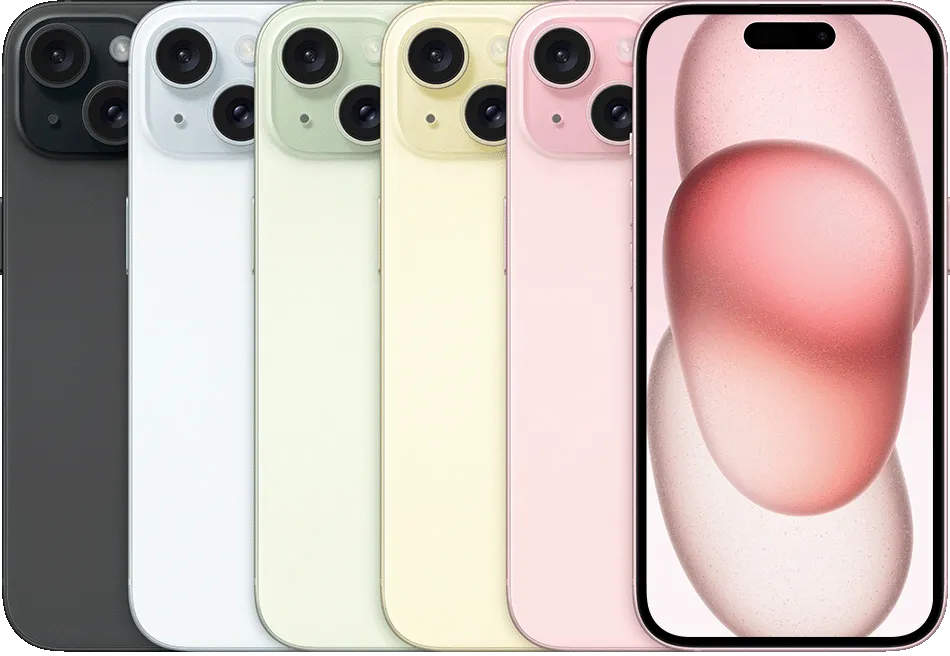
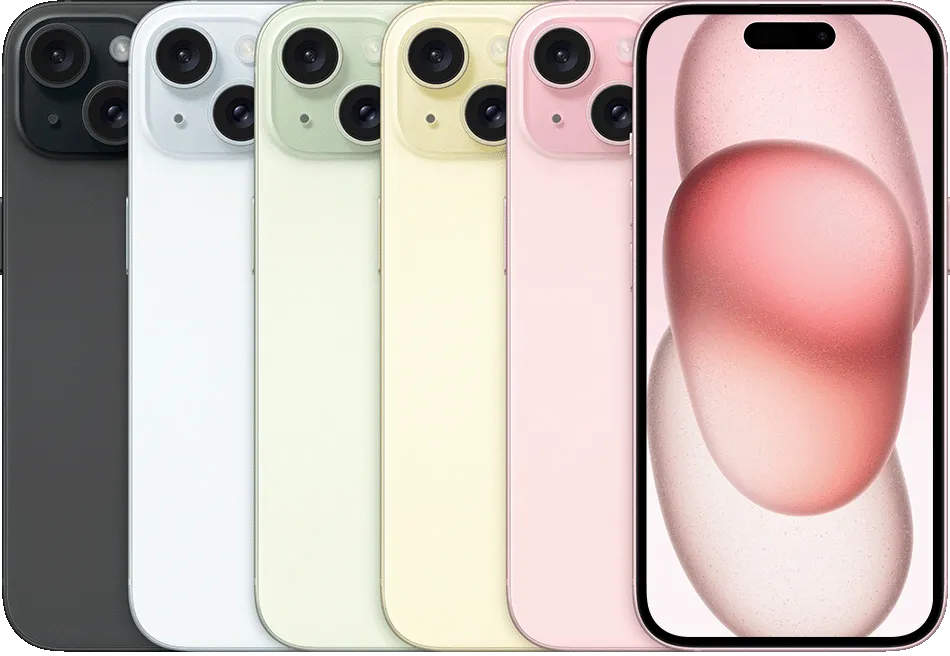
| Black | Blue | Green | Yellow | Pink |
| iPhone 15 — Technical Specifications (Apple Support) | ||||
[ Show / Hide ]
| ||||||||||||||||||||||||||||||||||||||||||||||||

The iPhone 15 is a smartphone designed and marketed by Apple, announced on September 12, 2023, and released on September 22, 2023, with the iPhone 15 Plus, iPhone 15 Pro, and iPhone 15 Pro Max. Its history-book line is the port on the bottom: after eleven years and roughly 2.5 billion devices, Lightning gave way to USB-C — the change the European Union's common-charger law made unavoidable, applied across the generation at once.
The rest of the update was the deepest trickle-down the base tier had received: the iPhone 14 Pro's Dynamic Island replaced the notch, the 48-megapixel main camera arrived with its 2× crop tier, the A16 Bionic followed the chip-behind cadence, peak brightness doubled to 2,000 nits, and the color-infused back glass came matte and pastel. Reviews summarized it as last year's Pro sold as this year's base — meant, for once, mostly as a compliment.
The 15 pair stayed in the lineup as discounted tiers until September 2025, the first base models to complete their run entirely in the USB-C era.
1 Design✎
The flat aluminum design continued with softer contoured edges and color infused through matte back glass — Black, Blue, Green, Yellow, Pink, all pale enough that reviewers joked about Apple's fear of saturation. The Dynamic Island brought the base tier the pill-shaped interactive cutout; 171 g, Ceramic Shield, IP68 at six meters, MagSafe. And USB-C: charging, data, DisplayPort out, and even accessory charging (AirPods off the phone) through the universal connector — USB 2.0 speeds at this tier, one of the remaining Pro separators.
2 Hardware✎
| Developer | Apple |
|---|---|
| Generation | 17th |
| Announced | September 12, 2023 |
| Released | September 22, 2023 |
| Discontinued | September 9, 2025 |
| Predecessor | iPhone 14 |
| Related | iPhone 15 Plus · iPhone 15 Pro · iPhone 15 Pro Max |
| Successor | iPhone 16 |
| Display | 6.1-inch Super Retina XDR OLED 2556 × 1179 (460 ppi) · Dynamic Island 2,000 nits peak |
| Chip | Apple A16 Bionic — carried from the 14 Pro |
| RAM | 6 GB |
| Storage | 128 GB · 256 GB · 512 GB |
| Rear cameras | 48 MP main, f/1.6, sensor-shift OIS (2× crop tier) + 12 MP ultra-wide, f/2.4 next-gen portraits (no mode switch) |
| Front camera | 12 MP TrueDepth, f/1.9, autofocus |
| Battery | 3,349 mAh · MagSafe 15 W · Qi2 |
| Connectivity | USB-C (USB 2.0) · 5G · Wi-Fi 6 Bluetooth 5.3 · US models eSIM only Roadside Assistance via satellite |
| Colors | Black · Blue · Green · Yellow · Pink |
| Launch price | $799 (128 GB) · $899 (256 GB) · $1,099 (512 GB) |
| OS | iOS 17.0 ~ current |
The A16 hand-me-down kept the base tier a chip ahead of the Android field, and Qi2 — the wireless standard built from Apple's MagSafe contribution — arrived via update, aligning the industry on Apple's magnet ring. Satellite features grew Roadside Assistance alongside Emergency SOS.
3 Camera✎
The 48-megapixel quad-pixel main sensor brought the Pro's photography playbook down-tier: 24-megapixel default output (a new middle ground), the optical-quality 2× crop, and portraits captured automatically whenever a subject was detected — depth recorded without switching modes, focus editable afterward. Low light and detail stepped clearly past the iPhone 14; the missing telephoto remained the Pro argument.
4 Software✎
Shipped with iOS 17 (StandBy, Contact Posters, interactive widgets); current release train since.
5 Release and reception✎
USB-C dominated coverage to the point of parody — reviewers charging a MacBook from a phone — and the consensus rated the 15 the strongest base model in years: Pro features one year late at $200 less. Complaints: 60 Hz in 2023, USB 2.0 speeds, and the A16 rather than A17. Strong sales through its flagship year were followed by the traditional price-cut afterlife at $699 and $599, ending September 9, 2025.
6 Legacy✎
The 15 closed the Lightning era for the mass market and completed the Dynamic Island's takeover of the lineup's face. Its 48 MP camera and 2× tier reset expectations of what the "regular" iPhone photographs like, and its Qi2 alignment turned Apple's proprietary magnets into everyone's wireless standard — the template the current iPhone 17 still follows.
Content available under CC BY-SA 4.0