Loading history…
iPhone 12
This is r1 (the current revision), saved by jack. Full history
|
iPhone 12
Blast past fast.
| |||||
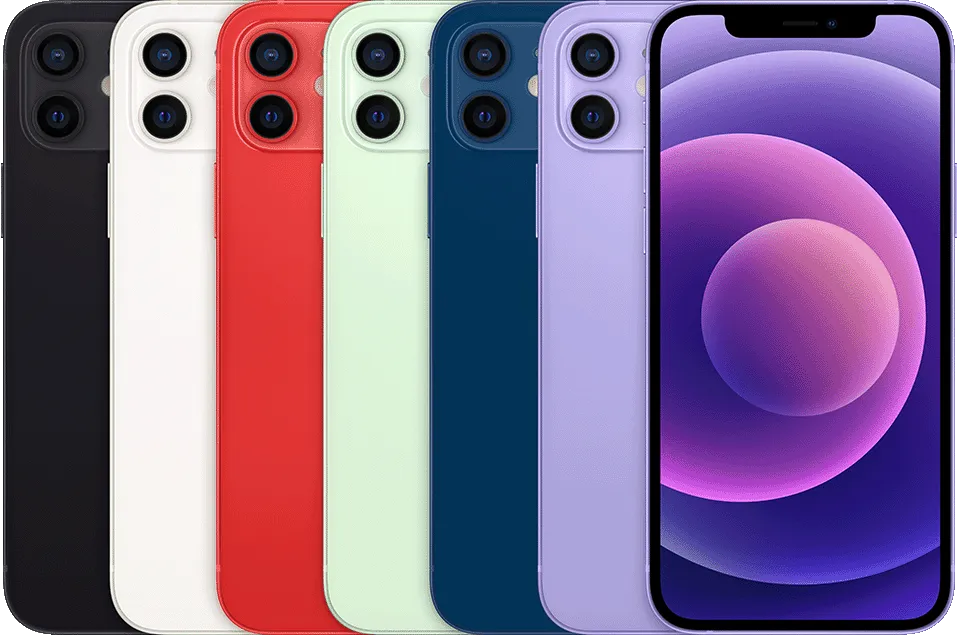
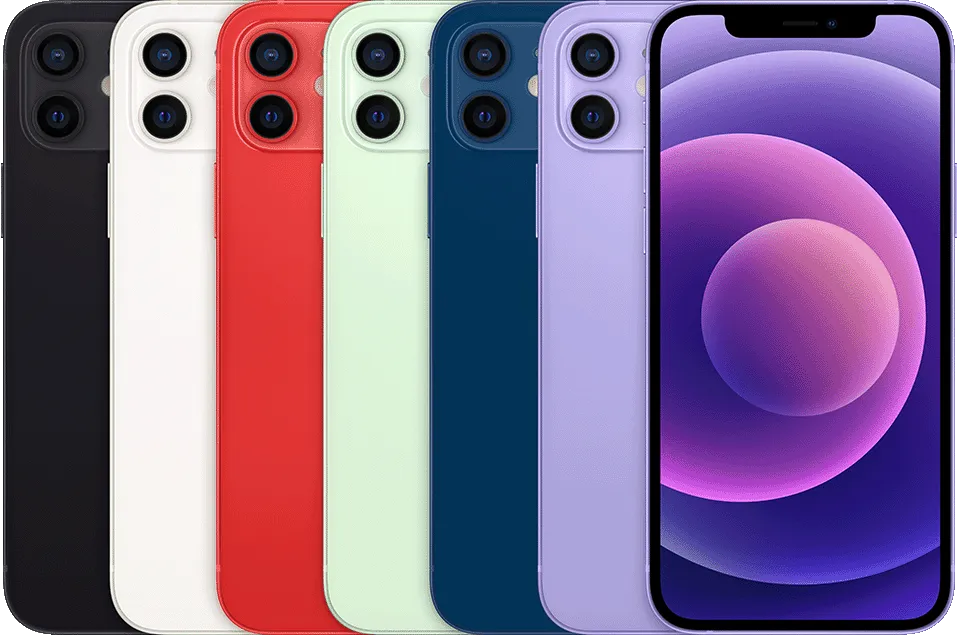
| Black | White | RED | Green | Blue | Purple |
| iPhone 12 — Technical Specifications (Apple Support) | |||||
[ Show / Hide ]
| ||||||||||||||||||||||||||||||||||||||||||||||||

The iPhone 12 is a smartphone designed and marketed by Apple, announced on October 13, 2020 — the first fall launch moved by a pandemic — and released on October 23, 2020, leading a four-model generation with the iPhone 12 mini, iPhone 12 Pro, and iPhone 12 Pro Max. It was the biggest base-model overhaul since the iPhone X: the flat-sided design that still defines the line debuted here, the base tier jumped from LCD to the Pro-grade Super Retina XDR OLED, 5G arrived across the lineup, Ceramic Shield quadrupled drop toughness, and MagSafe put a magnetic accessory system on the back.
The A14 Bionic — the first 5-nanometer chip in a phone — powered it all at $799, a $100 rise from the iPhone 11 that the OLED upgrade justified for most reviewers. The charger and earbuds left the box, a cost-and-carbon decision that generated the launch's loudest argument and the industry's quietest imitation.
Verizon's CEO appearing on Apple's stage marked 5G's marketing apex; the 12 itself became the generation's volume leader and one of the best-selling smartphones of 2021, staying in the lineup until 2023.
1 Design✎
The 12's flat aerospace-aluminum band between flat glass faces revived the iPhone 5 silhouette at 6.1 inches — 11% thinner, 15% smaller, and 16% lighter (164 g) than the iPhone 11 it replaced, with the same screen size. Ceramic Shield — high-temperature ceramic crystals grown in the glass, exclusive to Apple through its Corning investment — fronted the display with a claimed 4× drop improvement, borne out by torture tests. Six colors led with a deep navy Blue and added Purple in April 2021; IP68 rated to six meters. The MagSafe ring — magnets around the Qi coil — snapped chargers, wallets, and mounts into perfect alignment at up to 15 W.
2 Hardware✎
| Developer | Apple |
|---|---|
| Generation | 14th |
| Announced | October 13, 2020 |
| Released | October 23, 2020 |
| Discontinued | September 12, 2023 |
| Predecessor | iPhone 11 |
| Related | iPhone 12 mini · iPhone 12 Pro · iPhone 12 Pro Max |
| Successor | iPhone 13 |
| Display | 6.1-inch Super Retina XDR OLED 2532 × 1170 (460 ppi) HDR · True Tone · Ceramic Shield |
| Chip | Apple A14 Bionic (first 5 nm chip · 16-core Neural Engine) |
| RAM | 4 GB |
| Storage | 64 GB · 128 GB · 256 GB |
| Rear cameras | 12 MP wide, f/1.6, OIS + 12 MP ultra-wide, f/2.4 Night mode (all cameras) Dolby Vision HDR video (world first) |
| Front camera | 12 MP TrueDepth · Night mode |
| Battery | 2,815 mAh · MagSafe 15 W · Qi (no charger in box) |
| Connectivity | 5G (sub-6 GHz; + mmWave in US) Wi-Fi 6 · Bluetooth 5.0 |
| Colors | Black · White · (PRODUCT)RED · Green · Blue (+ Purple from April 2021) |
| Launch price | $799 (64 GB) · $849 (128 GB) · $949 (256 GB) |
| OS | iOS 14.1 ~ current |
The A14's 11.8 billion transistors on TSMC's 5-nanometer process and a Neural Engine doubled to sixteen cores kept the base model at chip parity with the Pros — by now a fixture of Apple's strategy. 5G spanned sub-6 GHz everywhere and mmWave in US models (the notorious "stand near the stadium antenna" bands), with a Smart Data Mode dropping to LTE when speed wasn't needed — the honest concession that 2020's 5G networks rarely deserved the battery cost.
3 Camera✎
The f/1.6 wide lens — the fastest aperture yet on an iPhone — pulled 27% more light, and the computational stack (Night mode, Deep Fusion, Smart HDR 3) now ran on every camera, front and ultra-wide included. The generation's world first: recording, editing, and playing Dolby Vision HDR video end-to-end on a phone, at 4K 30 on the base models. Reviewers found stills essentially at parity with the iPhone 12 Pro short of its telephoto and LiDAR — the second year the base camera made the Pro's case harder.
4 Software✎
Shipped with iOS 14.1 (home-screen widgets, App Library, the pandemic's Exposure Notifications era) and remains on the current release train. MagSafe launched its accessory ecosystem here; a brief scare about magnets and pacemakers produced an Apple support advisory and calmer follow-ups.
5 Release and reception✎
Pre-orders doubled the 11's pace with the 12 the volume pick, and reviews called it the rare base model that felt flagship-complete: design, display, and camera all effectively Pro-tier, with 5G more future-proofing than feature and the missing charger the recurring gripe (France's bundled-EarPods law produced the era's odd regional unboxings). The 12 placed among 2021's best-selling phones globally, drove Apple's largest upgrade cycle in years — the "supercycle" analysts had promised since the X — and retired on September 12, 2023.
6 Legacy✎
The 12 drew the template every generation since has refined: flat sides, OLED at the base tier, Ceramic Shield, MagSafe, 5G — the current iPhone 17 is its direct descendant in all five respects. The charger-less box became the industry norm within two years, and MagSafe grew from accessory gimmick to the Qi2 standard the whole market adopted. Few "number" iPhones changed this much at once; none since has needed to.
Content available under CC BY-SA 4.0