Loading history…
iPhone 11 Pro
This is r1 (the current revision), saved by jack. Full history
|
iPhone 11 Pro
And then there was Pro.
| |||
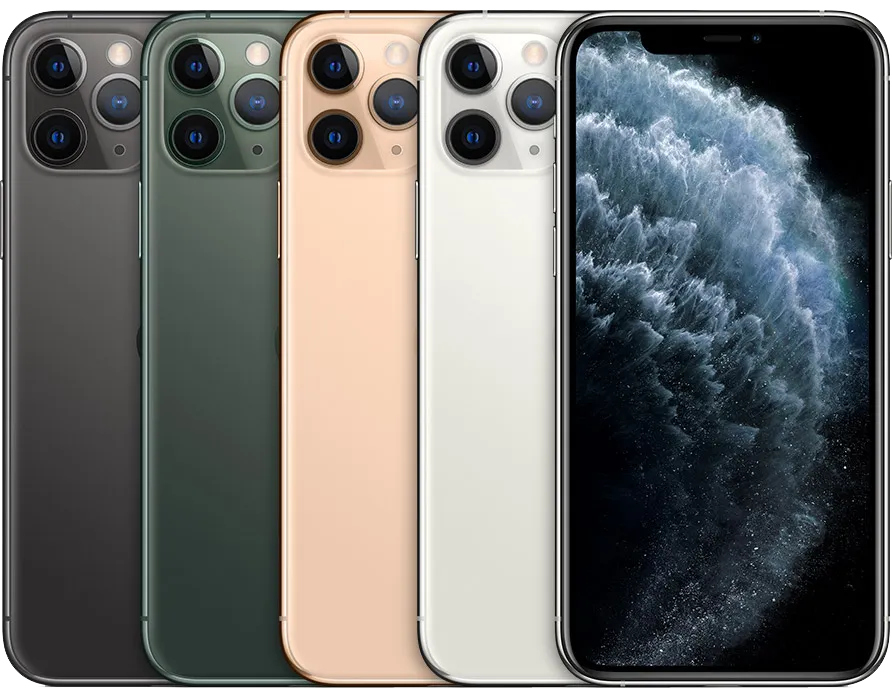
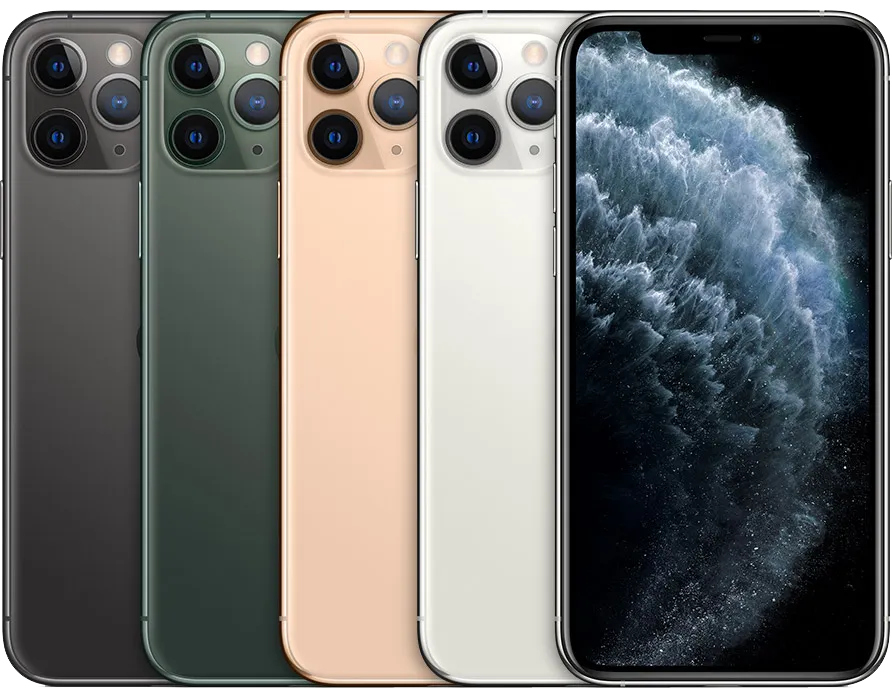
| Space Gray | Midnight Green | Gold | Silver |
| iPhone 11 Pro — Technical Specifications (Apple Support) | |||
[ Show / Hide ]
| ||||||||||||||||||||||||||||||||||||||||||||||||

The iPhone 11 Pro is a smartphone designed and marketed by Apple, announced on September 10, 2019, and released on September 20, 2019, with the iPhone 11 and iPhone 11 Pro Max. It was the first iPhone to carry the "Pro" name — retiring the S-suffix era for good — and the first with a triple camera: ultra-wide, wide, and telephoto, arranged in the square bump that became the design's most argued-about feature and then everyone else's design too.
Succeeding the iPhone XS, the 11 Pro kept the 5.8-inch size and stainless frame while upgrading nearly every subsystem: a Super Retina XDR OLED reaching 1,200 nits for HDR, the A13 Bionic, Night mode, a textured matte-glass back in a new Midnight Green, four more hours of battery than the XS, and — ending a decade of 5-watt bricks — an 18 W fast charger finally in the box.
Reviews rated it the most complete iPhone in years, with the camera system retaking the top of the comparison charts. It served the customary single year before the iPhone 12 Pro generation replaced it.
1 Design✎
The 11 Pro's frame and dimensions track the XS closely, but the back is new: a single sheet of frosted matte glass out of which the polished square camera plateau rises, holding three lenses in a triangular array. Midnight Green — the first new Pro-tier color since Jet Black — joined Space Gray, Silver, and Gold. Water resistance rose to four meters for thirty minutes, the toughest rating yet, and weight settled at 188 g.
2 Hardware✎
| Developer | Apple |
|---|---|
| Generation | 13th |
| Announced | September 10, 2019 |
| Released | September 20, 2019 |
| Discontinued | October 13, 2020 |
| Predecessor | iPhone XS |
| Related | iPhone 11 · iPhone 11 Pro Max |
| Successor | iPhone 12 Pro |
| Display | 5.8-inch Super Retina XDR OLED 2436 × 1125 (458 ppi) 1,200 nits HDR · True Tone |
| Chip | Apple A13 Bionic (2 + 4 cores · 8-core Neural Engine) |
| RAM | 4 GB |
| Storage | 64 GB · 256 GB · 512 GB |
| Rear cameras | 12 MP ultra-wide, f/2.4 (0.5×) + 12 MP wide, f/1.8, OIS + 12 MP telephoto, f/2.0, OIS (2×) Night mode · Deep Fusion · 4K 60 |
| Front camera | 12 MP TrueDepth |
| Battery | 3,046 mAh · 18 W charger included Qi wireless charging |
| Durability | IP68 (4 m / 30 min) · stainless steel |
| Colors | Space Gray · Midnight Green · Gold · Silver |
| Launch price | $999 (64 GB) · $1,149 (256 GB) · $1,349 (512 GB) |
| OS | iOS 13.0 ~ current |
The Super Retina XDR display — named for Apple's $5,000 Pro Display XDR — doubled typical OLED HDR brightness to 1,200 nits while cutting power 15%, the efficiency that, with the A13 and a thicker body, bought four more hours of battery than the XS. The A13's machine-learning accelerators (one trillion operations per second on CPU alone) fed Deep Fusion, the mid-light "sweater mode" pipeline that arrived in an iOS 13.2 update.
3 Camera✎
The triple system covered 0.5× to 2× optically, with the interface flowing between lenses as one continuous zoom and Night mode transforming the line's low-light standing in a single generation. Deep Fusion fused nine exposures pixel-by-pixel for texture detail in medium light; all four cameras (including the new 12-megapixel front) shot 4K, and extended dynamic range video at 60 fps made the 11 Pro the working videographer's phone of its year. Reviewers scored the system at or above the Pixel 4 and Galaxy Note 10 — the first unambiguous Apple camera win in several years.
4 Software✎
Shipped with iOS 13 (Dark Mode, revamped Photos, Sign in with Apple), gained Deep Fusion in 13.2, and remains on the current iOS train — the A13 generation still inside the support window seven years on.
5 Release and reception✎
"The camera, the battery, and the screen" ran the consensus — three upgrades big enough to overcome review fatigue with the third consecutive notch-era design. The square camera bump drew a week of memes and then universal imitation. Sales skewed toward the Max variant and the volume iPhone 11, with the 5.8-inch Pro the trio's connoisseur pick; all three carried Apple through a strong holiday cycle before the 11 Pro pair was discontinued on October 13, 2020, at the 12 generation's delayed unveiling.
6 Legacy✎
The 11 Pro named the tier the lineup still lives by — "Pro" replaced both the S-suffix and the Plus/Max distinction as the marker of Apple's best, running unbroken to the current iPhone 17 Pro. Its triple-camera square became the industry's default flagship layout, its included fast charger ended the 5-watt era (shortly before in-box chargers vanished entirely), and its battery turnaround erased the Pro tier's last practical weakness.
Content available under CC BY-SA 4.0