Loading history…
iPhone (1st generation)
This is r1 (the current revision), saved by jack. Full history
|
iPhone
Say hello to iPhone.
|
| iPhone — Technical Specifications (Apple Support) |
[ Show / Hide ]
| ||||||||||||||||||||||||||||||||||||||||||||||||

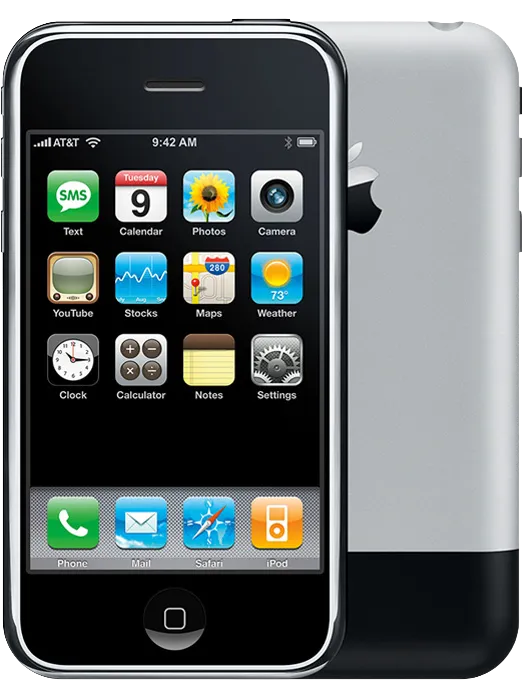
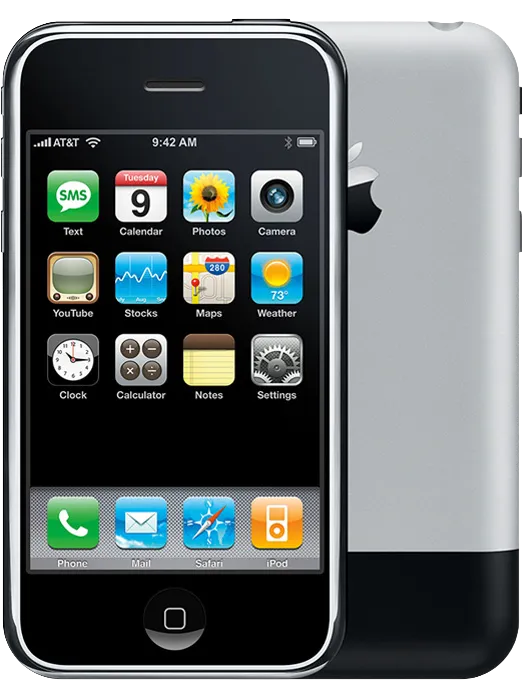
The iPhone (retroactively referred to as the iPhone 2G or the original iPhone) is the first smartphone designed and marketed by Apple. It was unveiled by Apple co-founder and CEO Steve Jobs during his keynote address at the Macworld Conference & Expo in San Francisco on January 9, 2007, and released in the United States on June 29, 2007. Jobs introduced the device as three products in one — "a widescreen iPod with touch controls, a revolutionary mobile phone, and a breakthrough internet communications device."
The iPhone abandoned nearly every convention of the era's handsets. It had no physical keyboard and no stylus; the entire front face was a 3.5-inch capacitive multi-touch display operated with fingers, backed by a single Home button. Software features that are now taken for granted — a desktop-class web browser, visual voicemail, pinch-to-zoom photos, and automatic screen rotation — were startling in 2007, when the market was dominated by BlackBerry-style keyboard phones and resistive-touch devices.
Despite lacking 3G data, a front camera, GPS, copy and paste, and third-party apps at launch, the iPhone reshaped the industry within a single product cycle. Time magazine named it the Invention of the Year for 2007, and its design language — a slab of glass dominated by a touchscreen — became the template for virtually every smartphone that followed, including its own successor, the iPhone 3G.
1 Development✎
The iPhone grew out of a secret program known internally as Project Purple, which Apple ran for roughly two and a half years at a reported cost of about $150 million. Apple had been experimenting with multi-touch interaction for a tablet project; Jobs redirected the effort toward a phone after concluding that mobile handsets — a market then led by Nokia, Motorola, and BlackBerry — were universally frustrating to use.
Development was heavily compartmentalized. Engineers worked on the operating system without seeing the industrial design, and hardware teams tested with placeholder software. Apple also made a late, consequential engineering change: weeks before launch, Jobs ordered the plastic display cover replaced with chemically strengthened glass after finding that keys in his pocket scratched the prototype's screen.
The device was announced roughly six months before it shipped — an unusual move for Apple, forced in part by the need to file with the FCC, which would have revealed the product anyway.
2 Design✎
The original iPhone is 115 mm tall, 61 mm wide, and 11.6 mm thick, weighing 135 grams. The back is anodized aluminum with a black plastic band at the bottom that serves as the antenna window; the front is a single sheet of strengthened glass surrounding the 3.5-inch display and the circular Home button. A recessed 3.5 mm headphone jack — deep enough that many third-party headphone plugs required an adapter — sits on the top edge beside the sleep/wake button and SIM tray.
The display is a 320 × 480 TFT LCD at 163 pixels per inch, driven by a capacitive touch layer that supports multi-touch gestures. Apple deliberately shipped no stylus; Jobs dismissed them on stage with "Who wants a stylus? You have to get them, put them away, you lose them. Yuck."
3 Hardware✎
| Developer | Apple |
|---|---|
| Generation | 1st |
| Announced | January 9, 2007 |
| Released | June 29, 2007 |
| Discontinued | July 11, 2008 |
| Successor | iPhone 3G |
| Display | 3.5-inch TFT LCD 320 × 480 (163 ppi) capacitive multi-touch |
| Chip | Samsung S5L8900 (ARM11 core at 412 MHz) PowerVR MBX Lite graphics |
| RAM | 128 MB |
| Storage | 4 GB · 8 GB · 16 GB |
| Rear camera | 2 MP fixed-focus (no video recording, no flash) |
| Battery | 1,400 mAh built-in (8 hrs talk time claimed) |
| Connectivity | Quad-band GSM/EDGE (no 3G) Wi-Fi 802.11b/g · Bluetooth 2.0 (no GPS) |
| Colors | Aluminum with black accents |
| Launch price | $499 (4 GB) · $599 (8 GB) with 2-year contract (U.S.) |
| OS | iPhone OS 1.0 ~ 3.1.3 |
The iPhone runs on a Samsung-fabricated system-on-a-chip with an ARM11 core clocked at 620 MHz but underclocked to 412 MHz to preserve battery life, paired with 128 MB of RAM and PowerVR MBX Lite graphics. At launch Apple offered 4 GB and 8 GB models; the 4 GB model sold poorly and was dropped just over two months later, and a 16 GB model was added in February 2008.
Connectivity was the design's most criticized compromise. The iPhone shipped with quad-band GSM and EDGE data only — no 3G — at a time when competing smartphones already supported faster networks. Jobs defended the choice on battery-life grounds. The phone also lacked GPS, relying on Wi-Fi and cell-tower triangulation for location.
The battery was sealed inside the case and not user-replaceable — standard for iPods but virtually unheard of in phones at the time, and another early point of controversy.
4 Camera✎
The rear camera is a 2-megapixel fixed-focus unit with no flash, no autofocus, and no video recording. It was widely regarded as the phone's weakest component, adequate for casual snapshots in good light and little else. There is no front-facing camera.
5 Software✎
The iPhone launched running what Apple then called simply "OS X" for iPhone — later renamed iPhone OS and eventually iOS. Version 1.0 had no App Store: Jobs initially insisted that third-party developers build web applications that ran in Safari, a position Apple reversed the following year when iPhone OS 2.0 and the App Store launched alongside the iPhone 3G in July 2008. The original iPhone received that update, gaining native third-party apps.
Early software omissions were significant: no copy and paste (added in OS 3.0, 2009), no MMS (never supported on this model, as the hardware lacked it on AT&T's implementation), no push email at launch, and no ability to record video. Activation itself was novel — new owners activated the phone at home through iTunes rather than in a carrier store.
The original iPhone's final supported software release was iPhone OS 3.1.3, issued in February 2010; it did not receive iOS 4.
6 Release and reception✎
The iPhone launched in the United States on June 29, 2007, exclusively on AT&T (which was completing its rebranding from Cingular at the time), with a required two-year contract. Buyers lined up outside Apple and AT&T stores for days; the launch was covered as a cultural event, and the press nicknamed the device the "Jesus phone." Apple sold 270,000 units in the first 30 hours and one million by early September 2007. European launches followed in November 2007 in the United Kingdom, Germany, and France.
Reviews praised the interface as a generational leap while faulting the missing 3G, the weak camera, and the price. Time magazine named the iPhone its Invention of the Year for 2007.
On September 5, 2007 — 68 days after launch — Apple cut the 8 GB model's price from $599 to $399. Early adopters reacted with fury, and within a day Jobs published an open letter apologizing and offering a $100 Apple Store credit to anyone who had paid full price. The episode remains one of the most cited examples of early-adopter backlash in consumer electronics.
Apple sold approximately 6.1 million original iPhones before discontinuing the model on July 11, 2008, the day the iPhone 3G launched.
7 Legacy✎
The original iPhone is widely regarded as one of the most influential consumer products ever shipped. Within two years, nearly every major handset maker had reoriented its lineup around large capacitive touchscreens; within five, the BlackBerry-style keyboard phone was effectively extinct. The App Store economy it made possible (via its successor's software) reshaped software distribution, and the iPhone line grew into Apple's largest business, running through the current iPhone 17 generation.
Working first-generation iPhones — particularly factory-sealed units — have become collector's items, with sealed examples selling at auction for tens of thousands of dollars.
Content available under CC BY-SA 4.0