Mac
|
Mac
If you can dream it, Mac can do it.
|
 i i
|
| Official Mac site — Apple |
[ Show / Hide ]
| ||||||||||||||||||||||||||||||||||||||||||||



[ Show / Hide ]
| |||||||||||||||


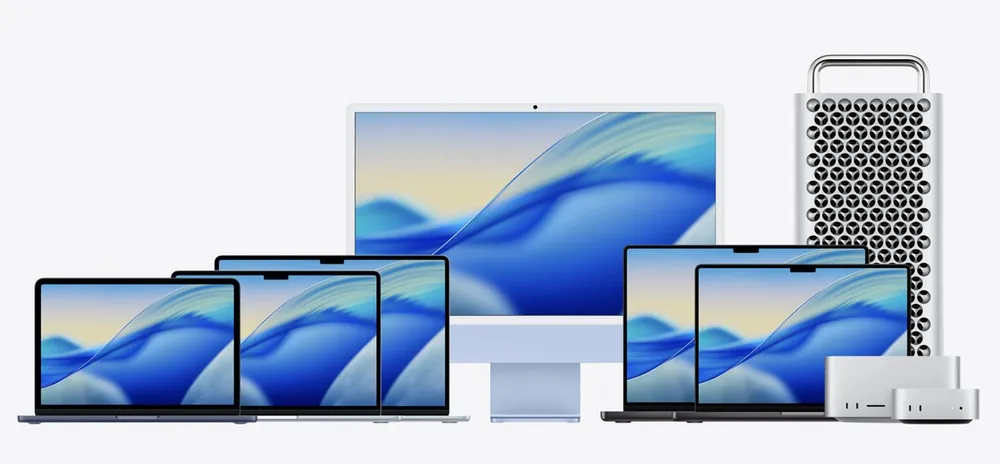
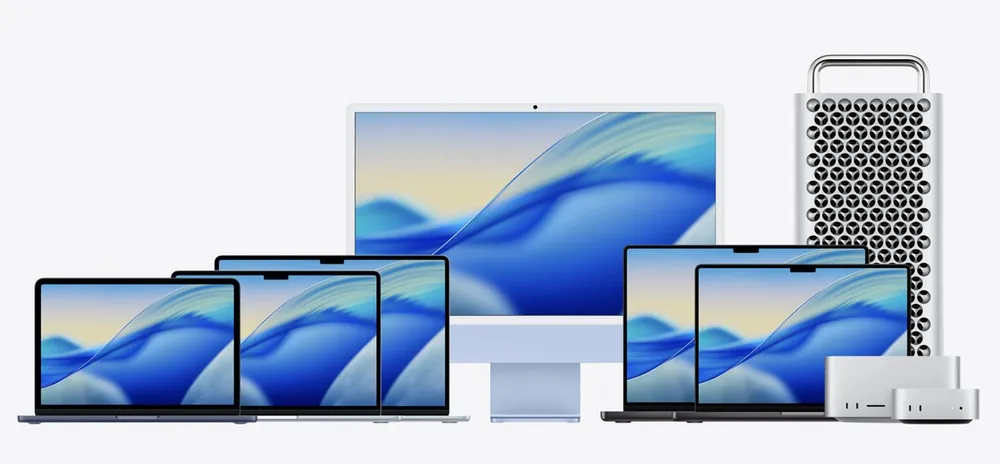
The Mac is Apple's line of personal computers, begun in 1984 with the Macintosh — the machine that carried the graphical user interface, the mouse, and desktop publishing into the mainstream. Four processor architectures, three operating-system eras, and forty-plus years later, every Mac runs macOS on Apple silicon, and the line spans laptops and desktops from the $599 MacBook Neo to the Mac Studio.
The Mac is where Apple's hardware-software integration began and where it is now most complete: the M-series chips, macOS, and the industry's longest-lived personal-computer design language all belong to one company — an arrangement the 1984 original promised and the 2020 silicon transition finally delivered.
1 History✎
1.1 1984–1997: Macintosh✎
The original Macintosh popularized the GUI but spent a decade fighting cheaper DOS and Windows PCs. The era produced desktop publishing, the PowerBook's modern laptop layout, and the PowerPC transition — and nearly killed the company by 1996.
1.2 1998–2005: The iMac turnaround✎
Steve Jobs's return produced the 1998 iMac — translucent, all-in-one, internet-first — which saved Apple and set the design-led pattern. Mac OS X (2001) rebuilt the platform on Unix, and the iBook, Power Mac, and PowerBook filled out the consumer/pro grid the lineup still echoes.
1.3 2006–2019: Intel✎
The Intel transition (2006) let Macs run Windows and doubled performance overnight; the MacBook Air (2008) defined the thin laptop; Retina displays (2012) reset screen expectations. The late Intel years strained — the butterfly keyboard, the 2013 Mac Pro dead end, thermal ceilings — while Apple's phone chips quietly outpaced the Macs' processors, and the T1 and T2 security chips put Apple silicon inside Intel Macs ahead of the main event.
1.4 2020–present: Apple silicon✎
The Apple M1 (2020) began the two-year architecture transition — fanless MacBook Airs outrunning Intel Pros — completed by the Apple M2-era Mac Pro in 2023. The M3 brought 3-nanometer chips and hardware ray tracing, the M4 swept the line in a year, and the M5 generation's Pro laptops arrived in March 2026 on the two-die Fusion Architecture. macOS Tahoe (26) unified the platform's design with iOS's Liquid Glass era.
March 2026 redrew the lineup at both ends: the $599 MacBook Neo — a 13-inch laptop running the iPhone 16 Pro's A18 Pro chip — became the cheapest Mac ever and an immediate best-seller, while the Mac Pro was discontinued after twenty years with no successor planned, leaving the Mac Studio as the flagship desktop.
2 Current lineup✎
| Model | Chip | Role |
|---|---|---|
| MacBook Neo | A18 Pro (2026) | The $599 entry Mac |
| MacBook Air | M5 (2026) | The volume laptop |
| MacBook Pro 14"/16" | M5 · M5 Pro · M5 Max (2025–26) | Pro laptops |
| iMac 24" | M4 (2024) | The all-in-one |
| Mac mini | M4 · M4 Pro (2024) | Smallest desktop |
| Mac Studio | M4 Max · M3 Ultra (2025) | The flagship desktop |
The Mac Pro — the expandable tower — was discontinued in March 2026; Discontinued Apple products tells that story.
3 Position✎
The Mac is Apple's oldest product and its proof of patience: forty years of keeping a minority-share computer alive paid off when the company's own silicon made it the performance-per-watt benchmark of the PC industry. It anchors the pro side of the ecosystem — the machine iOS, iPadOS, and visionOS apps are built on.