Roman Empire
|
[ Show / Hide ]
| ||||||||||||||||||||||||||||||||||||||||
|---|---|---|---|---|---|---|---|---|---|---|---|---|---|---|---|---|---|---|---|---|---|---|---|---|---|---|---|---|---|---|---|---|---|---|---|---|---|---|---|---|
The Roman Empire (Latin: Imperium Romanum) was the period of ancient Roman civilization that began in 27 BC, when the Roman Senate granted Octavian the title Augustus, and lasted in the west until AD 476, when the last Western Roman emperor was deposed. In the east, the empire continued for nearly another thousand years as the Byzantine Empire, until the fall of Constantinople in 1453.
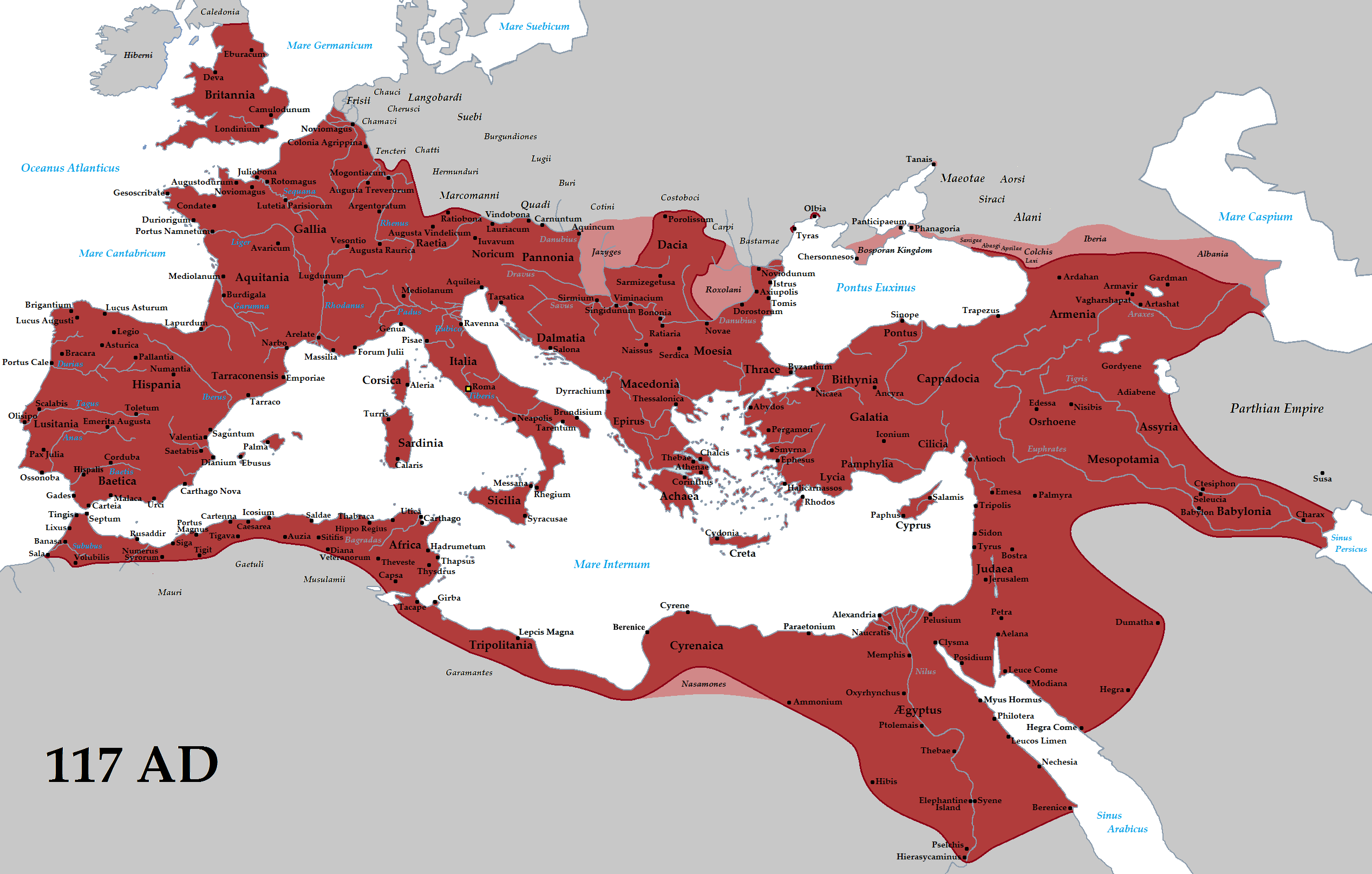
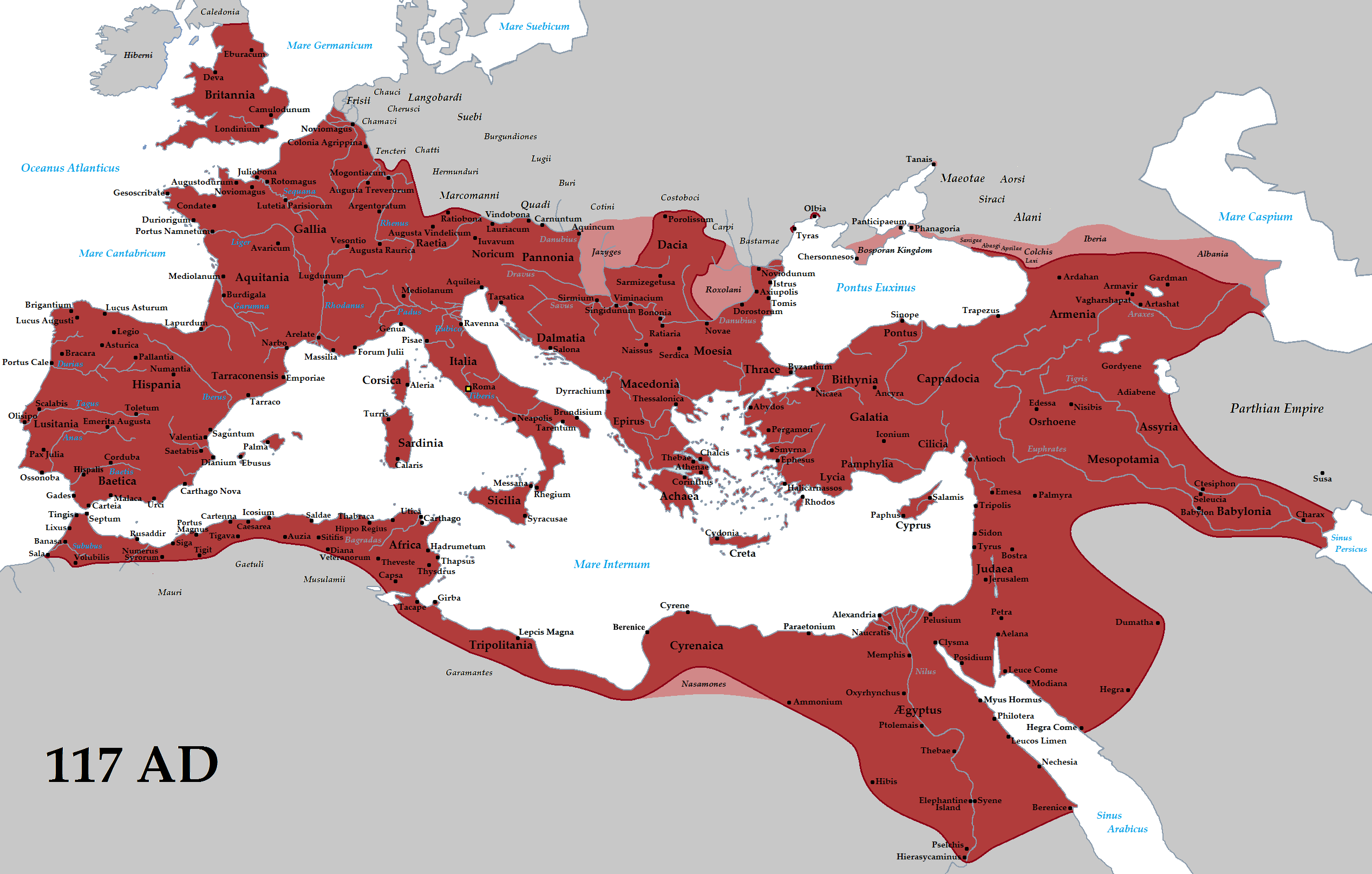
At its height under Emperor Trajan around AD 117, the Roman Empire covered roughly 5 million square kilometers and held between 55 and 70 million people — perhaps one-quarter of the entire world's population at the time. It stretched from Hadrian's Wall in northern Britain to the deserts of North Africa, and from Spain in the west to the Euphrates River in modern-day Iraq. The Romans called the Mediterranean Sea Mare Nostrum — "Our Sea" — because the empire completely encircled it.
The Empire was not simply a military conquest. It was a vast, interconnected civilization united by Roman law, Latin language, a system of well-built roads, engineering marvels like aqueducts, and a shared culture that absorbed influences from Greek, Egyptian, Celtic, and many other traditions. The empire's adoption of Christianity as its official religion in the late 4th century helped shape the religious landscape of Europe and the Middle East for the next two thousand years.
The history of the Roman Empire is usually divided into two main periods: the Principate (27 BC – AD 284), during which emperors ruled behind the fiction that the Republic still existed, and the Dominate (AD 284–476/1453), during which emperors ruled more openly as absolute monarchs. The first two centuries of the Empire are often called the Pax Romana ("Roman Peace"), one of the longest periods of relative stability and prosperity in the history of civilization.
|
Roman Empire
Imperium Romanum27 BC – AD 476 (West) / AD 1453 (East) | |||||||||||||||||||||||||||||||||||||||||||||||||||||||||
|---|---|---|---|---|---|---|---|---|---|---|---|---|---|---|---|---|---|---|---|---|---|---|---|---|---|---|---|---|---|---|---|---|---|---|---|---|---|---|---|---|---|---|---|---|---|---|---|---|---|---|---|---|---|---|---|---|---|
| The empire at its greatest extent, AD 117 | |||||||||||||||||||||||||||||||||||||||||||||||||||||||||
|
[ Show / Hide ]
| |||||||||||||||||||||||||||||||||||||||||||||||||||||||||
1 Augustus and the birth of the Empire✎
The Roman Empire began not with a dramatic revolution but with a careful political performance. After defeating Mark Antony and Cleopatra at the Battle of Actium in 31 BC, Octavian was the unchallenged master of the Roman world. But he had learned from Julius Caesar's fate that openly claiming supreme power could get you killed. So instead of calling himself king or dictator, Octavian presented himself as merely the "first citizen" — princeps — who had "restored the Republic."
In January 27 BC, the Roman Senate granted Octavian the honorary title Augustus ("the revered one") and gave him imperium — supreme military authority — over the most important provinces. He controlled the army, the treasury, and foreign policy, but maintained the outward forms of republican government. The Senate still met, magistrates were still elected, and laws were still passed through assemblies. In reality, Augustus held all the meaningful power, and everyone knew it.
This system of disguised monarchy is called the Principate (from princeps), and it worked remarkably well. Augustus ruled for over 40 years (27 BC – AD 14), during which he brought stability after decades of devastating civil wars. He reformed the army into a permanent professional force of about 28 legions (roughly 150,000 soldiers), established the Praetorian Guard as his personal bodyguards in Rome, created a professional civil service, built an extensive road network, and launched massive building projects throughout the empire. He reportedly boasted that he "found Rome a city of brick and left it a city of marble."
Augustus faced a recurring problem, however: who would rule after him? Having no surviving sons, he adopted his stepson Tiberius and made him heir. When Augustus died peacefully in AD 14 at the age of 75, Tiberius succeeded him smoothly. This established the principle — though never a formal law — that the emperor would be succeeded by his chosen heir, usually an adopted son or a family member.
2 The Julio-Claudian dynasty✎
The first dynasty of emperors is called the Julio-Claudian dynasty because its members were related to the families of Julius Caesar (the Julii) and Augustus's wife Livia's first husband (the Claudii). After Augustus, this dynasty produced four more emperors:
Tiberius (AD 14–37) was a competent but deeply unpopular ruler. An effective military commander before becoming emperor, he grew increasingly suspicious and withdrew from Rome to the island of Capri for the last decade of his reign, governing through intermediaries.
Caligula (AD 37–41) — whose real name was Gaius — began his reign with great popularity but quickly became known for erratic and cruel behavior. Ancient sources describe him as mentally unstable, though modern historians debate how much of this was real and how much was hostile propaganda. He was assassinated by members of his own Praetorian Guard after just four years.
Claudius (AD 41–54) was an unlikely emperor — elderly, physically disabled, and long dismissed by his family as a fool. But he proved to be a surprisingly capable administrator. He expanded the empire by conquering southern Britain in AD 43, improved the legal system, and built major public works including harbors and aqueducts. He was likely poisoned by his wife Agrippina the Younger, who wanted her son Nero to become emperor.
Nero (AD 54–68) is probably the most famous — and infamous — of the Julio-Claudians. His early reign, guided by the philosopher Seneca and the military commander Burrus, was considered quite good. But Nero gradually became more tyrannical, murdering his own mother and first wife. When the Great Fire of Rome devastated the city in AD 64, rumors spread that Nero had played his lyre (fiddle) while the city burned — almost certainly false, but revealing of his reputation. He ordered the first major persecution of Christians, blaming them for the fire. When military revolts broke out against him in AD 68, Nero committed suicide, ending the Julio-Claudian line.
3 The Flavians and the Year of the Four Emperors✎
Nero's death in AD 68 plunged Rome into a brief but violent civil war known as the Year of the Four Emperors (AD 69). In rapid succession, four men — Galba, Otho, Vitellius, and Vespasian — each claimed the throne. The conflict demonstrated a dangerous truth about the Roman system: as the historian Tacitus observed, the "secret of empire" was that an emperor could be made somewhere other than Rome — that is, by the legions in the provinces.
Vespasian (AD 69–79) emerged victorious and founded the Flavian dynasty. A practical, no-nonsense general from a middle-class Italian family, he restored stability and replenished the treasury. His most famous construction project was the Colosseum — officially the Flavian Amphitheatre — which could seat roughly 50,000 spectators for gladiatorial games and other spectacles. He also fought the First Jewish-Roman War, during which Roman forces under his son Titus destroyed the Second Temple in Jerusalem in AD 70.
Titus (AD 79–81) had a brief but memorable reign. The catastrophic eruption of Mount Vesuvius in 79 AD buried the cities of Pompeii and Herculaneum under volcanic ash, preserving them as extraordinary snapshots of Roman daily life for future archaeologists. Titus also completed the Colosseum and opened it with 100 days of games.
Domitian (AD 81–96), Titus's younger brother, was an efficient but authoritarian ruler. He strengthened the empire's borders and improved the administration but clashed bitterly with the Senate. He was assassinated in AD 96, ending the Flavian dynasty.
4 The Five Good Emperors and the Pax Romana✎
The death of Domitian brought to power a remarkable series of rulers known as the Five Good Emperors — so called because each was chosen for his ability rather than simply inheriting the throne. For nearly a century (AD 96–180), the empire experienced its greatest period of peace and prosperity: the Pax Romana ("Roman Peace").
Nerva (AD 96–98) was an elderly senator chosen as a compromise candidate after Domitian's assassination. His most important act was adopting Trajan, a talented military commander, as his heir — establishing the principle of choosing the best available successor rather than a biological heir.
Trajan (AD 98–117) was the first emperor born outside Italy (he came from Hispania, modern Spain). He was a brilliant soldier-emperor who expanded the empire to its greatest territorial extent. His conquests of Dacia (modern Romania) and Mesopotamia pushed the empire's borders to their farthest limits. At his death, the empire covered roughly 5 million square kilometers. The Roman Senate granted him the title Optimus — "the Best" — and later emperors were honored with the phrase "Be luckier than Augustus and better than Trajan."
Hadrian (AD 117–138) took a very different approach. He pulled back from Trajan's most distant conquests and focused on consolidating and defending the empire's existing borders. His most famous project was Hadrian's Wall in northern Britain — an 118-kilometer stone wall marking the empire's northernmost frontier. Hadrian was also a passionate admirer of Greek culture and traveled extensively throughout the provinces, personally inspecting conditions across the empire.
Antoninus Pius (AD 138–161) had one of the most peaceful reigns in Roman history. The empire was stable, prosperous, and largely at peace. His reign is sometimes seen as the high point of the Roman Empire.
Marcus Aurelius (AD 161–180) was the philosopher-emperor — a devoted student of Stoicism who wrote a famous work of philosophy called the Meditations while on military campaigns. Despite his love of philosophy and peace, he spent much of his reign fighting wars on the empire's Danube frontier against Germanic tribes in the Marcomannic Wars. His decision to make his biological son Commodus his heir, rather than choosing an adopted successor based on merit, is often seen as the end of the era of good governance.
4.1 Life during the Pax Romana✎
The roughly 200 years of the Pax Romana (27 BC – AD 180) were a golden age for much of the empire's population. Trade flourished across an enormous interconnected network of roads and sea routes. The empire's common languages (Latin in the west, Greek in the east), shared legal system, and standardized currency made commerce easy across vast distances. Roman merchants traded as far as India and Han China via the Silk Road.
Cities throughout the empire prospered and grew. Rome itself had over a million inhabitants — by far the largest city in the world at that time. Other major cities included Alexandria in Egypt, Antioch in Syria, and Carthage in North Africa. Roman cities typically featured impressive public buildings: forums (public squares), bathhouses, amphitheatres, temples, and aqueducts that carried fresh water over great distances.
In AD 212, Emperor Caracalla issued the Constitutio Antoniniana, which granted Roman citizenship to virtually all free inhabitants of the empire. This was a landmark moment: millions of people across three continents were now citizens of a single political entity with shared legal rights.
5 The Crisis of the Third Century✎
The death of Commodus in AD 192 — assassinated after a reign marked by megalomania and cruelty — plunged the empire into another round of civil war. The Severan dynasty (AD 193–235) that eventually emerged managed to hold things together, but the period after the Severans was catastrophic.
The Crisis of the Third Century (AD 235–284) was a nearly 50-year period of military chaos, political instability, epidemic disease, and economic collapse that nearly destroyed the Roman Empire. During this time:
The empire had over 50 different claimants to the throne in just 50 years. Most emperors ruled for only a few months or years before being killed by rivals or their own soldiers.
The empire temporarily broke into three pieces: the central Roman Empire, the breakaway Gallic Empire in the west (covering Gaul, Britain, and parts of Spain), and the Palmyrene Empire in the east (centered on the city of Palmyra in modern-day Syria).
A devastating plague swept through the empire from about AD 249 to 262, killing thousands daily in Rome alone at its peak and severely depleting both the civilian population and the army.
Foreign enemies pressed in from all sides. Germanic tribes raided across the Rhine and Danube frontiers, and the powerful Sasanian Empire (the new Persian dynasty) attacked in the east, even capturing Emperor Valerian in AD 260 — the only Roman emperor ever taken prisoner by a foreign enemy.
The crisis was eventually ended by a series of tough military emperors, beginning with Aurelian (AD 270–275), who reconquered the breakaway empires and earned the title Restitutor Orbis — "Restorer of the World."
6 Diocletian and the Dominate✎
The man who truly stabilized the empire was Diocletian (AD 284–305), a soldier from humble origins who completely reorganized the Roman state. His reforms were so sweeping that historians use his reign to mark the beginning of the Dominate — the later period of the empire in which emperors ruled openly as absolute monarchs (dominus means "master" or "lord"), dropping any pretense of being merely the "first citizen."
Diocletian's most radical reform was the Tetrarchy ("rule of four"): he divided the empire into eastern and western halves, each ruled by a senior emperor (called Augustus) and a junior emperor (called Caesar). The idea was that four rulers could better defend the empire's vast frontiers than one. He also dramatically expanded the army and the bureaucracy, reformed the tax system, and attempted to control inflation by issuing an edict fixing maximum prices for goods and services.
Diocletian also launched the Diocletianic Persecution — the most severe and systematic persecution of Christians in Roman history. Churches were destroyed, scriptures were burned, and Christians who refused to sacrifice to the traditional Roman gods were imprisoned, tortured, or executed.
In AD 305, Diocletian did something no Roman emperor had ever done before: he voluntarily abdicated (resigned), and forced his co-emperor to do the same. However, the Tetrarchy system quickly broke down after he left, as the sons and rivals of the original four rulers fought for power.
7 Constantine and the rise of Christianity✎
The civil wars that followed Diocletian's abdication were eventually won by Constantine the Great (AD 306–337), who reunited the empire under his sole rule by AD 324. Constantine made two decisions that would reshape the course of Western civilization.
First, he embraced Christianity. In AD 312, before the Battle of the Milvian Bridge against a rival emperor, Constantine reportedly saw a vision of a cross in the sky with the words "In this sign, conquer." Whether or not the story is literally true, Constantine won the battle and afterward became a patron of the Christian church. In AD 313, he and his co-emperor Licinius issued the Edict of Milan, which granted religious tolerance throughout the empire and effectively ended the persecution of Christians.
Constantine did not make Christianity the official state religion — that came later — but he gave the church enormous privileges: tax exemptions, the right to receive gifts and bequests, and funds for building grand churches, including the original St. Peter's Basilica in Rome. He also convened the First Council of Nicaea in AD 325, which established core Christian doctrines.
Second, Constantine moved the capital of the empire. In AD 330, he founded a new capital on the site of the ancient Greek city of Byzantium, at the strategic crossroads between Europe and Asia. He named it Constantinople ("City of Constantine") — today it is the city of Istanbul, Turkey. This new capital would become the center of the eastern empire for over a thousand years.
8 The division of the Empire✎
After Constantine, the empire was increasingly governed as two halves — east and west — sometimes unified under one emperor, sometimes split between two. The last emperor to rule the entire Roman Empire was Theodosius I (AD 379–395).
Theodosius made two fateful decisions. In AD 380, he issued the Edict of Thessalonica, which made Nicene Christianity the official state religion of the Roman Empire, and ordered all subjects to adopt it. Traditional Roman religion, which had existed for over a thousand years, was gradually suppressed. Temples were closed, sacrifices were banned, and the Olympic Games — held for over a millennium — were eventually discontinued.
When Theodosius died in AD 395, he left the empire to his two young sons: Honorius received the west (with its capital at Ravenna in northern Italy, not Rome) and Arcadius received the east (with its capital at Constantinople). Although this was not intended to be a permanent split, the two halves of the empire would never be effectively reunited. From this point, historians generally speak of the Western Roman Empire and the Eastern Roman Empire (later called the Byzantine Empire) as increasingly separate entities.
9 The fall of the Western Empire✎
The Western Roman Empire's final century was a story of accelerating decline. Multiple factors contributed:
Barbarian pressure: From the late 4th century onward, massive migrations of Germanic peoples — Goths, Vandals, Franks, Burgundians, and others — pushed into Roman territory, driven partly by the advance of the Huns from the Central Asian steppe. In AD 376, a large group of Visigoths, fleeing the Huns, were admitted into the empire as refugees. When Roman officials mistreated them, they revolted and destroyed a Roman army at the Battle of Adrianople in AD 378, killing Emperor Valens.
The sack of Rome: On 24 August AD 410, the Visigothic king Alaric I captured and sacked Rome — the first time the city had been taken by a foreign enemy in nearly 800 years. The psychological shock across the empire was enormous. The Vandals sacked Rome again in AD 455, this time more thoroughly.
Loss of territory: One by one, the Western Empire lost its provinces. The Vandals conquered North Africa (including the vital grain supply from Egypt and Carthage). The Visigoths carved out a kingdom in Spain and southern France. The Franks took northern Gaul. Britain, which Roman legions had evacuated around AD 410, was left to fend for itself.
Attila the Hun led devastating raids across the Balkans and into Gaul and Italy in the AD 440s and 450s. A combined Roman and Visigothic army managed to defeat him at the Battle of the Catalaunian Plains in AD 451, but the Western Empire was by this point a shadow of its former self, dependent on barbarian allies for its own defense.
On 4 September AD 476, the Germanic warlord Odoacer deposed the last Western Roman Emperor, a teenager named Romulus Augustulus. Odoacer sent the imperial insignia to the Eastern Emperor Zeno in Constantinople, effectively declaring that there was no longer a need for a separate Western emperor. This date is traditionally considered the fall of the Western Roman Empire and the end of ancient history in Europe.
10 The Eastern Empire continues✎
While the west crumbled, the Eastern Roman Empire survived and often thrived. With its capital at Constantinople — one of the best-fortified cities in the world, protected by massive walls and surrounded by water on three sides — the eastern half had a stronger economy, more defensible borders, and a more stable political system than the west.
Under Emperor Justinian I (AD 527–565), the Eastern Empire even briefly reconquered parts of the west, including Italy, North Africa, and southern Spain. Justinian is also remembered for commissioning the Corpus Juris Civilis ("Body of Civil Law"), a massive codification of Roman law that became the foundation of legal systems across Europe and remains influential today.
The Eastern Empire — which modern historians call the Byzantine Empire, though its inhabitants always called themselves "Romans" — continued for nearly a thousand years after the fall of the west. It preserved Greek and Roman learning through the Middle Ages, developed its own distinctive art and architecture, and served as a bulwark against eastern expansion into Europe.
Constantinople finally fell on 29 May 1453, when Ottoman sultan Mehmed II breached the city's legendary walls. The last Roman emperor, Constantine XI, died fighting on the walls. With his death, the Roman Empire — in both name and reality — came to an end after nearly 1,500 years.
11 What the Empire left behind✎
The Roman Empire left a legacy that is almost impossible to overstate.
In language, Latin evolved into the Romance languages — French, Spanish, Italian, Portuguese, and Romanian — spoken today by hundreds of millions of people. Countless English words also derive from Latin, especially in law, science, medicine, and government.
In law, Roman law, especially as codified under Justinian, became the foundation of legal systems across continental Europe and Latin America. The Napoleonic Code, which influenced law worldwide, was directly based on Roman legal principles.
In religion, the empire's adoption of Christianity as its state religion helped transform a small Middle Eastern sect into the world's largest religion. The Roman Catholic Church and the Eastern Orthodox Church both trace their organizational structures to the late Roman period.
In architecture and engineering, Roman innovations including the arch, the dome, concrete, aqueducts, and the road system influenced building practices for centuries. Structures like the Colosseum, the Pantheon, and Hadrian's Wall still stand today as monuments to Roman engineering skill. The Pantheon's concrete dome, built nearly 2,000 years ago, remains the world's largest unreinforced concrete dome.
In government, the empire's administrative systems — provincial governance, tax collection, professional civil service, and codified law — provided models that later states would imitate. The very titles "emperor," "kaiser" (German), and "tsar" (Russian) all derive from the Roman words imperator and Caesar.
In culture, the empire's role in preserving and transmitting Greek and Roman knowledge was crucial. When the Western Empire fell, much of this learning was preserved in the Byzantine east and later transmitted to the Islamic world and back to Western Europe, contributing to the Renaissance and the Scientific Revolution.
The fall of the Western Roman Empire also left a lasting question that has fascinated historians for centuries: why do great civilizations collapse? The historian Edward Gibbon, who published his famous The History of the Decline and Fall of the Roman Empire in 1776, was the first to attempt a systematic answer. Scholars have since proposed hundreds of theories — from military overextension to economic decline to climate change to epidemic disease. The debate continues today, and the lessons of Rome's fall remain relevant to modern discussions about the durability and fragility of complex societies.