Byzantine Empire
The Byzantine Empire, also called the Eastern Roman Empire, was the continuation of the Roman Empire centered on Constantinople during late antiquity and the Middle Ages. It survived the fall of the Western Roman Empire in the 400s AD and lasted until the fall of Constantinople to the Ottoman Empire in 1453. Over the course of roughly a thousand years, the empire went through repeated cycles of decline and recovery, growing from a late Roman state into a distinctly Greek-speaking, Eastern Orthodox Christian civilization that shaped the politics, religion, art, and law of Europe, the Middle East, and beyond.
The name "Byzantine Empire" was not used by the empire's own people. Its citizens called themselves Romaioi (Romans) and referred to their state as Rhomanía (the Roman land). The term "Byzantine" comes from Byzantion (Byzantium in Latin), the ancient Greek city on which Constantinople was built. Western Europeans began calling the empire "Greek" after about 800 AD, as the Papacy and medieval German emperors claimed the Roman title for themselves. The label "Byzantine Empire" only came into widespread use after the empire's fall, popularized by the 15th-century historian Laonikos Chalkokondyles and the German scholar Hieronymus Wolf.
The empire reached its greatest territorial extent under Justinian I (reigned 527–565), who reconquered much of Italy and North Africa. After devastating plagues and wars with Persia, the Arab conquests of the 600s stripped away its richest provinces: Egypt, Syria, and eventually North Africa. The empire stabilized under the Isaurian dynasty and expanded again under the Macedonian dynasty (867–1056), experiencing what historians call the Macedonian Renaissance. Following a catastrophic defeat by the Seljuk Turks at the Battle of Manzikert (1071), the Komnenian dynasty led a partial recovery. Constantinople remained the largest and wealthiest city in Europe until the Fourth Crusade sacked it in 1204. The empire was restored in 1261 under the Palaiologos dynasty, but it never fully recovered. By the 1400s, it had shrunk to little more than Constantinople and a few outposts. The Ottoman sultan Mehmed II captured the city on May 29, 1453, ending over a millennium of Roman imperial rule in the East.
| Byzantine Empire | ||||||||||||||||||||||||||||||||||||||||||||||||||||||
|---|---|---|---|---|---|---|---|---|---|---|---|---|---|---|---|---|---|---|---|---|---|---|---|---|---|---|---|---|---|---|---|---|---|---|---|---|---|---|---|---|---|---|---|---|---|---|---|---|---|---|---|---|---|---|
| 330–1453 | ||||||||||||||||||||||||||||||||||||||||||||||||||||||
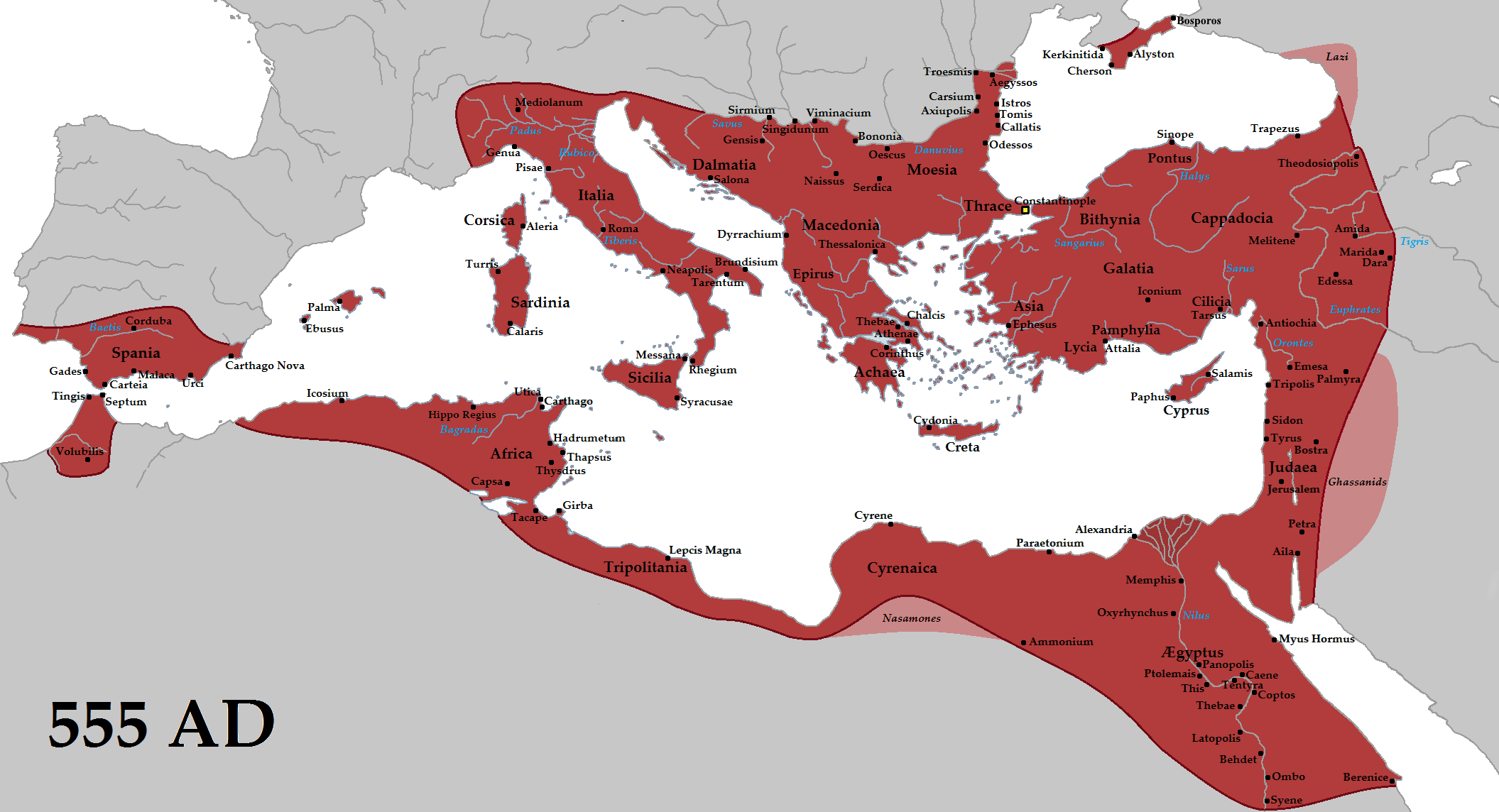 i iThe empire in 555 under Justinian I, its greatest extent since the fall of the Western Roman Empire, vassals shaded in pink | ||||||||||||||||||||||||||||||||||||||||||||||||||||||
|
[ Show / Hide ]
| ||||||||||||||||||||||||||||||||||||||||||||||||||||||
1 Origins and the late Roman background✎
There is no single agreed-upon founding date for the Byzantine Empire. Historians who focus on Greece or Eastern Orthodox Christianity often trace it to the early 300s, while others place its beginning in the 600s or 700s, when the empire became predominantly Greek-speaking and lost its western character. The roots of the Byzantine state lie in the broader transformation of the Roman Empire during its final centuries.
Between the 200s and 100s BC, the Roman Republic established control over the eastern Mediterranean, absorbing the old kingdoms of the Hellenistic period. While the western provinces became deeply Latinized (meaning they adopted the Latin language and Roman customs), the eastern half kept its Greek language and Hellenistic culture. The empire enjoyed relative stability during the Pax Romana ("Roman Peace"), but by the 200s AD, a period historians call the Crisis of the Third Century brought civil wars, foreign invasions, and economic collapse. Regional armies began proclaiming their generals as rival emperors, fragmenting imperial authority.
Diocletian (reigned 284–305) recognized that the empire was too large for one person to govern effectively. He created the Tetrarchy (a system of four co-rulers), dividing authority between eastern and western halves. The Tetrarchy collapsed quickly, but the idea of dividing the empire proved lasting. Constantine I (reigned 306–337) reunified the empire under his sole rule by 324. Over the next six years, he rebuilt the ancient city of Byzantium as a grand new capital, calling it "New Rome." It soon became known as Constantinople (the "city of Constantine"). The old capital of Rome had lost much of its strategic importance. It was far from the wealthy eastern provinces and the dangerous frontiers where emperors actually needed to be.
Constantine introduced two changes that would define the Byzantine world for centuries. First, he issued the Edict of Milan (313), which legalized Christianity throughout the empire. He became the first emperor to personally favor the Christian faith and played a major role in its early organization, convening the First Council of Nicaea (325) to settle theological disputes. Second, he established the gold solidus as a stable currency, which remained the standard of Mediterranean trade for over 700 years. His dynasty continued to rule until the death of his nephew Julian in 363, who was the last emperor to try to restore traditional Roman paganism.
Theodosius I (reigned 379–395) was the last emperor to rule both halves of the empire. He made Nicene Christianity the official state religion and actively suppressed paganism. After his death, the empire was permanently divided between his two sons: Honorius received the West and Arcadius received the East. The Western Roman Empire deteriorated rapidly under pressure from Germanic peoples, while the Eastern Empire survived thanks to its stronger economy, better-defended capital, more stable civilian government, and the massive Theodosian Walls built around Constantinople during the reign of Theodosius II (reigned 408–450).
The warlord Odoacer deposed the last western emperor, Romulus Augustulus, in 476. With the assassination of the titular western emperor Julius Nepos in 480, the office of western emperor was abolished entirely. The Eastern Roman Empire now stood alone as the heir to Rome.
2 The age of Justinian✎
The reign of Justinian I (527–565) represented the high point of early Byzantine power. Justinian pursued an ambitious program of legal reform, military reconquest, and monumental building. His most lasting achievement was the Corpus Juris Civilis (Body of Civil Law), a massive codification and streamlining of Roman law. This legal code became the foundation of law across much of Europe and continues to influence legal systems today.
Justinian's general Belisarius conquered the Vandal Kingdom in North Africa in 533, reclaiming territory that had been lost to Germanic invaders a century earlier. Belisarius then invaded Italy, and after a long and devastating war (535–554), the Ostrogothic Kingdom was largely destroyed. At its peak under Justinian, the empire controlled territory stretching from Spain to Mesopotamia, the closest it had come to matching the old Roman Empire since the western collapse.
Justinian also rebuilt much of Constantinople after the destructive Nika riots of 532, when rioting factions nearly overthrew his government. The centerpiece of his building program was the Hagia Sophia, a cathedral so architecturally revolutionary that it remained the largest enclosed space in the world for nearly a thousand years. He ruthlessly suppressed paganism, heresy, and other forms of religious dissent, asserting imperial control over church affairs.
However, the 540s brought severe reversals. The Plague of Justinian, which began around 541, killed a massive proportion of the population and devastated the empire's economy and military manpower. The Sasanian Persian king Khosrow I exploited Constantinople's focus on the West by invading and sacking Antioch in 540. The Italian war dragged on far longer and cost far more than expected. When Justinian died in 565, he left behind a vastly expanded but overstretched and financially strained empire.
His successors inherited these problems. The Lombards conquered much of northern Italy by 572. Wars against Sasanian Persia restarted and continued until 591. Avars and Slavs repeatedly invaded the Balkans. Emperor Maurice managed to restore some order through hard campaigning in the 590s, but when he pushed his exhausted troops too far in 602, they mutinied. The soldiers proclaimed an officer named Phocas as emperor and executed Maurice. Phocas proved incompetent, and a destructive civil war followed until Heraclius overthrew him in 610.
3 Crisis and transformation✎
The early 600s brought the empire to the brink of destruction. Under the Sasanian king Khosrow II, Persian armies occupied the Levant (the eastern Mediterranean coastal region) and Egypt, seizing Jerusalem in 614 and advancing deep into Asia Minor. Simultaneously, Avars and Slavs ravaged the Balkans. The empire seemed on the verge of total collapse.
Heraclius (reigned 610–641) orchestrated a remarkable comeback. After years of careful preparation, he launched a series of bold counterattacks into the heart of Sasanian territory. He repelled a combined Avar-Persian siege of Constantinople in 626 and won a decisive victory at the Battle of Nineveh in 627, forcing the Persians to sue for peace.
The triumph was short-lived. Beginning in the 630s, Arab armies inspired by the new religion of Islam swept out of the Arabian Peninsula with astonishing speed. They defeated Byzantine field armies in Syria and conquered the Levant, Egypt, and eventually all of North Africa. By the time Heraclius died in 641, the empire had lost perhaps three-quarters of its revenue along with its richest and most populous provinces. This was one of the most dramatic and permanent territorial losses in Roman history.
The next century was a dark period, poorly documented by surviving sources. Arab raids into Asia Minor became an annual occurrence, though permanent occupation was avoided. The empire's response was largely defensive, holding fortified strongholds and avoiding pitched battles. Emperor Constans II (reigned 641–668) reorganized the empire's administration into a system that eventually developed into the theme system, where military governors controlled provinces and local soldiers were settled on land in exchange for military service. This system gave the empire a reliable, self-sustaining defensive force.
Constantine IV (reigned 668–685) repelled a major Arab siege of Constantinople in the 670s, employing a terrifying secret weapon called Greek fire (a flammable liquid that burned even on water). However, the Bulgars established a powerful state in the northern Balkans that would challenge Byzantine control of the region for centuries. A period of political chaos called the Twenty Years' Anarchy (695–717) brought six emperors to the throne in rapid succession. Stability returned only when Leo III (reigned 717–741) repelled another Arab siege of Constantinople in 717–718, a victory that effectively halted the Arab advance into southeastern Europe.
Leo III and his son Constantine V (reigned 741–775) were among the most capable Byzantine rulers. They reformed the military, issued a new legal code called the Ecloga, and won important victories against both Arab and Bulgar enemies. However, they also launched the Iconoclasm controversy by banning the use of religious images (icons) in worship, a policy that caused deep divisions within Byzantine society and worsened relations with the Papacy in Rome. The loss of Ravenna to the Lombards in 751 effectively ended Byzantine control of central Italy and contributed to a growing split between the Eastern and Western churches.
4 The Macedonian golden age✎
The Macedonian dynasty, which ruled from 867 to 1056, presided over what many historians consider the golden age of the Byzantine Empire. Founded by Basil I (reigned 867–886), a peasant from Thrace who rose through the imperial court, the dynasty oversaw a cultural, military, and administrative revival known as the Macedonian Renaissance.
Under the Macedonians, the empire reconquered Crete, Cyprus, and large parts of Syria, Cilicia, and Armenia. Basil I began a major legal reform that his son Leo VI (reigned 886–912) completed: the Basilika, a 60-volume codification of Roman law in Greek that became the legal foundation of the empire for the rest of its existence. The dynasty also produced one of Byzantium's greatest warrior-emperors, Basil II (reigned 976–1025). Through decades of relentless campaigning, Basil II conquered the First Bulgarian Empire, restoring the Danube frontier for the first time since the 600s. At his death, the Byzantine Empire was the undisputed superpower of the eastern Mediterranean.
Culturally, the Macedonian period saw a revival of interest in classical Greek learning. Scholars compiled encyclopedias, preserved ancient texts, and produced sophisticated works of art and architecture. The court of Constantine VII Porphyrogennetos (reigned 913–959) was particularly notable for its literary output, though much of it was designed to glorify the ruling dynasty. Byzantine art from this period, with its characteristic gold backgrounds and formal religious imagery, influenced artistic traditions across Eastern Europe and the Islamic world.
However, the Macedonian dynasty also sowed the seeds of future problems. Powerful aristocratic families (called the dynatoi, meaning "the powerful ones") steadily acquired the lands of smaller farmers, weakening the tax base and the theme system's supply of soldier-farmers. Basil II tried to curb this trend through legislation, but after his death in 1025, a series of weak successors allowed the aristocracy to grow unchecked. Military spending was slashed, frontier defenses were neglected, and the professional army deteriorated. These failures would have catastrophic consequences in the decades that followed.
5 The Seljuk crisis and the Komnenian restoration✎
The period after the end of the Macedonian dynasty was one of decline and disaster. In 1071, the Seljuk Turks inflicted a devastating defeat on the Byzantines at the Battle of Manzikert in eastern Asia Minor. Emperor Romanos IV was captured on the battlefield, an almost unprecedented humiliation. The defeat itself was not militarily decisive, but the civil war that followed it was catastrophic. As rival claimants fought for the throne, the Seljuks flooded into Asia Minor virtually unopposed, seizing the empire's agricultural heartland and its main source of military manpower.
By the time Alexios I Komnenos (reigned 1081–1118) took the throne, the empire was in desperate condition. The treasury was nearly empty, the army was disorganized, and enemies threatened on every side: Normans from southern Italy attacked in the Balkans, Seljuks held most of Asia Minor, and Pecheneg nomads raided from the north. Alexios proved to be a brilliant and resourceful leader. He rebuilt the army, reformed imperial finances, and skillfully played his enemies against each other.
Most significantly, Alexios appealed to Pope Urban II for military assistance against the Seljuks in 1095. The Pope's response was the First Crusade, a massive armed pilgrimage that captured Jerusalem in 1099. Although the Crusaders established their own independent states rather than returning territory to Byzantium, Alexios used the upheaval to recover much of the western coast of Asia Minor.
Alexios's son John II (reigned 1118–1143) was a cautious but effective ruler who expanded Byzantine control deeper into Asia Minor through a methodical campaign of fortress-building and careful diplomacy. His son Manuel I (reigned 1143–1180) was the most ambitious of the Komnenian emperors. He crushed the Kingdom of Hungary at the Battle of Sirmium (1167) and established Byzantine influence over the Balkans at its strongest point since late antiquity. He cultivated extensive diplomatic ties with western European kingdoms and even organized jousting tournaments in Constantinople.
However, Manuel suffered a serious defeat at the Battle of Myriokephalon (1176) against the Seljuk Turks, ending any realistic hope of fully recovering Asia Minor. After his death, the empire quickly unraveled. His young son was overthrown, a series of weak and cruel rulers followed, and the empire descended into chaos. In 1185, a revolt in Bulgaria reestablished an independent Bulgarian state for the first time in nearly two centuries.
6 The Fourth Crusade and the Latin interlude✎
Relations between the Byzantine Empire and western Europe had been deteriorating for decades. Religious disagreements between the Eastern Orthodox and Roman Catholic churches, commercial rivalries with the Italian city-states of Venice and Genoa, and resentment from previous Crusades all fueled mutual distrust. A massacre of Latin (western European) residents in Constantinople in 1182 deepened the hostility.
In 1195, Emperor Isaac II Angelos was overthrown by his brother Alexios III. Isaac's son fled to western Europe and convinced the leaders of the Fourth Crusade to restore his father to the throne in exchange for enormous financial and military promises. In 1203, the Crusaders arrived at Constantinople and briefly reinstalled Isaac II. When the promised payments failed to materialize, tensions escalated. On April 13, 1204, the Crusaders stormed the city and subjected it to three days of looting and destruction, one of the most infamous episodes of the medieval period.
The conquerors established the Latin Empire of Constantinople and divided Byzantine territory among themselves and their Venetian allies. Byzantine refugees established several successor states, the most important being the Empire of Nicaea in western Asia Minor, the Empire of Trebizond on the Black Sea coast, and the Despotate of Epirus in northwestern Greece. These Greek states fought each other, the Latins, and various neighboring powers for control of the former empire's lands.
The Empire of Nicaea, under the Laskarid dynasty, proved the most successful. Emperor John III (reigned 1221–1254) built a strong, self-sufficient state and steadily expanded at the expense of his rivals. In 1261, forces loyal to Michael VIII Palaiologos recaptured Constantinople, finding the once-great city sparsely populated and largely in ruins. Michael declared the restoration of the Byzantine Empire and founded the Palaiologos dynasty, the longest-ruling and last dynasty of Byzantine emperors.
7 Decline and fall✎
The restored empire was a shadow of its former self. Michael VIII managed to reclaim Constantinople and some surrounding territory, but the cost was enormous. To protect against further western attacks, he attempted to reunite the Eastern Orthodox and Roman Catholic churches, a decision that was deeply unpopular with his own people, who hated the Latins more than ever after the sack of 1204. To fund his western campaigns, he pulled troops out of Asia Minor and raised crushing taxes on the peasantry, leaving the empire's eastern frontier dangerously exposed.
The consequences were devastating. Turkish warrior bands called ghazis (raiders motivated by religious zeal and the prospect of plunder) flooded into Anatolia, the empire's traditional heartland. By the early 1300s, nearly all of Asia Minor had been lost. Among the many small Turkish states that emerged, one would prove fatally dangerous: the Ottoman emirate, founded around 1299.
Meanwhile, the Byzantine Empire tore itself apart through civil wars. The conflict between Andronikos II and Andronikos III (1321–1328) allowed the Turks to advance further. An even more destructive civil war between John VI Kantakouzenos and John V Palaiologos (1341–1347) enabled the Serbian king Stefan Dušan to conquer large portions of Byzantine Macedonia and Thessaly. Kantakouzenos made the fateful decision to hire Ottoman Turkish mercenaries, who seized the fortress of Gallipoli in 1354, giving the Ottomans their first permanent foothold in Europe.
The Black Death struck the empire in the late 1340s, further reducing its population and resources. Economic concessions to Venice and Genoa drained what little revenue remained. By 1380, the Byzantine Empire consisted of little more than Constantinople itself, the city of Thessalonica, and some scattered territory in the Morea (the Peloponnese peninsula in southern Greece).
The Ottoman advance seemed unstoppable until the Central Asian conqueror Timur (Tamerlane) invaded Anatolia and shattered the Ottoman army at the Battle of Ankara (1402), capturing the Ottoman sultan Bayezid I. This bought the Byzantines a few more decades. Emperor Manuel II Palaiologos (reigned 1391–1425) skillfully exploited the Ottoman civil war that followed, gaining territorial concessions and temporary relief.
But the reprieve could not last. Under Murad II and especially his son Mehmed II, the Ottomans rebuilt their power. In 1439, Emperor John VIII Palaiologos desperately agreed to reunite the churches at the Council of Florence, hoping to gain western military aid. Most Byzantines rejected the agreement. A popular saying of the time summed up the mood: "Better the Turkish turban than the Papal tiara."
The last emperor, Constantine XI Palaiologos (reigned 1449–1453), inherited a virtually hopeless situation. Mehmed II assembled an enormous army of perhaps 80,000 soldiers and brought massive cannons to breach Constantinople's ancient walls. The siege began on April 6, 1453. Despite a courageous defense by perhaps 7,000 defenders, the walls were breached on May 29. Constantine XI died fighting in the final assault. After over a thousand years, the Roman Empire in the East had come to an end.
8 Government and administration✎
The Byzantine Empire was an autocracy (a system where one ruler holds supreme power). The emperor held absolute authority over civil, military, and religious affairs, and was considered God's representative on Earth. Unlike western European monarchies, the Byzantine throne did not follow a strict hereditary line. While emperors often tried to establish dynasties, the throne could be seized by successful generals, ambitious officials, or popular revolt. This made Byzantine politics notoriously unstable at times, but also allowed capable individuals to rise to power regardless of birth.
The imperial bureaucracy was one of the most sophisticated government systems in the medieval world. A complex hierarchy of titled officials managed everything from taxation and justice to diplomacy and the postal system. The empire's administrative language shifted gradually from Latin to Greek, a process largely complete by the 600s. Major officials included the logothetes (department heads), strategos (military governors of themes), and the eparch (prefect of Constantinople, who managed the capital's markets, guilds, and public order).
The theme system, developed during the crisis of the 600s and 700s, was one of Byzantium's most important administrative innovations. Each theme was a province governed by a military commander who controlled both civil and military affairs. Soldiers were settled on land within their theme and served in exchange for their holdings, providing the empire with a self-sustaining defense force without the expense of a large standing army. The system worked effectively for several centuries but gradually broke down as powerful aristocrats absorbed peasant landholdings.
Byzantine diplomacy was legendary for its sophistication. Emperors maintained an elaborate intelligence network, used strategic marriages and lavish gifts to manage foreign rulers, and employed a combination of military threats, bribery, and religious conversion to extend their influence. The empire's gold currency, the solidus (later replaced by the hyperpyron), served as the standard currency of international trade for centuries, giving Constantinople enormous economic leverage.
9 Religion and culture✎
Eastern Orthodox Christianity was the defining element of Byzantine identity. The emperor played a central role in church affairs, appointing the Patriarch of Constantinople and convening ecumenical councils (church-wide meetings) to resolve theological disputes. This close relationship between imperial and religious authority is sometimes called "caesaropapism" (where the emperor functions as both head of state and effective head of the church), though modern historians debate how accurately this term describes Byzantine reality.
Major theological controversies shaped the empire's history. The Arian disputes of the 300s and 400s concerned the nature of Christ's divinity. The Monophysite controversy, which held that Christ had only one nature rather than two, divided the empire's eastern provinces (particularly Egypt and Syria) from Constantinople and was never fully resolved. The Iconoclasm controversy of the 700s and 800s, over whether religious images should be venerated or destroyed, caused bitter internal conflict and deepened the rift with Rome.
The East–West Schism of 1054, in which the Pope and the Patriarch of Constantinople excommunicated each other, formalized the division between Roman Catholicism and Eastern Orthodoxy. Although the split had been developing for centuries over issues of papal authority, theological differences, and cultural divergence, it became permanent after the Fourth Crusade's sack of Constantinople in 1204.
Byzantine culture blended Roman governmental traditions, Greek language and philosophy, and Christian theology into a distinctive civilization. Byzantine art is characterized by its iconic style: formal, gold-backed religious images (icons) that emphasize spiritual meaning over realistic representation. Architecture reached extraordinary heights, from the massive dome of the Hagia Sophia to the intricate mosaic decorations of churches across the empire.
The Byzantines preserved and transmitted much of ancient Greek literature, philosophy, and science. Byzantine scholars copied manuscripts of Plato, Aristotle, Homer, and countless other classical authors that would otherwise have been lost. When Constantinople fell in 1453, many of these scholars fled to Italy, bringing their manuscripts with them. This influx of classical knowledge contributed significantly to the Italian Renaissance.
10 Legacy✎
The Byzantine Empire's legacy is vast and far-reaching. Its legal tradition, rooted in Justinian's Corpus Juris Civilis, influenced the development of law across continental Europe. Eastern Orthodox Christianity, shaped by centuries of Byzantine theology and practice, remains the dominant faith in Russia, Greece, Serbia, Romania, Bulgaria, Georgia, and other countries. Byzantine art and architectural styles spread throughout Eastern Europe and influenced Islamic art as well.
The empire served as a cultural and political bridge between the ancient and modern worlds, preserving classical learning through the medieval period and transmitting it both to the Islamic world and to western Europe. The concept of a Christian empire governed by a divinely appointed ruler influenced political thought in Russia, where the tsars (a title derived from "Caesar") saw themselves as heirs to Byzantine tradition. Moscow was sometimes called the "Third Rome" after the fall of Constantinople.
Even the empire's fall had transformative consequences. The Ottoman conquest of Constantinople closed overland trade routes to Asia, motivating European explorers to seek new sea routes to the East, contributing to the Age of Exploration. The Greek scholars who fled to Italy brought manuscripts and teaching methods that helped spark the Renaissance's rediscovery of classical antiquity.
Today, the Byzantine Empire's history continues to be studied and debated. Once dismissed by western historians as a stagnant or decadent "Eastern" civilization, Byzantium is now recognized as one of the most important and influential states of the medieval world: a thousand-year empire that shaped the religious, legal, cultural, and political foundations of both Europe and the Middle East.
10.1 See also✎
- Roman Empire
- Roman Republic
- Fall of the Western Roman Empire
- Constantinople
- Justinian I
- Hagia Sophia
- Eastern Orthodox Christianity
- Ottoman Empire