Goths
 i i
| |
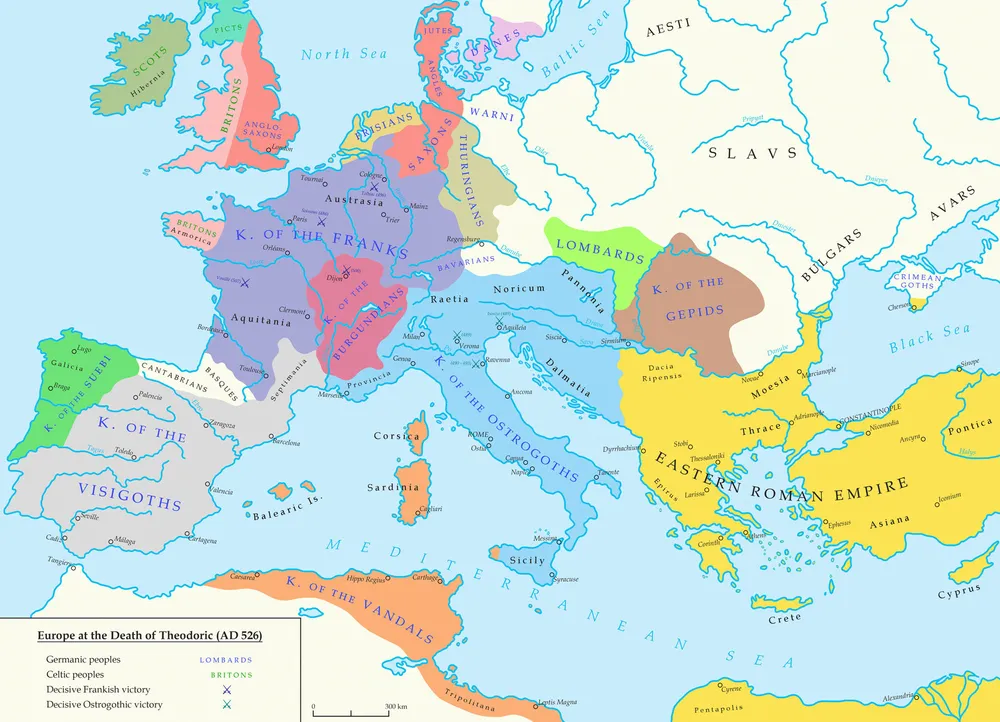
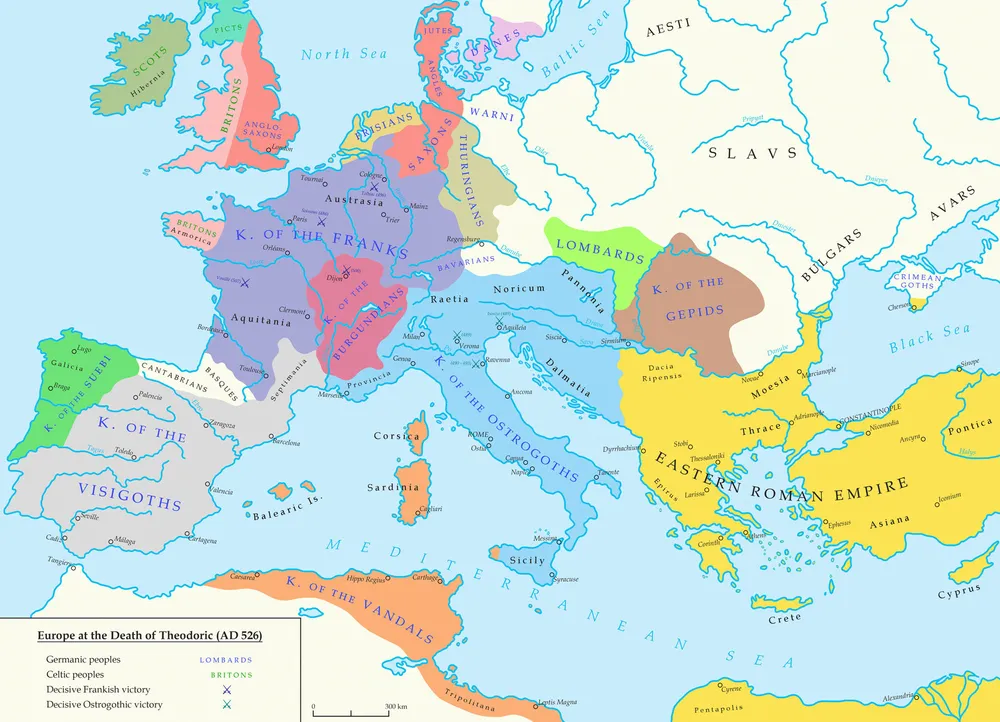
| Europe in 526 AD. The Goths ruling Spain (gray; Visigothic Kingdom) and Italy (light blue; Ostrogothic Kingdom) | |
| Type | Germanic people |
|---|---|
| Language | Gothic language (East Germanic) |
| Religion | Germanic paganism (early) Arian Christianity (4th century onward) |
| Branches | Visigoths (western) Ostrogoths (eastern) |
| Homeland | Baltic coast / Vistula delta (1st–2nd c.) Black Sea region (3rd–4th c.) |
| Key events | Battle of Adrianople (378 AD) Sack of Rome (410 AD) Fall of Western Rome (476 AD) |
| Kingdoms | Visigothic Kingdom (418–711) Ostrogothic Kingdom (493–553) |
The Goths were a Germanic people who played a decisive role in the fall of the Western Roman Empire and the shaping of medieval Europe. First attested by Greco-Roman writers in the 3rd century AD living north of the Danube in what is now Ukraine, Moldova, and Romania, the Goths became one of the most powerful groups on the Roman frontier. Their two major branches — the Visigoths in the west and the Ostrogoths in the east — established kingdoms that governed large parts of the former Roman world for centuries.
Unlike many other groups that the Romans called "barbarians," the Goths left behind significant cultural records, including a written language, law codes, and the earliest substantial text in any Germanic language: the Gothic Bible, translated by Bishop Ulfilas in the 4th century.
1 Navigation✎
|
[ Show / Hide ]
| ||||||||||||||||||||||||||||||||||||||||
|---|---|---|---|---|---|---|---|---|---|---|---|---|---|---|---|---|---|---|---|---|---|---|---|---|---|---|---|---|---|---|---|---|---|---|---|---|---|---|---|---|
2 Origins✎
The earliest origins of the Goths are debated among scholars. The 6th-century historian Jordanes, who may himself have been of Gothic descent, wrote in his Getica that the Goths originated on an island called Scandza — generally identified with southern Scandinavia — and migrated under their king Berig to the southern shore of the Baltic Sea, settling in an area called Gothiscandza near the mouth of the Vistula River in modern Poland. While the literal accuracy of this account is questioned, it has some support from archaeology.
A people called the Gutones, possibly early Goths, are documented by Roman writers living near the lower Vistula in the 1st century AD. The Roman historian Tacitus, writing around 98 AD, described the Gutones as Germanic people who carried round shields and short swords and were "ruled by kings, a little more strictly than the other Germanic peoples." Their name is thought to be etymologically identical to that of the Gutes from Gotland, Sweden, and closely related to that of the Geats from mainland Sweden, though the exact connections remain uncertain.
Archaeologists associate the early Goths with the Wielbark culture, which emerged along the lower Vistula and the Pomeranian coast in the 1st century AD. This culture is distinguished from its predecessors by the practice of inhumation burial (rather than cremation), the absence of weapons in graves, and the presence of stone circles — features with parallels in Scandinavian burial traditions.
3 Migration to the Black Sea✎
By the 2nd and 3rd centuries AD, the Goths had migrated southeast from the Vistula region to the area north of the Black Sea, in what is now Ukraine, Moldova, and Romania. This placed them at the periphery of the Roman Empire, and from the 230s onward they began launching raids into Roman territory across the Danube. In 238 AD, Gothic forces attacked the Roman city of Histria, one of the first recorded Gothic military actions against the empire.
In this region, the Goths are associated with the Chernyakhov culture, which flourished during the 3rd and 4th centuries across a vast area from the Danube to the Dnieper River. The culture was ethnically diverse, including Goths alongside other Germanic and non-Germanic peoples, but Gothic groups appear to have been the politically dominant element.
By the mid-4th century, the Goths had divided into two main groupings, separated roughly by the Dniester River: the Thervingi (later known as Visigoths) to the west and the Greuthungi (later known as Ostrogoths) to the east.
4 Conflict with Rome✎
The Goths' relationship with Rome was complex — they were simultaneously enemies, allies, and recruits. Large numbers of Goths served in the Roman military, and the empire alternated between fighting the Goths and negotiating with them.
4.1 The Hunnic invasion and Adrianople✎
In the late 370s AD, the arrival of the Huns from Central Asia shattered the Gothic world. The Huns overwhelmed the Ostrogoths and drove large numbers of Visigoths to the Roman frontier at the lower Danube, where they sought refuge within the empire. Emperor Valens allowed them to cross in 376, but Roman officials mistreated and exploited the desperate refugees, provoking a revolt.
On 9 August 378, Gothic forces under Fritigern inflicted a devastating defeat on the Roman army at the Battle of Adrianople, killing Emperor Valens himself. The battle is considered one of the most significant military disasters in Roman history and demonstrated that the empire could no longer simply overpower the Germanic peoples on its borders.
4.2 The sack of Rome✎
In 410 AD, Visigothic forces under King Alaric I sacked the city of Rome itself — the first time the city had been captured by a foreign enemy in nearly 800 years. The event sent shockwaves throughout the Roman world. The theologian Jerome, writing from Bethlehem, lamented that "the city which had taken the whole world was itself taken." While the damage was relatively limited (the Visigoths were Christians and spared churches), the symbolic impact was enormous.
5 Gothic kingdoms✎
After the fall of the Western Roman Empire in 476 AD, the Goths established two major successor kingdoms.
5.1 Visigothic Kingdom✎
The Visigoths settled first in southwestern Gaul (modern France), establishing a kingdom centered on Toulouse in 418 AD. After the Franks defeated them at the Battle of Vouillé in 507, the Visigoths retreated into the Iberian Peninsula (modern Spain and Portugal), where they ruled until the Muslim Arab and Berber conquest of 711.
The Visigothic Kingdom in Spain was one of the most significant successor states to Rome. The Visigoths issued their own law codes, convened church councils (most notably the Councils of Toledo), and eventually converted from Arian Christianity to Catholic Christianity under King Reccared I in 589.
5.2 Ostrogothic Kingdom✎
The Ostrogoths, encouraged by the Eastern Roman emperor, invaded Italy under King Theodoric the Great in 489 and established a kingdom with its capital at Ravenna by 493. Theodoric's reign (493–526) was a period of relative peace and cultural flourishing. He preserved Roman institutions, maintained the Roman Senate, and patronized learning, employing scholars like Boethius and Cassiodorus.
The Ostrogothic Kingdom fell to the armies of the Eastern Roman Emperor Justinian I during the devastating Gothic Wars (535–554), which left much of Italy depopulated and ruined. The Ostrogoths effectively ceased to exist as a distinct people after this conflict.
6 Culture✎
6.1 Language✎
The Gothic language is the earliest Germanic language with a substantial written record. It belongs to the East Germanic branch — a group now entirely extinct — and is distinct from both the West Germanic languages (including English, German, and Dutch) and the North Germanic languages (including Swedish and Danish).
The primary surviving text in Gothic is the Bible translation made by Bishop Ulfilas (also known as Wulfila) around 350–380 AD. Ulfilas created the Gothic alphabet, drawing on Greek, Latin, and runic letter forms, specifically to produce this translation. The most important surviving manuscript is the Codex Argenteus ("Silver Book"), a 6th-century copy written in silver and gold ink on purple parchment, now held at Uppsala University in Sweden.
6.2 Religion✎
The Goths were originally pagans who worshipped traditional Germanic deities. In the 4th century, many Goths converted to Christianity, largely through the missionary work of Ulfilas, who was himself the grandson of Roman Christians captured in a Gothic raid. Crucially, Ulfilas was an Arian Christian — he believed that Christ was created by and subordinate to God the Father, a position condemned as heresy by the mainstream Roman church at the Council of Nicaea in 325.
The Goths' Arian Christianity set them apart from the Catholic Roman population they would later rule, creating a persistent cultural barrier. The Visigoths in Spain eventually resolved this tension by converting to Catholicism in 589, while the Ostrogoths remained Arian until their kingdom's destruction.
6.3 Society✎
Gothic society was hierarchical. At the top were nobles and warriors, whose status was earned through lineage and military valor. Below them were free men, and at the bottom were slaves, often prisoners taken in warfare. The economy was primarily agrarian, based on farming and animal herding.
Gothic material culture, revealed through archaeological finds, shows skilled craftsmanship in metalwork, particularly in jewelry, belt buckles, and fibulae (brooches). Gothic art blended influences from Roman, Greek, Scythian, and steppe traditions, and these "polychrome" and "animal style" decorative traditions influenced early medieval European art more broadly.
7 Legacy✎
The Goths' most visible legacy is their role in ending the Western Roman Empire and shaping the political landscape of early medieval Europe. The Visigothic Kingdom in Spain lasted nearly three centuries and left lasting marks on Spanish law, language, and church organization. The Ostrogothic Kingdom, though shorter-lived, preserved Roman culture and institutions during a critical transitional period.
The Gothic language, though it died out after the fall of the Gothic kingdoms (with the possible exception of Crimean Gothic, attested as late as the 16th century), remains invaluable to linguists as the oldest well-documented Germanic language. It provides crucial evidence for reconstructing the development of all Germanic languages.
The word "Gothic" itself took on a second life during the Renaissance, when Italian writers used it as a pejorative term for the medieval architecture they considered crude and "barbaric" compared to classical Roman models. This usage eventually lost its negative connotation, and "Gothic" became the accepted name for the great medieval cathedrals of northern Europe — one of many unexpected ways the name of this ancient people continues to resonate in modern culture.