Julius Caesar
|
[ Show / Hide ]
| ||||||||||||||||||||||||||||||||||||||||
|---|---|---|---|---|---|---|---|---|---|---|---|---|---|---|---|---|---|---|---|---|---|---|---|---|---|---|---|---|---|---|---|---|---|---|---|---|---|---|---|---|
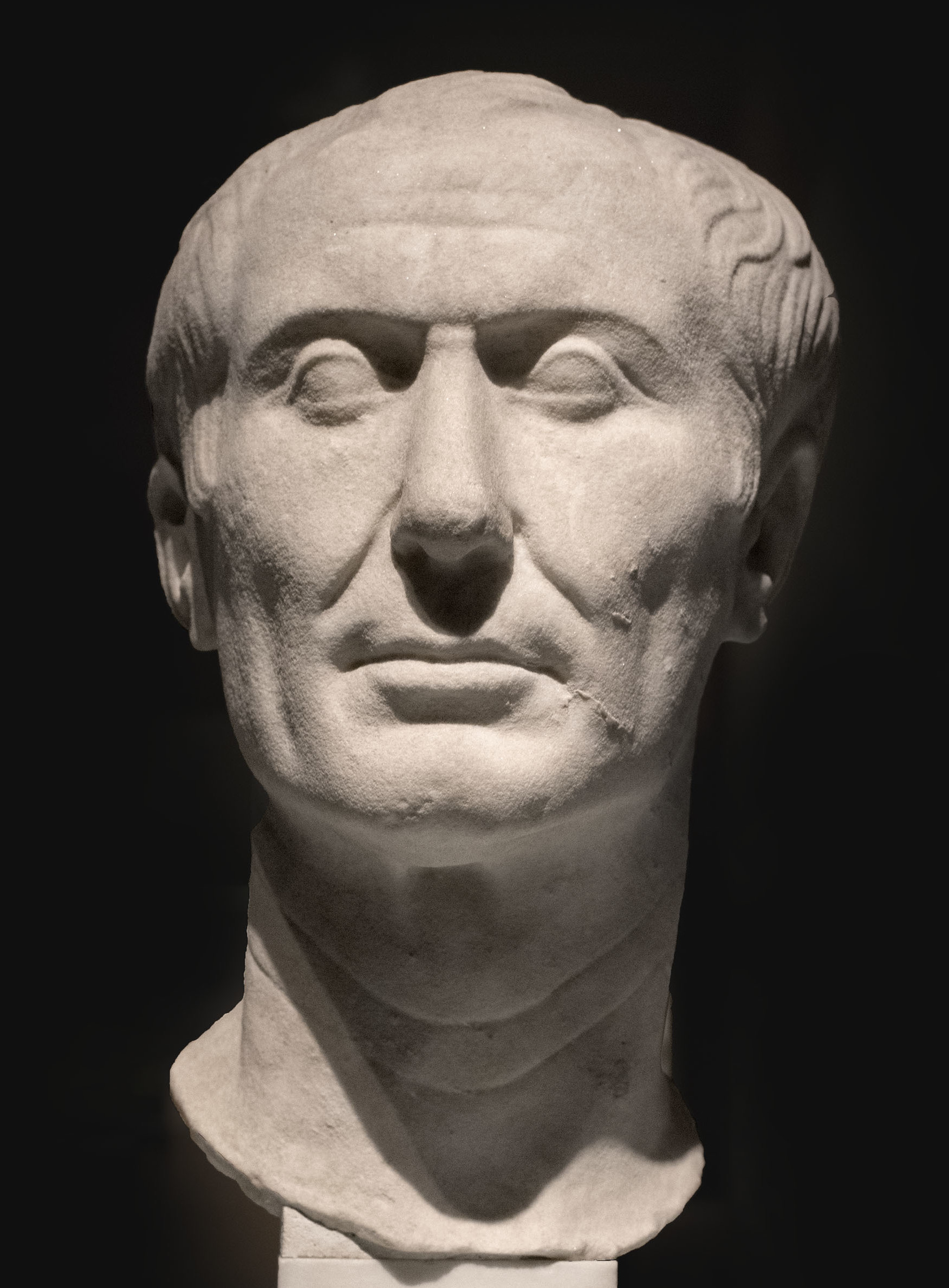
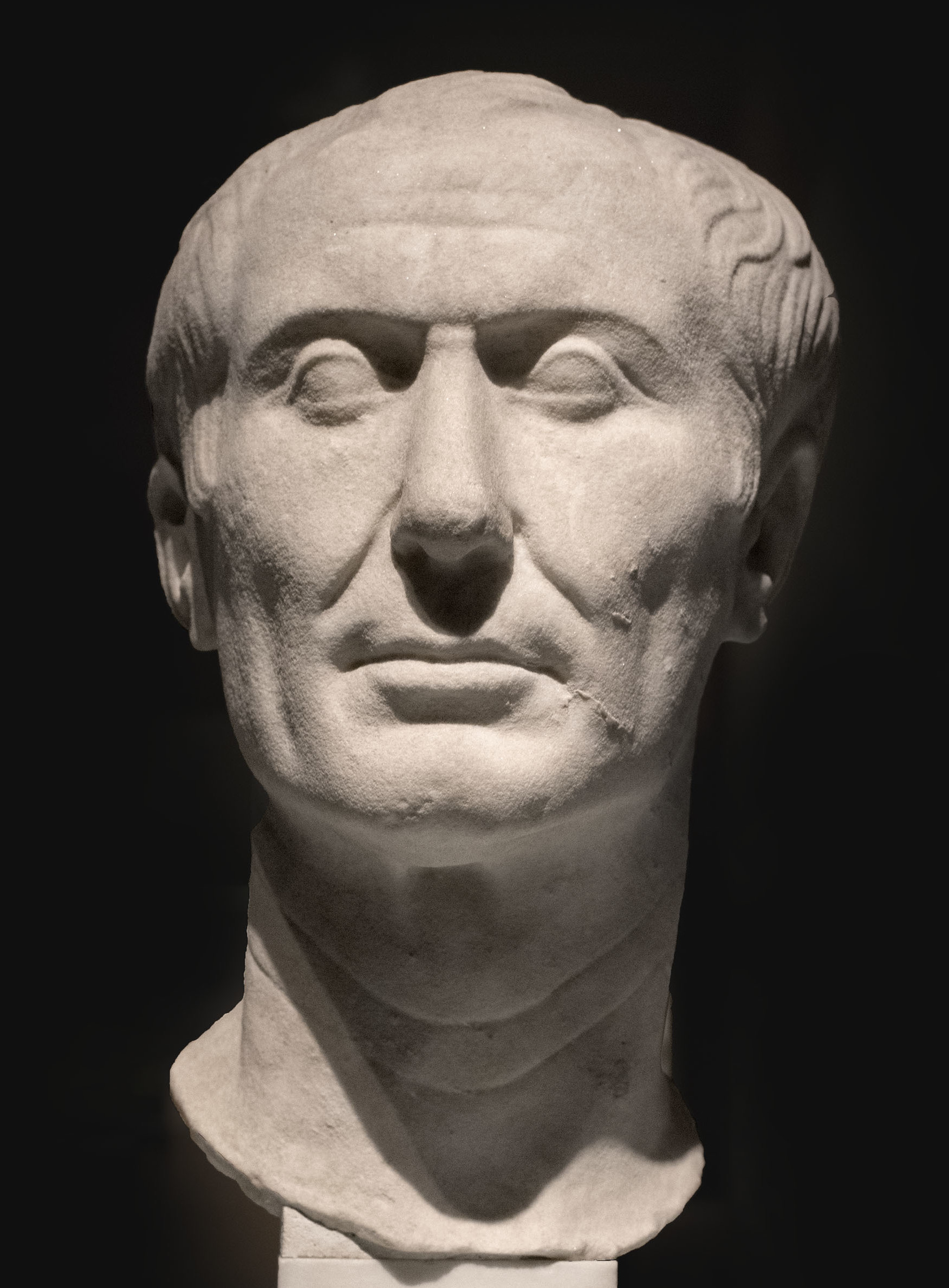
Gaius Julius Caesar (12 or 13 July 100 BC – 15 March 44 BC) was a Roman general, statesman, and author who played a critical role in the transformation of the Roman Republic into the Roman Empire. He conquered Gaul (roughly modern-day France) during the Gallic Wars, fought and won a civil war against his political rivals, and became dictator of Rome before being assassinated by a group of senators on the Ides of March in 44 BC.
Caesar is widely regarded as one of the greatest military commanders in history. His conquests in Gaul extended Roman territory by hundreds of thousands of square kilometers, and his military writings — the Commentarii de Bello Gallico ("Commentaries on the Gallic War") — are both a firsthand account of those campaigns and a masterpiece of Latin prose that students still read today.
But Caesar's legacy is more than military. His seizure of power and his reforms as dictator — including the creation of the Julian calendar, the basis of the calendar used around the world today — changed the course of Roman and world history. His assassination did not save the Republic, as his killers had hoped. Instead, it triggered another round of civil wars that ended with Caesar's adopted heir Octavian becoming Augustus, the first Roman emperor.
Even Caesar's name became a title. The word "Caesar" was used by Roman emperors for centuries, and eventually evolved into the German Kaiser and the Russian Tsar — all meaning "emperor."
|
Julius Caesar
Gaius Iulius Caesar
| |||||||||||||||||||||||||||||||||
|---|---|---|---|---|---|---|---|---|---|---|---|---|---|---|---|---|---|---|---|---|---|---|---|---|---|---|---|---|---|---|---|---|---|
| Marble bust of Caesar | |||||||||||||||||||||||||||||||||
|
[ Show / Hide ]
| |||||||||||||||||||||||||||||||||
1 Early life and family✎
Gaius Julius Caesar was born on 12 or 13 July 100 BC into the gens Julia — one of Rome's oldest patrician families. The Julii claimed an extraordinary lineage: they traced their ancestry all the way back to Aeneas, the legendary Trojan prince, and through him to the goddess Venus herself. This made the family theoretically divine in origin, a connection Caesar would exploit throughout his political career.
Despite their ancient and prestigious name, the Julii had not been especially powerful in recent centuries. Caesar's father — also named Gaius Julius Caesar — held some political offices, including the position of praetor, but never reached the top office of consul. His mother, Aurelia, came from the influential Aurelii Cottae family and was widely regarded as a woman of strong character who supervised her son's education closely.
A crucial family connection shaped Caesar's early life: his aunt Julia was married to Gaius Marius, the famous general who had saved Rome from a massive Germanic invasion and had been elected consul an unprecedented seven times. This link to Marius placed the young Caesar on one side of the violent political conflict between Marius's supporters (the populares, who championed the common people) and Sulla's supporters (the optimates, who defended the power of the aristocratic Senate).
When Caesar was about 16, his father died suddenly, leaving the young man as head of the household. Soon after, Sulla won a brutal civil war and established himself as dictator. Sulla ordered Caesar to divorce his wife Cornelia — the daughter of Sulla's enemy Cinna — but the teenage Caesar refused. This was an act of extraordinary courage (or recklessness), given that Sulla was having his political enemies executed by the hundreds through his infamous proscription lists. Caesar was forced into hiding, and his relatives had to intervene to save his life. Sulla reportedly relented, but warned that he saw "many a Marius" in the young man.
2 Early political career✎
Caesar spent the next several years away from Rome, serving on military campaigns in Asia Minor and building his reputation. He won the civic crown — a prestigious military decoration — for saving a fellow soldier's life during the siege of Mytilene. On his way to study rhetoric on the island of Rhodes, he was captured by pirates who held him for ransom. According to the ancient biographers Plutarch and Suetonius, Caesar was remarkably at ease during his captivity, joking with his captors that he would return and have them executed — which he did, after his ransom was paid.
Returning to Rome after Sulla's death in 78 BC, Caesar began climbing the cursus honorum — the ladder of political offices that ambitious Romans were expected to ascend in order. He gained a reputation as a gifted public speaker and a generous spender who won popular support by staging lavish public games and festivals.
His most remarkable early achievement came in 63 BC, when he was elected pontifex maximus — the chief priest of Rome's state religion and one of the most prestigious positions in Roman public life. Caesar defeated two far more senior and established candidates, an upset that astonished the Roman political establishment and signaled his extraordinary ambition and popular appeal. The position was held for life and gave Caesar both prestige and a prominent residence in the Roman Forum.
3 The First Triumvirate✎
By 60 BC, three men dominated Roman politics, each powerful but each frustrated by the Senate's resistance to his ambitions:
Gnaeus Pompeius Magnus (Pompey the Great) was Rome's most celebrated general, who had conquered the eastern Mediterranean and cleared the seas of pirates. But the Senate refused to ratify his settlement of the eastern provinces or provide land for his veterans.
Marcus Licinius Crassus was the wealthiest man in Rome, who had gained fame by crushing the great slave rebellion led by Spartacus. His business allies in the provinces needed tax relief that the Senate had blocked.
Caesar was ambitious, politically skilled, and deeply in debt from his expensive campaigns for public office. He needed a consulship and a military command to advance his career and pay his creditors.
Caesar brokered a deal: he reconciled Pompey and Crassus, who personally disliked each other, into an informal political alliance known as the First Triumvirate. This was not an official government institution but a private agreement to help each other achieve their goals. With Pompey and Crassus's support, Caesar was elected consul for 59 BC.
As consul, Caesar pushed through legislation that gave Pompey's veterans their land and provided Crassus's tax collectors with debt relief. He also secured for himself a five-year command over the provinces of Cisalpine Gaul, Illyricum, and Transalpine Gaul — placing him in control of a large army at Rome's northern frontier. To seal the alliance personally, Pompey married Caesar's daughter Julia.
4 The conquest of Gaul✎
From 58 to 50 BC, Caesar waged the Gallic Wars — a sprawling series of military campaigns that conquered all of Gaul (roughly modern-day France, Belgium, and parts of Switzerland, the Netherlands, and Germany) and dramatically expanded the Roman world.
The wars began in 58 BC when Caesar intervened to stop the Helvetii, a Gallic tribe, from migrating through Roman-allied territory. After defeating them at the Battle of Bibracte, Caesar was drawn deeper into Gaul by requests from allied tribes for help against Ariovistus, a powerful Germanic king who had crossed the Rhine. Caesar defeated Ariovistus and established the Rhine as Rome's frontier.
Over the following years, Caesar conducted campaigns across Gaul with devastating effectiveness. He subdued the Belgae (warlike tribes in the north), destroyed the fleet of the Veneti (a seafaring people in what is now Brittany), and built two remarkable engineering feats: a bridge across the Rhine — the first Roman bridge over the great river, constructed in just ten days as a demonstration of Roman power — and launched two expeditions to Britain (55 and 54 BC), taking Roman soldiers to an island that was, to most Romans, a place of mystery at the edge of the known world.
The most dangerous moment came in 52 BC, when most of central Gaul united in a massive uprising led by Vercingetorix, a young chieftain of the Arverni tribe. After an initial defeat at the Battle of Gergovia, Caesar pursued Vercingetorix to the hilltop fortress of Alesia, where he conducted one of the most extraordinary sieges in military history. Caesar built a ring of fortifications around the city to keep Vercingetorix in, then built a second ring facing outward to defend against the enormous Gallic relief army that came to break the siege. Fighting on two fronts simultaneously, Caesar won a decisive victory. Vercingetorix surrendered personally, and organized resistance in Gaul collapsed.
By 50 BC, Gaul was effectively conquered. Caesar's campaigns had extended Roman territory by hundreds of thousands of square kilometers and brought millions of people under Roman rule. According to ancient sources — though the numbers are likely exaggerated — Caesar fought thirty major battles, captured over 800 towns, and defeated three million Gallic warriors, killing roughly a million and enslaving another million.
Throughout the wars, Caesar wrote his famous Commentarii de Bello Gallico ("Commentaries on the Gallic War"), a series of reports that served as both military dispatches and political propaganda. Written in an elegant, understated third-person style ("Caesar decided..." rather than "I decided..."), the Commentarii kept Caesar's name before the Roman public and justified his campaigns. They remain one of the most important sources for ancient Gallic and Germanic history.
5 The alliance breaks down✎
While Caesar was conquering Gaul, the political alliance that had launched his career was falling apart.
In 54 BC, Caesar's daughter Julia — who was married to Pompey — died in childbirth. The personal bond between the two men died with her. In 53 BC, Crassus was killed at the Battle of Carrhae while leading an invasion of the Parthian Empire in the east. His army was annihilated, and his death removed the third balancing figure from the alliance.
With Crassus dead and Julia gone, Pompey drifted toward the conservative faction in the Senate that viewed Caesar's growing power and popularity with alarm. Caesar's enemies in the Senate, led by Cato the Younger, demanded that Caesar disband his army and return to Rome as a private citizen — which would have left him vulnerable to prosecution and political destruction.
Caesar offered multiple compromises, but the Senate — driven by his opponents — rejected them all. On 7 January 49 BC, the Senate passed the senatus consultum ultimum (the "ultimate decree"), effectively declaring Caesar an enemy of the state.
6 Crossing the Rubicon✎
Faced with the choice between surrendering and fighting, Caesar chose to fight.
On 10 January 49 BC, Caesar marched the Legio XIII south to the Rubicon — a small river in northern Italy that marked the legal boundary between Caesar's province and Italy proper. By Roman law, no general could bring his army across this boundary without the Senate's permission. To do so was an act of treason — an irreversible step toward war.
Caesar reportedly paused at the riverbank, fully aware of the magnitude of what he was about to do. Then he stepped forward and crossed, supposedly saying the famous words "Alea iacta est" — "The die is cast." The phrase has become one of the most famous quotations in Western history, a metaphor for any irreversible decision.
The expression "crossing the Rubicon" is still used today in English to describe passing a point of no return.
7 Caesar's civil war✎
The civil war that followed was surprisingly swift. Pompey and much of the Senate, caught off guard by Caesar's boldness, fled Rome without a fight. Many had expected to have time to organize resistance, but Caesar moved with extraordinary speed — a hallmark of his generalship.
Caesar pursued Pompey across the Mediterranean. After securing Italy and Spain, he crossed to Greece, where Pompey had assembled a larger army. At the decisive Battle of Pharsalus on 9 August 48 BC, Caesar defeated Pompey despite being heavily outnumbered — roughly 22,000 of Caesar's veterans against about 45,000 of Pompey's troops. Caesar's tactical brilliance and his soldiers' experience and loyalty proved decisive.
Pompey fled to Egypt, hoping for shelter from the young pharaoh Ptolemy XIII. Instead, Ptolemy's advisors had Pompey murdered as he stepped ashore, hoping to win Caesar's favor. When Caesar arrived in Egypt and was presented with Pompey's severed head, he reportedly wept — not tears of triumph, but of genuine grief for a man who had once been his son-in-law and ally.
In Egypt, Caesar became involved with Queen Cleopatra, supporting her in a power struggle against her brother Ptolemy XIII. Their relationship — both political and romantic — produced a son, Caesarion. Caesar spent several months in Egypt before continuing to fight the remaining Pompeian forces across North Africa and Spain, finally defeating the last resistance at the Battle of Munda in 45 BC.
Throughout the civil war, Caesar was notably merciful to defeated enemies — a stark contrast to Sulla's mass proscriptions a generation earlier. He pardoned many senators who had fought against him, including Brutus and Cassius, who would later lead the conspiracy against him. This policy of clementia (mercy) won him admiration but also created danger: it left alive men who deeply resented his power.
8 Dictator of Rome✎
After defeating his enemies, Caesar returned to Rome as the unchallenged master of the Roman world. Between 49 and 44 BC, he held the office of consul multiple times and was appointed dictator — first for limited terms, then, in February 44 BC, as dictator perpetuo ("dictator for life").
Caesar used his power to push through an ambitious program of reforms:
The Julian calendar: Caesar replaced the old Roman calendar, which had become hopelessly out of sync with the actual solar year, with a new calendar designed by the Alexandrian astronomer Sosigenes. The Julian calendar had 365 days with a leap year every four years — essentially the same system (with minor adjustments made in 1582 by Pope Gregory XIII) that the world uses today. The month of July (Iulius) is named after Caesar.
Land reform: Caesar settled tens of thousands of his veterans and Rome's urban poor on land in new colonies across the empire, including refounded cities at Carthage and Corinth — both of which Rome had destroyed a century earlier.
Citizenship: He extended Roman citizenship to many communities in the provinces, particularly in Cisalpine Gaul and Hispania, beginning the process of integrating the empire's diverse peoples.
Senate reform: Caesar expanded the Roman Senate from about 600 to 900 members, bringing in men from the provinces and from non-traditional backgrounds. This infuriated the old aristocracy, who saw it as a dilution of their exclusive club.
Debt relief and public works: He provided partial relief for debtors, launched major building projects, and planned ambitious infrastructure works including a canal through the Isthmus of Corinth in Greece.
9 The assassination✎
Caesar's accumulation of power — especially the title of dictator for life — alarmed many senators who saw the Republic being destroyed. Several incidents in early 44 BC heightened fears that Caesar intended to make himself king. At the festival of Lupercalia in February, Mark Antony publicly offered Caesar a royal crown (diadem). Caesar refused it — but the gesture, whether rehearsed or spontaneous, fueled suspicion that he was testing public reaction to the idea of monarchy.
A conspiracy formed among about 60 senators, led by Marcus Brutus and Gaius Cassius. Brutus was a particular surprise — Caesar had pardoned him after the civil war, promoted his career, and reportedly considered him almost like a son. But Brutus was also a descendant (or claimed descendant) of Lucius Junius Brutus, the man who had overthrown Rome's last king and founded the Republic nearly five centuries earlier. The weight of that ancestry, combined with genuine republican conviction, drew him into the plot.
On 15 March 44 BC — a date known as the Ides of March — the conspirators struck. As Caesar entered the Senate meeting at the Curia of Pompey, the conspirators surrounded him on the pretext of presenting a petition. Tillius Cimber grabbed Caesar's toga, and the others drew their hidden daggers. Caesar was stabbed approximately 23 times. According to a well-known tradition, when Caesar saw Brutus among the attackers, he said "Et tu, Brute?" ("You too, Brutus?") — though this exact phrase likely comes from Shakespeare's famous play rather than from historical sources. The ancient historian Suetonius reports that Caesar may have said the Greek equivalent, or may have said nothing at all.
Caesar fell dead at the base of a statue of his old rival Pompey.
10 Aftermath✎
The assassins — who called themselves the Liberatores ("Liberators") — expected the Roman people to thank them for saving the Republic. They were wrong. Caesar had been enormously popular with the common people and his veterans, and many Romans were horrified by the murder.
Mark Antony, Caesar's co-consul and closest political ally, seized the initiative. At Caesar's public funeral, Antony delivered a famous speech and displayed Caesar's bloodstained toga to the crowd. The result was a riot: the Roman mob attacked the houses of the conspirators, who were forced to flee the city.
Caesar's will revealed that he had adopted his 18-year-old great-nephew Gaius Octavius (Octavian) as his son and heir, and had left a generous gift of money to every Roman citizen. Octavian — young, inexperienced, but ruthlessly intelligent — arrived in Rome to claim his inheritance and his adoptive father's name.
The years that followed saw another round of devastating civil wars. Antony, Octavian, and Marcus Aemilius Lepidus formed the Second Triumvirate, hunted down and defeated the assassins Brutus and Cassius at the Battle of Philippi in 42 BC, and then turned on each other. Octavian eventually defeated Antony and Cleopatra at the Battle of Actium in 31 BC and became sole ruler of the Roman world. In 27 BC, the Senate gave him the title Augustus, and the Roman Republic was officially transformed into the Roman Empire.
The assassination of Julius Caesar — intended to preserve the Republic — ultimately guaranteed its destruction.
11 Legacy✎
Julius Caesar's impact on history is vast and enduring.
As a military commander, he is ranked among the greatest generals who ever lived. His speed of movement, his ability to inspire loyalty in his soldiers, his willingness to take calculated risks, and his talent for improvisation on the battlefield made him nearly unbeatable. Military strategists have studied his campaigns for over two thousand years.
As a writer, his Commentarii on the Gallic Wars and the Civil War are considered classics of Latin literature. Their clear, direct prose style became a model for historical writing and remain standard reading for Latin students worldwide.
As a political figure, Caesar represents the turning point between the Republic and the Roman Empire. Whether he intended to become a permanent monarch or genuinely planned to step down is debated to this day. What is clear is that his career demonstrated that Rome's republican institutions could no longer contain the ambitions of its most powerful citizens.
As a cultural symbol, Caesar has been depicted in literature, art, and drama for centuries. Shakespeare's Julius Caesar (c. 1599) is one of the most performed plays in the English language, and the phrase "Beware the Ides of March" from that play remains common in everyday speech.
His very name became synonymous with supreme power. The title "Caesar" was used by every subsequent Roman emperor for centuries. It passed into Germanic languages as Kaiser and into Slavic languages as Tsar or Czar — all meaning "emperor." In this way, Julius Caesar's name echoed through European politics for nearly two thousand years after his death.