Denmark
|
Denmark
Kongeriget Danmark
| |
|
National flag
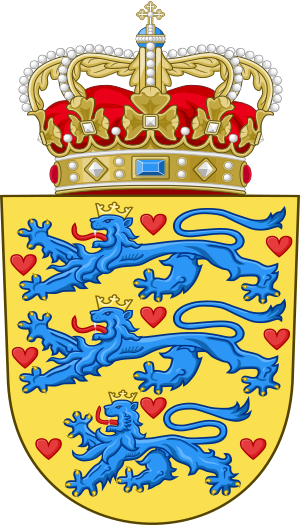
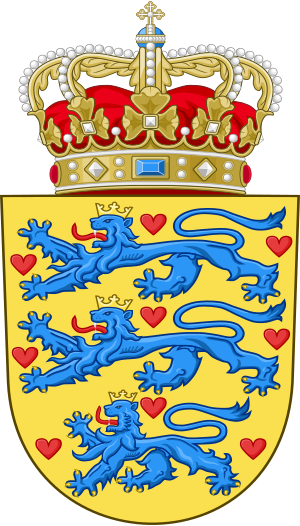
Coat of arms
| |
| Capital | Copenhagen |
|---|---|
| Official language | Danish |
| Government | Unitary parliamentary constitutional monarchy |
| Monarch | Frederik X |
| Prime Minister | Mette Frederiksen |
| Legislature | Folketing |
| Area | 42,944 km² (mainland) |
| Population | ~6 million (2025) |
| Currency | Danish krone (DKK) |
| Time zone | CET (UTC+1) |
| Drives on | Right |
| Calling code | +45 |
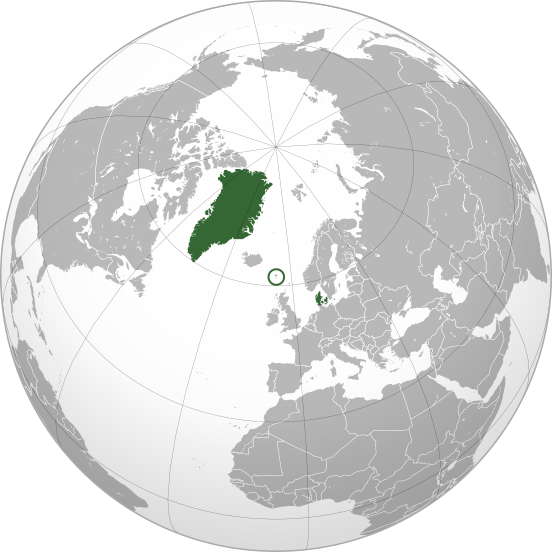
| Part of | Kingdom of Denmark (Faroe Islands · Greenland) |

| Location |
|---|
 i i
|
[ Show / Hide ]
|
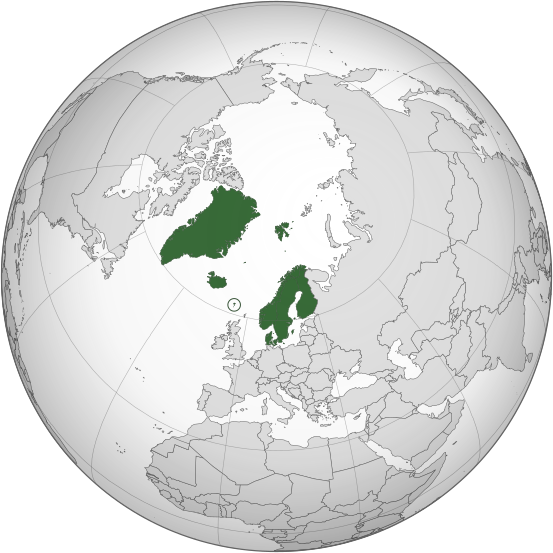

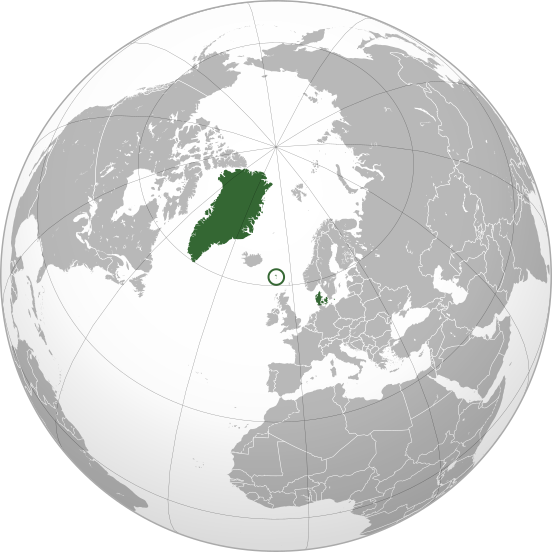
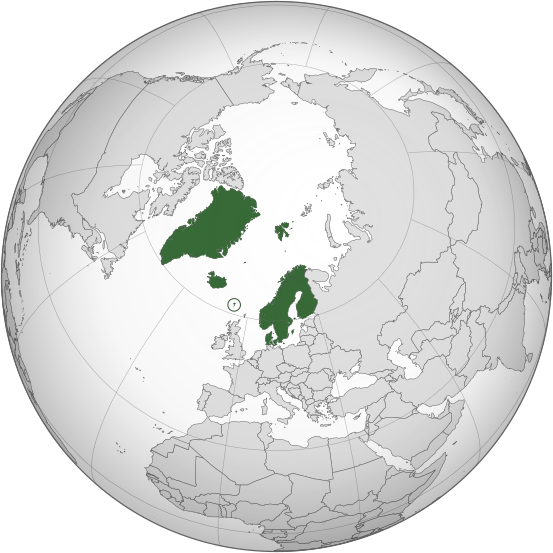
Denmark (Danish: Danmark) is a Nordic country in Northern Europe. It is the metropole and most populous part of the Kingdom of Denmark, a constitutionally unitary state that also includes two autonomous territories in the North Atlantic Ocean: the Faroe Islands and Greenland. Metropolitan Denmark — sometimes called "Denmark proper" — consists of the northern Jutland peninsula and an archipelago of 406 islands, of which 78 are inhabited. It is the southernmost of the Scandinavian countries, lying southwest of Sweden, south of Norway, and north of Germany, with which it shares a short land border. Denmark proper sits between the North Sea to the west and the Baltic Sea to the east.
Denmark's population is over 6 million, of whom roughly 40% live on Zealand, the largest island, where the capital and largest city, Copenhagen, is located. The country is mostly flat, composed largely of arable land, with sandy coasts, low elevation, and a temperate climate.
Denmark is a developed country with a high-income economy, one of the world's highest standards of living, and strong social welfare policies. It was the first country to legally recognize same-sex partnerships and is a founding member of NATO, the Nordic Council, the OECD, and the United Nations. Denmark joined the European Union in 1973 but has negotiated several opt-outs, including retaining its own currency, the Danish krone, rather than adopting the euro.
American political scientist Francis Fukuyama has used Denmark as a reference point for near-ideal governance, coining the phrase "getting to Denmark" to describe a country with stable, democratic, and well-functioning institutions.
1 Etymology✎
The name "Denmark" (Danmark) has been debated by scholars for centuries. Most etymologists trace "Dan" to a word meaning "flat land," related to the German word Tenne ("threshing floor") and the English word "den." The element "-mark" likely means woodland or borderland, probably referring to the border forests in southern Schleswig.
The earliest recorded uses of the word "Danmark" appear on the Jelling stones, two runestones erected around 955–965 AD. The larger stone, raised by Harald Bluetooth, is often called the "baptismal certificate" of Denmark. Both stones use the word in different grammatical forms of Old Norse, and refer to the inhabitants as "Danes" (tani).
2 History✎
2.1 Prehistory✎
The earliest archaeological evidence of human habitation in Denmark dates to the last interglacial period, around 130,000–110,000 BC. Permanent settlement began around 12,500 BC, and agriculture appeared by 3900 BC. The Nordic Bronze Age (roughly 1800–600 BC) left behind distinctive artifacts including lurs (curved bronze instruments) and the famous Sun Chariot of Trundholm.
During the Pre-Roman Iron Age (500 BC – AD 1), the tribal Danes migrated into the region from the east, settling on Zealand and the other islands. They spoke an early form of North Germanic. Before the Danes' arrival, Jutland was largely inhabited by the Jutes, many of whom later migrated to Great Britain and formed the southeastern territory of Kent. Roman trade routes connected Denmark to the wider European world, and Roman coins have been found across the country.
The Danevirke, a massive defensive earthwork in southern Jutland, was built in phases starting from the 3rd century. The sheer scale of the construction around 737 AD suggests the emergence of a centralized Danish kingdom. Ribe, the oldest town in Denmark, was founded around 700 AD.
2.2 Viking Age✎
From the 8th to 10th centuries, the Scandinavian population known as the Vikings raided, traded, and settled across vast distances — from Iceland and Greenland to Constantinople and beyond. Danish Vikings were particularly active in the eastern and southern British Isles and in Western Europe. Under King Sweyn Forkbeard, Danes settled across parts of England in an area known as the Danelaw. In France, Danes and Norwegians were allowed to settle what became Normandy in exchange for loyalty to the French king.
The Danish monarchy traces its roots to Gorm the Old, who established his rule in the early 10th century. His son Harald Bluetooth Christianized Denmark around 965, reportedly to prevent invasion by the Holy Roman Empire. Harald built a ring of fortresses called Trelleborg and further extended the Danevirke. In the early 11th century, Canute the Great united Denmark, England, and Norway into a North Sea empire that lasted nearly 30 years.
2.3 Medieval period✎
Throughout the High Middle Ages and Late Middle Ages, Denmark's territory also included Skåneland (the areas of Scania, Halland, and Blekinge in present-day southern Sweden), Danish Estonia, and the duchies of Schleswig and Holstein.
In 1397, Denmark, Norway, and Sweden were joined under a single crown in the Kalmar Union, led by Queen Margaret I. Although the union was intended to treat all three kingdoms equally, Denmark dominated in practice. Sweden repeatedly broke away and rejoined before permanently departing in 1523 under Gustav Vasa. The Protestant Reformation reached Scandinavia in the 1530s, and Denmark converted to Lutheranism in 1536. That same year, Denmark and Norway were formally united as Denmark-Norway.
2.4 Wars with Sweden and early modern period✎
After Sweden left the Kalmar Union, Denmark tried repeatedly to reassert control over its neighbor. King Christian IV fought the Kalmar War (1611–1613) against Sweden but failed to force it back into the union. He later intervened in the Thirty Years' War as a champion of Lutheranism but suffered a crushing defeat at the Battle of Lutter in 1626, leading to the occupation of Jutland by Catholic forces.
The wars with Sweden in the mid-17th century proved catastrophic for Denmark. The Treaty of Roskilde (1658) forced Denmark to cede Scania, Blekinge, and other territories to Sweden — losses that permanently reshaped the map of Scandinavia. When Sweden attacked again shortly after, King Frederick III rallied Copenhagen's citizens to defend the city during a two-year siege. Denmark survived, and Frederick used his newfound popularity to dissolve the elective monarchy and establish absolute monarchy, which lasted until 1848.
Denmark also built a modest colonial empire during this period. The Danish East India Company acquired the trading post of Tranquebar on India's coast, and Danish trading outposts in West Africa played a role in the Atlantic slave trade, through which roughly 1.5 million enslaved people were traded via Fort Christiansborg.
2.5 19th century: constitution and territorial losses✎
The 19th century brought dramatic change. Denmark peacefully transitioned to a constitutional monarchy on June 5, 1849, ending the absolute monarchy. The new Constitution of Denmark established a two-chamber parliament.
However, the Second Schleswig War (1864) was a devastating defeat. Denmark was forced to cede Schleswig and Holstein to Prussia, shrinking the country to roughly its modern borders. This loss led Denmark to pursue a policy of neutrality and focus inward. Industrialization arrived in the second half of the century, trade unions developed in the 1870s, and Danish agriculture shifted toward dairy and meat exports.
2.6 20th century: world wars and welfare✎
Denmark maintained neutrality during World War I. After Germany's defeat, plebiscites in 1920 returned northern Schleswig to Denmark, adding some 163,600 inhabitants.
Despite signing a non-aggression pact with Nazi Germany in 1939, Denmark was invaded on April 9, 1940. The Danish government quickly surrendered to avoid destruction, and the occupation was initially more cooperative than in other countries — partly because Germany relied on Danish agricultural output. However, when the government refused further cooperation in 1943, the Royal Danish Navy scuttled most of its ships and sent officers to neutral Sweden. The Danish resistance movement organized the remarkable rescue of more than 7,000 Jewish Danes, evacuating them to Sweden before the Nazis could deport them. Iceland declared independence from Denmark in 1944; Denmark was liberated in May 1945.
After the war, Denmark abandoned neutrality and became a founding member of NATO (1949) and the United Nations (1945). The center-left Social Democrats led a series of governments that built the modern welfare state. Denmark joined the European Economic Community (now the EU) in 1973, though voters rejected the Maastricht Treaty in 1992 before accepting it with opt-outs in 1993. Danes also rejected adopting the euro in a 2000 referendum.
In 2022, Danes voted to abolish the country's defense opt-out from the EU, driven by Russia's invasion of Ukraine. Denmark has since significantly increased defense spending, surpassing 3% of GDP by 2025.
3 Geography✎
Denmark proper occupies a total area of about 42,944 square kilometers. The country consists of the northern part of the Jutland peninsula and an archipelago of 406 islands. The largest island is Zealand, where Copenhagen is situated, followed by the North Jutlandic Island, Funen, and Lolland. Many major islands are connected by bridges: the Great Belt Fixed Link connects Zealand and Funen, the Little Belt Bridge connects Funen to Jutland, and the Øresund Bridge links Zealand to Sweden.
The landscape is mostly flat, with the highest natural point being Møllehøj at just 170.86 meters (561 feet). No location in Denmark is more than 52 kilometers from the coast. The country shares a 68-kilometer land border with Germany to the south and is otherwise surrounded by about 8,750 kilometers of coastline.
Denmark has a temperate maritime climate with mild winters (averaging about 1.5°C in January) and cool summers (averaging about 17.2°C in August). The western coast faces the North Sea and receives strong winds, while the eastern coast along the Baltic is more sheltered.
The Kingdom of Denmark also includes two overseas autonomous territories: Greenland, the world's largest island, and the Faroe Islands in the North Atlantic. Both have their own parliaments and handle most domestic affairs independently, while foreign policy, defense, and monetary policy remain with the Danish government.
4 Government and politics✎
Denmark is a constitutional monarchy with a parliamentary system. The monarch — currently King Frederik X, who ascended the throne in January 2024 — is the ceremonial head of state. Executive power is exercised by the Folketing, the unicameral parliament of 179 seats: 175 representing Denmark proper, two for the Faroe Islands, and two for Greenland.
No single party has held a majority in the Folketing in over a century, so Denmark is always governed by coalition or minority cabinets. The current prime minister is Mette Frederiksen of the Social Democrats, who has served since 2019. Her government, formed in December 2022, is an unusual cross-bloc coalition with the liberal party Venstre and the centrist Moderates.
A general election has been called for March 24, 2026, amid debate over defense spending, the economy, and diplomatic tensions surrounding US President Donald Trump's renewed interest in acquiring Greenland.
5 Economy✎
Denmark has an advanced, high-income economy with one of the highest GDP per capita figures in the world. Key industries include pharmaceuticals (led by Novo Nordisk and Lundbeck), shipping (Maersk, the world's largest container shipping company), wind energy (Vestas, Ørsted), and food production.
Denmark is a global leader in wind energy — wind turbines regularly supply more than half of the country's electricity. Despite lacking significant natural resources beyond limited North Sea oil and gas, Denmark has built a prosperous economy through high-value manufacturing, design, and innovation.
The country operates an extensive welfare state funded by some of the highest tax rates in the world. Citizens receive free healthcare, free education through university, generous parental leave, and a strong social safety net. The system follows a model known as "flexicurity" — flexible labor markets paired with robust unemployment benefits and active retraining programs.
6 Culture✎
Denmark is known for the concept of hygge — a Danish word roughly meaning coziness and contentment — which reflects broader cultural values of modesty, equality, and community. Danish design is internationally renowned for clean lines and functional elegance, with companies like LEGO, Bang & Olufsen, and Royal Copenhagen recognized worldwide.
Notable Danish figures include fairy tale author Hans Christian Andersen, philosopher Søren Kierkegaard, and physicist Niels Bohr, who made foundational contributions to quantum mechanics. Denmark's film industry has earned global acclaim through directors like Lars von Trier and Thomas Vinterberg and the Dogme 95 movement.
Denmark was the first country to legally recognize same-sex partnerships in 1989 and legalized same-sex marriage in 2012. Danish society is broadly progressive and socially liberal, though immigration policy has become an increasingly debated topic in recent decades.