Mercedes-AMG GT
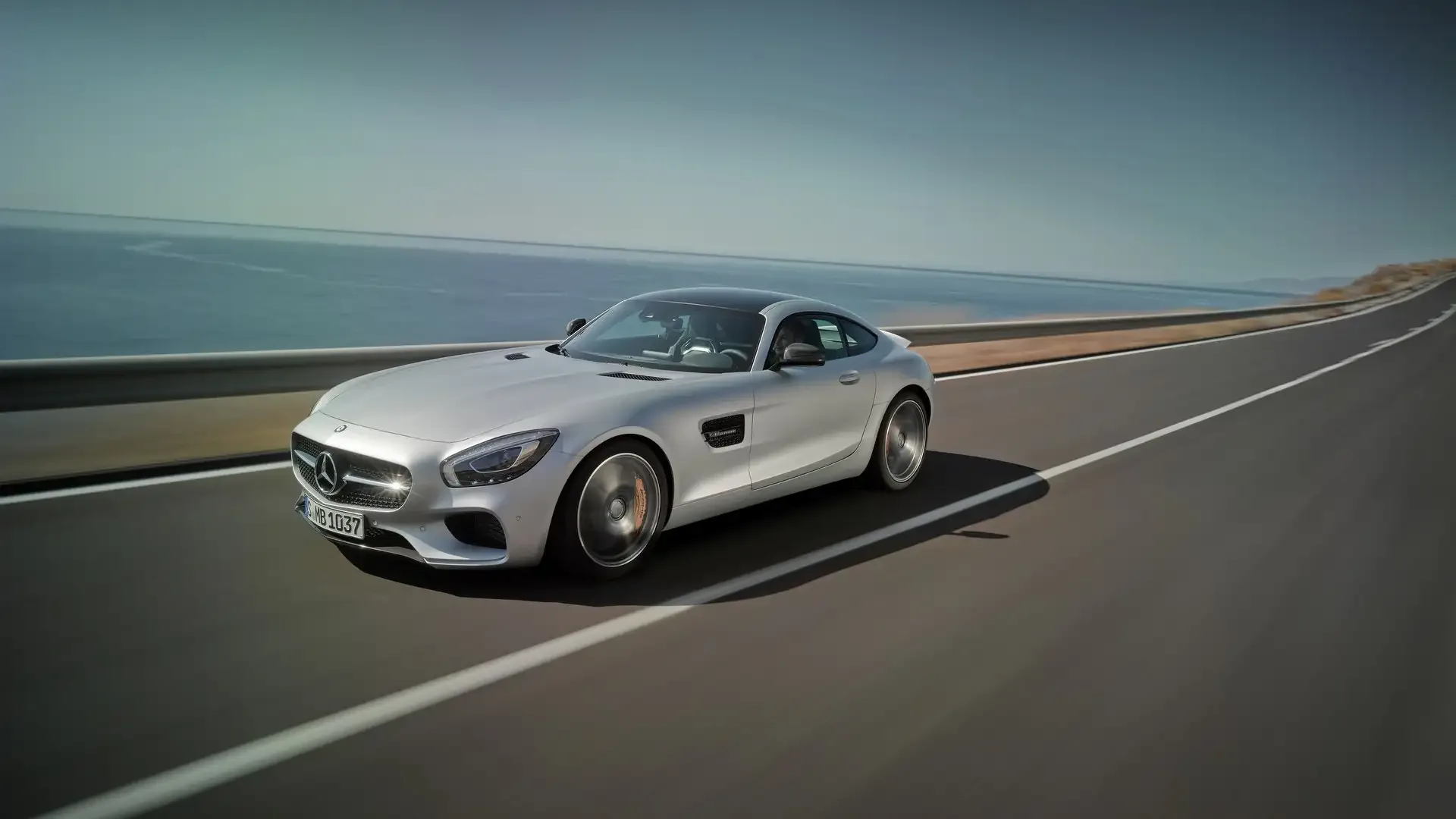
The Mercedes-AMG GT is a series of two-door sports cars made by the German car manufacturer Mercedes-AMG. First revealed on September 9, 2014, and officially shown to the public at the Paris Motor Show in October that year, it is the second sports car designed and built entirely in-house by Mercedes-AMG, following the SLS AMG. All versions of the first-generation car were assembled at the Mercedes-Benz factory in Sindelfingen, Germany.
The AMG GT went on sale in March 2015 in two versions: the base GT and the more powerful GT S. Over the following years, Mercedes-AMG expanded the lineup with several additional variants, including the GT C, the track-focused GT R, and the extreme GT Black Series. In October 2021, Mercedes-Benz announced that the R232 SL-Class would replace the roadster version of the GT. A fully redesigned second-generation coupe arrived in 2023, built on the same platform as the new SL.
1 First generation (C190 / R190, 2014–2022)✎
1.1 Design✎
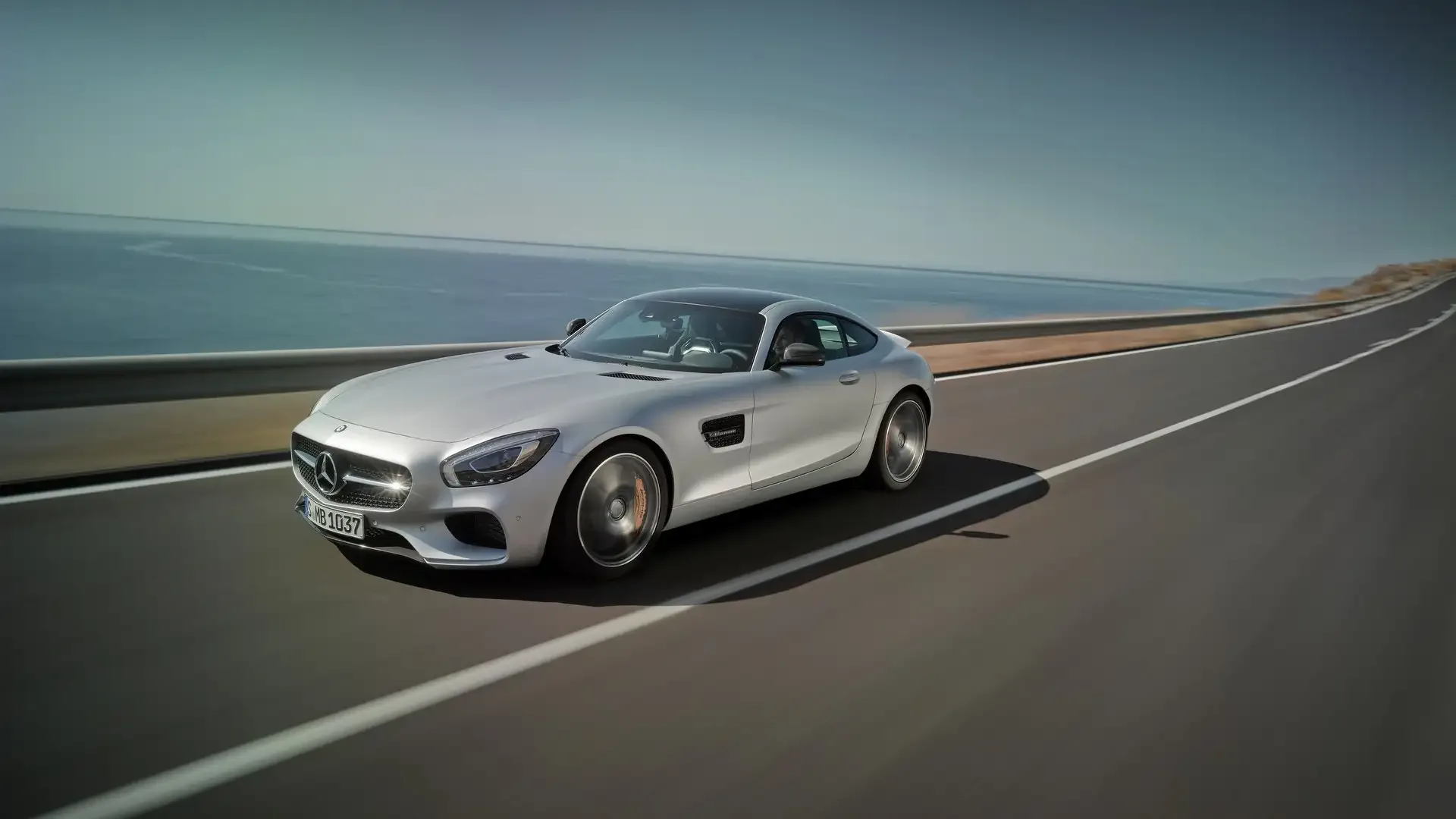
The exterior of the AMG GT drew heavily from the design of its predecessor, the SLS AMG. It kept the wide wheel arches, low bodywork, and fastback sloping roofline, but ditched the SLS's iconic gullwing doors in favor of conventional forward-opening ones. The gullwing doors had been a signature feature since the classic Mercedes-Benz 300 SL of the 1950s, but the AMG GT took a more practical approach. The car was built on an upgraded and shortened version of the Transaxle Spaceframe platform that the SLS used.
The vehicle's structure is made up of 93% aluminum, with the front module base constructed from magnesium, making the car both light and rigid. The exterior was led by designer Mark Fetherston, who had previously worked on the W176 A-Class, the CLA-Class, and the SLS AMG. The interior, designed by Jan Kaul, features a large center console and decorative elements in leather and carbon polymer. The trunk is relatively small, offering room for about one medium-sized suitcase.
1.2 Engine and drivetrain✎
The first-generation AMG GT uses a front mid-engine, rear-wheel-drive layout, meaning the engine sits behind the front axle but ahead of the driver. This placement helps balance the car's weight for better handling. The spaceframe chassis and body panels are made from aluminum alloys, while the trunk lid is steel and the hood is magnesium.
At the heart of the car is a 4.0-liter M178 twin-turbocharged V8 engine. This engine uses a clever "hot inside V" configuration, where the exhaust manifolds and turbochargers are placed between the cylinder banks rather than on the outside. This design shortens the path exhaust gases travel to reach the turbochargers, which reduces turbo lag (the brief delay before the turbo kicks in). The engine also uses dry-sump lubrication, which keeps the oil in a separate tank rather than in a pan at the bottom of the engine. This allows the engine to be mounted lower in the car, improving handling.
Power is sent to the rear wheels through a seven-speed AMG SPEEDSHIFT dual-clutch transmission mounted at the rear axle (a layout known as a transaxle), which further improves the car's front-to-rear weight balance. The suspension uses double wishbones at both the front and rear, with forged aluminum components.
In a road test by Car and Driver, the GT S accelerated from 0 to 97 km/h (60 mph) in just 3.0 seconds, completed the quarter mile in 11.2 seconds, and reached a top speed of 311 km/h (193 mph).
1.3 2017 facelift✎
In 2017, the AMG GT family received a mid-cycle refresh. The key changes included slightly more power from the M178 engine for the GT and GT S models (gains of about 10 kW and 9 kW respectively), and the adoption of the "Panamericana" front grille — featuring vertical chrome slats inspired by the classic 300 SL race car — as standard equipment across all variants. This grille had originally been exclusive to the GT R and the GT3 race car. The facelift also introduced the GT C variant and the limited-edition Edition 50 model.
1.4 Variants✎
1.4.1 AMG GT✎
The base GT is the entry-level model of the family. Its M178 engine produces 340 kW (462 PS / 456 hp) and 601 N·m (443 lb·ft) of torque. Compared to the more expensive models, the GT uses a mechanical (rather than electronic) limited-slip differential, lacks the "Race Mode" and "Race Start" settings in the AMG Dynamic Select system, and comes without the adaptive AMG Ride Control suspension. It uses 19-inch wheels at both front and rear.
1.4.2 AMG GT S✎
The GT S is the next step up. Its engine is tuned to 375 kW (510 PS / 503 hp) and 651 N·m (480 lb·ft) of torque. It adds an electronically controlled limited-slip differential, "Race Mode" and "Race Start" settings, the AMG Ride Control adaptive suspension, an AMG Performance Exhaust System with dynamic flaps, and a lithium-ion battery. It also gets staggered wheels — 19-inch at the front and 20-inch at the rear.
At launch, Mercedes-AMG also offered a limited "Edition 1" version of the GT S, with 375 examples sold worldwide. It featured a gloss black aerodynamic package, a carbon fiber roof, a fixed rear wing, red interior accents, and red brake calipers.
1.4.3 AMG GT C✎
The GT C sits between the GT S and the GT R in the lineup. Its engine produces 410 kW (557 PS / 550 hp) and 681 N·m (502 lb·ft) of torque. Beyond the GT S's features, the GT C adds a wider body measuring 2,007 mm (79 inches) across and active rear-axle steering, which makes the car more agile in corners and more stable at high speeds.
A limited "Edition 50" model was released alongside the GT C at the 2017 Detroit Auto Show to celebrate AMG's 50th anniversary. It came in special matte paint colors and featured unique interior trim with "Edition 50" and "1 of 500" lettering. Globally, only 500 units were made.
1.4.4 AMG GT R✎
The GT R is the high-performance variant, introduced at the Goodwood Festival of Speed on June 24, 2016. Its M178 engine produces 430 kW (585 PS / 577 hp) at 6,250 rpm and 700 N·m (516 lb·ft) of torque at 5,500 rpm. It accelerates from 0 to 100 km/h (62 mph) in 3.6 seconds and has a top speed of 319 km/h (198 mph).
On top of the GT C's wider body and rear steering, the GT R adds manually adjustable coilover springs, an active underbody fairing that manages airflow beneath the car, a manually adjustable rear wing, and a sophisticated 9-mode AMG Traction Control system that lets drivers fine-tune how much wheel spin the car allows — useful for track driving.
The GT R stood out visually with vertical slats in the front grille (inspired by the 300 SL that won the 1952 Carrera Panamericana race), along with new front air intakes and front and rear diffusers. Its styling closely resembled the AMG GT3 race car.
At the Nürburgring Nordschleife, the GT R recorded a lap time of 7 minutes and 10.92 seconds in a test by German magazine Sport Auto, making it the fastest rear-wheel-drive production car around the track at the time.
A roadster version of the GT R was introduced in March 2019, limited to just 750 units.
1.4.5 AMG GT R Pro✎
The GT R Pro, revealed at the 2018 Los Angeles Auto Show, is an even more track-focused version of the GT R. Limited to 750 units worldwide at a starting price of about $200,645, it shares the GT R's 430 kW engine and performance figures but adds numerous upgrades for track use.
These include a new manually adjustable coilover suspension, lightweight anti-roll bars, electronically controlled dynamic engine and transmission mounts, carbon-fiber bucket seats, and lightweight forged wheels (19-inch front, 20-inch rear). The carbon-fiber roof and carbon-ceramic brakes — options on the GT R — come as standard on the Pro. Aerodynamic improvements include a carbon-fiber front splitter with canards, GT3-inspired fender vents, an updated rear diffuser with canards, new side skirts, and a rear wing with a gurney flap for extra downforce.
At the Nürburgring Nordschleife in November 2018, the GT R Pro set a lap time of 7 minutes and 4.632 seconds with driver Maro Engel behind the wheel.
1.4.6 AMG GT Black Series✎
The Black Series is the ultimate first-generation AMG GT, officially revealed on July 9, 2020. Its M178 engine — referred to as the M178 LS2 — is tuned to produce 537 kW (730 PS / 720 hp) at 6,700–6,900 rpm and 800 N·m (590 lb·ft) of torque between 2,000 and 6,000 rpm. It accelerates from 0 to 100 km/h in 3.2 seconds (tested at 3.0 seconds) and has a top speed of 325 km/h (202 mph).
What makes the Black Series engine special is its use of a flat-plane crankshaft instead of the cross-plane crankshaft found in other AMG GT models. This changes the engine's firing order and gives it a different, more exotic sound. The engine also has a higher redline of 7,200 rpm (versus 7,000 rpm on the GT R) and higher turbo boost pressure of 170 kPa (24.6 psi) compared to the GT R's 135 kPa (19.6 psi).
Carbon fiber is used extensively throughout the body, including the hood, roof, hatch, and underbody. The exterior features an enlarged grille inspired by the GT3 race car, large air outlets on the hood, a manually adjustable front splitter, and an upgraded rear wing with an active aero flap. The wing and overall aerodynamic package generate more than 400 kg (882 lb) of downforce at 249 km/h (155 mph). The car rides on car-specific Michelin Pilot Cup 2 R tires, available in soft and hard compounds.
On November 4, 2020, the GT Black Series recorded a lap time of 6 minutes and 43.616 seconds at the Nürburgring Nordschleife with driver Maro Engel, making it the fastest road-legal production car around the track at the time.
1.4.7 AMG GT Track Series✎
In 2022, Mercedes-AMG launched the GT Track Series, a track-only car based on the Black Series. Created to celebrate AMG's 55th anniversary, only 55 units were built. It is not road legal and was designed exclusively for track day enthusiasts.
1.5 Roadster variants✎
The GT Roadster and GT C Roadster are open-top versions of their coupe counterparts. Announced shortly after the GT R's introduction, both made their debut at the 2016 Paris Motor Show.
Both roadsters use the active air management system from the GT R for improved cooling and airflow. The GT C Roadster keeps the wider body of the GT C coupe. They feature a three-layer fabric roof built around an aluminum, magnesium, and steel structure, available in black, red, or beige. The roof can open and close in just 11 seconds at speeds up to 50 km/h (31 mph).
In October 2021, Mercedes-Benz announced that the new R232 SL-Class would serve as the direct successor to the GT Roadster.
1.6 Formula 1 safety car✎
The AMG GT has a notable history as the official Formula 1 safety car. The GT S served in this role for the 2015, 2016, and 2017 F1 seasons, debuting at the 2015 Australian Grand Prix. The GT R took over as the safety car from 2018 through 2021. During the 2020 Tuscan Grand Prix, the safety car wore a special red livery instead of its traditional silver to celebrate Scuderia Ferrari's 1,000th Grand Prix start. For the 2021 season, the GT R safety car permanently switched to a red livery to improve visibility in poor conditions. Starting in 2022, the GT Black Series replaced the GT R as the official F1 safety car.
2 Second generation (C192, 2023–present)✎
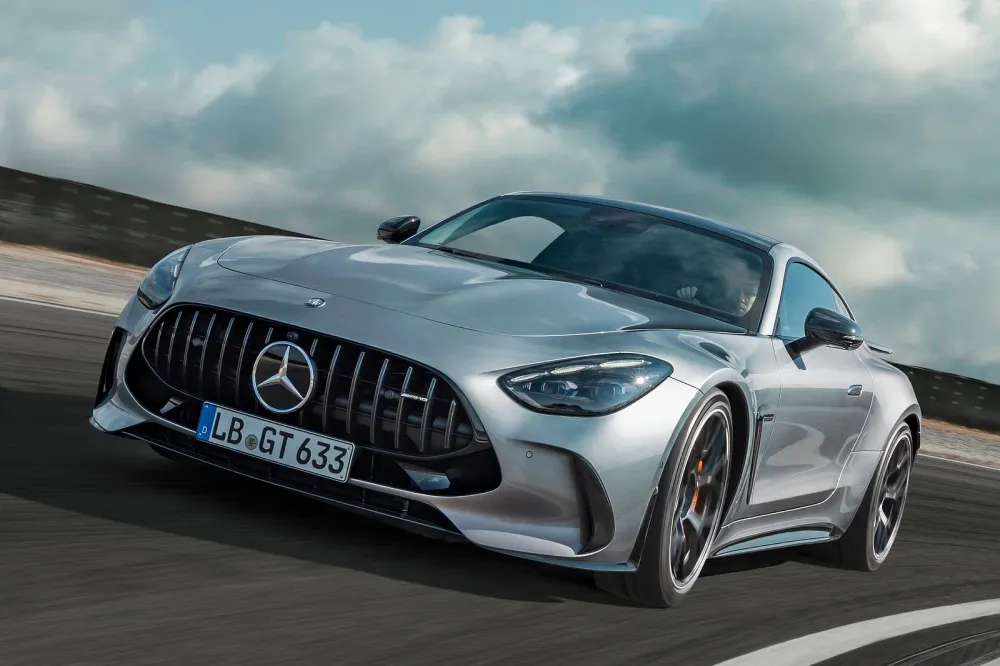
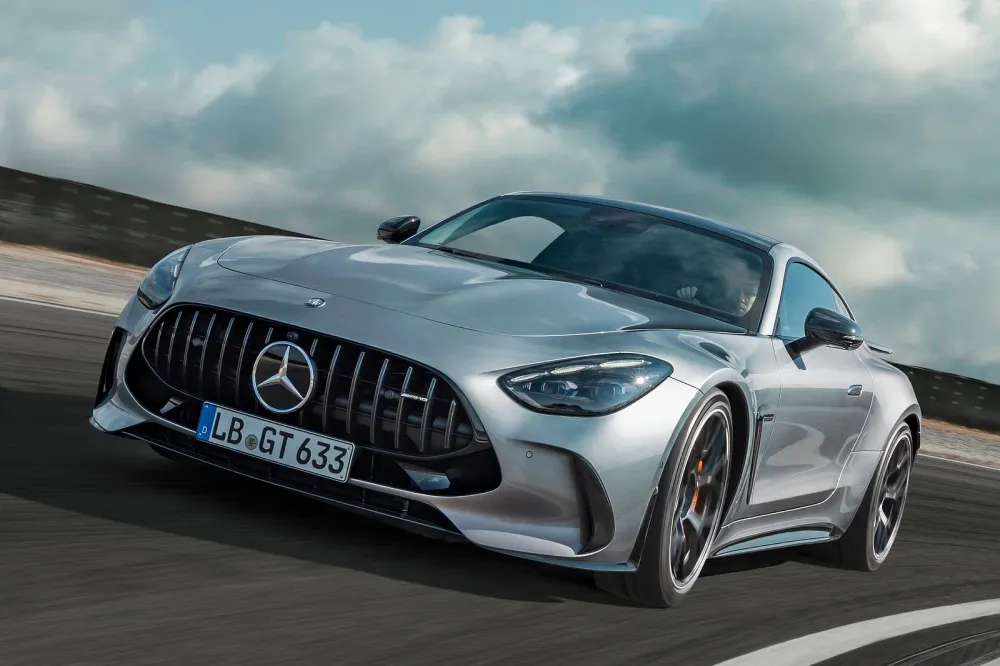
The second-generation AMG GT was unveiled at the Pebble Beach Concours d'Elegance on August 19, 2023, roughly eleven months after the first generation ended production. This new version is built on the same platform as the redesigned R232 SL-Class roadster, but it is offered only as a coupe (hardtop). The new car is longer than its predecessor, which allows for a 2+2 seating layout — meaning it has small rear seats in addition to the two main front seats.
2.1 Powertrain options✎
At launch, the second-generation GT was available with two versions of a 4.0-liter twin-turbo V8 engine, both paired with all-wheel drive and a 9-speed automatic transmission:
The GT 55 produces 350 kW (469 hp), while the GT 63 delivers a more powerful 430 kW (577 hp).
In 2024, two additional powertrains were added. The GT 43 is the entry-level model with a 2.0-liter turbocharged four-cylinder engine paired with a mild-hybrid system and rear-wheel drive. The GT 63 S E Performance is the flagship model — a plug-in hybrid that combines the 4.0-liter twin-turbo V8 with a rear-mounted electric motor. The V8 alone produces 470 kW (639 PS / 630 hp), and the electric motor can add up to 150 kW (201 hp) for short bursts. The combined output reaches 620 kW (843 PS / 831 hp) and 1,400 N·m (1,033 lb·ft) of torque, making it the most powerful AMG GT ever built. It can sprint from 0 to 97 km/h (60 mph) in under 3 seconds.
2.2 Special editions✎
In June 2025, Mercedes-Benz unveiled the limited GT 63 APXGP Edition, inspired by the fictional APXGP race cars from the movie F1. It features a satin black paint finish with gold graphics, a gold checkerboard pattern on the doors, and gold wheels. Production is limited to just 52 units for 2026.
3 Motorsport✎
3.1 GT3✎
In March 2015, Mercedes-AMG presented the AMG GT3 race car at the Geneva Motor Show. Unlike the road car's 4.0-liter twin-turbo V8, the GT3 uses the older 6.2-liter M159 naturally aspirated V8 engine (the same engine used in the SLS AMG GT3), chosen for its proven reliability and user-friendliness in racing conditions. The car's body is made largely of carbon-fiber-reinforced polymer to bring its weight under 1,300 kg (2,866 lb), as required by FIA regulations.
The GT3 quickly became a dominant force in GT racing worldwide. At the 2016 24 Hours of Nürburgring, Mercedes-AMG GT3 cars finished in the top six positions (1st through 4th, and 6th). The car competed in major series around the world, including the Blancpain Endurance Series, ADAC GT Masters, Super GT (Japan), Australian GT Championship, and the IMSA SportsCar Championship. By June 2019, a total of 130 GT3 cars had been sold to customer teams.
An updated version of the GT3 was introduced in 2019 for the 2020 racing season, featuring new headlamps, an updated grille, improved brake and traction control systems, and an automatic data logger. The GT3's entry in the FIA World Endurance Championship's LM GT3 class starting in 2025 marks Mercedes' return to the 24 Hours of Le Mans since the dramatic 1999 race, where the Mercedes-Benz CLR famously flipped during the event.
3.2 GT4✎
The AMG GT4 customer racing car was presented at the 2017 24 Hours of Spa. Based on the road-going GT R, it is aimed at semi-professional drivers competing in the SRO GT4 class. The car made its racing debut in the fifth round of the 2017 VLN season at the Nürburgring, and received significant upgrades for the 2022 season.
3.3 GT2✎
The AMG GT2 was unveiled in December 2022 for competition in the SRO GT2 category. Powered by a 707 hp version of the 4.0-liter twin-turbo V8, it is the most powerful customer racing car Mercedes-AMG had built at the time. The GT2 made its racing debut during the first round of the 2023 GT2 European Series at Monza and won its first race during the second round at the Red Bull Ring.
A non-competitive track-day version called the GT2 Pro was also introduced, featuring an even more powerful 739 hp engine.
4 Specifications overview✎
| Model | Engine | Power | Torque | 0–100 km/h | Top speed |
|---|---|---|---|---|---|
| First generation (C190 / R190) | |||||
| GT | 4.0 L M178 twin-turbo V8 | 340 kW (462 PS) | 601 N·m (443 lb·ft) | 4.0 s | 304 km/h (189 mph) |
| GT S | 4.0 L M178 twin-turbo V8 | 375 kW (510 PS) | 651 N·m (480 lb·ft) | 3.8 s | 310 km/h (193 mph) |
| GT C | 4.0 L M178 twin-turbo V8 | 410 kW (557 PS) | 681 N·m (502 lb·ft) | 3.7 s | 317 km/h (197 mph) |
| GT R | 4.0 L M178 twin-turbo V8 | 430 kW (585 PS) | 700 N·m (516 lb·ft) | 3.6 s | 319 km/h (198 mph) |
| GT R Pro | 4.0 L M178 twin-turbo V8 | 430 kW (585 PS) | 700 N·m (516 lb·ft) | 3.6 s | 319 km/h (198 mph) |
| GT Black Series | 4.0 L M178 LS2 twin-turbo V8 | 537 kW (730 PS) | 800 N·m (590 lb·ft) | 3.2 s | 325 km/h (202 mph) |
| Second generation (C192) | |||||
| GT 43 | 2.0 L M139 turbo I4 (mild hybrid) | 280 kW (381 PS) | 480 N·m (354 lb·ft) | 4.6 s | 275 km/h (171 mph) |
| GT 55 | 4.0 L M177 twin-turbo V8 | 350 kW (476 PS) | 700 N·m (516 lb·ft) | 3.9 s | 295 km/h (183 mph) |
| GT 63 | 4.0 L M177 twin-turbo V8 | 430 kW (585 PS) | 800 N·m (590 lb·ft) | 3.2 s | 315 km/h (196 mph) |
| GT 63 S E Performance | 4.0 L M177 twin-turbo V8 + electric motor | 620 kW (843 PS) | 1,400 N·m (1,033 lb·ft) | 2.8 s | 317 km/h (197 mph) |
WikiGlide