Copenhagen
[ Show / Hide ]
|
|
Copenhagen
København
| |||||
| |||||
| Country | Denmark | ||||
|---|---|---|---|---|---|
| Region | Capital Region | ||||
| Founded | 11th century (traditionally 1167) | ||||
| Lord Mayor | Sisse Marie Welling | ||||
| Municipality pop. | ~667,000 (2025) | ||||
| Urban area pop. | ~1.4 million (2025) | ||||
| Metro area pop. | ~2 million | ||||
| Time zone | CET (UTC+1) | ||||
| Airport | Kastrup (CPH) | ||||


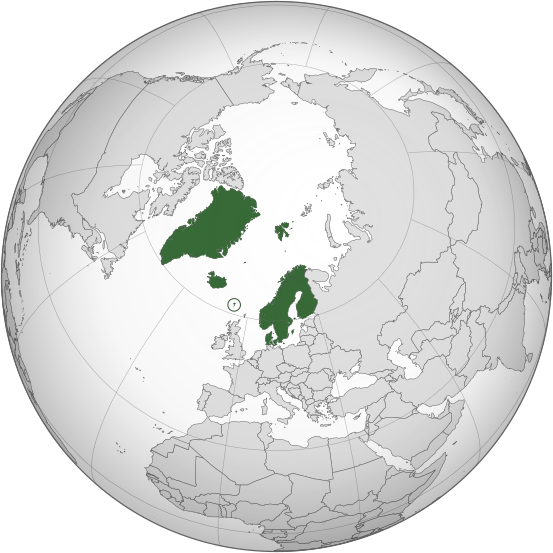


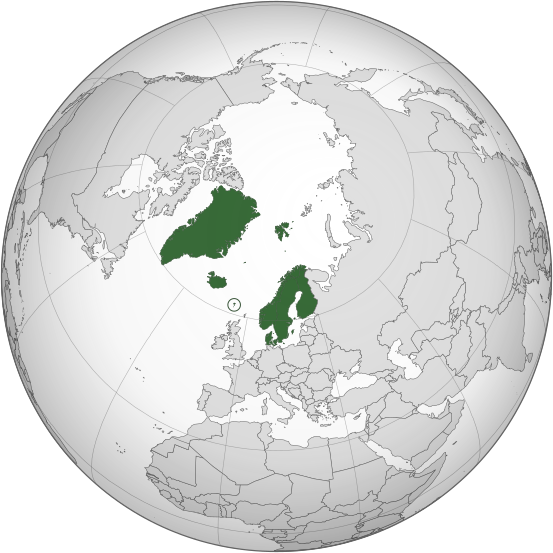
Copenhagen (Danish: København kʰøpm̩ˈhɑwˀn) is the capital and most populous city of Denmark and the Kingdom of Denmark. The city has a population of about 667,000 within the municipality, roughly 1.4 million in the urban area, and about 2 million in the wider metropolitan area. Copenhagen is situated mainly on the eastern coast of the island of Zealand, with a smaller part on the island of Amager. It faces the Øresund strait to the east, and since 2000 has been connected to Malmö, Sweden, by the Øresund Bridge, forming a cross-border metropolitan area known as the Øresund Region with a combined population of about 3.8 million.
Originally a Viking fishing village established in the 10th century, Copenhagen became the capital of Denmark in the early 15th century. It served as the seat of the Kalmar Union monarchy in the 16th century and flourished as the cultural and economic center of Scandinavia during the Renaissance. The city suffered devastating setbacks in the 18th century — including a plague that killed a third of its population and two major fires — but recovered through ambitious rebuilding and the construction of grand districts like Frederiksstaden.
Today Copenhagen is Denmark's cultural, economic, and governmental center, and one of the major financial hubs of Northern Europe. It is known internationally for its landmarks — including Tivoli Gardens, the Little Mermaid statue, Amalienborg and Christiansborg palaces, and the Round Tower — as well as its bicycle-friendly streets, innovative urban planning, and thriving food scene. Copenhagen Airport at Kastrup is the busiest airport in the Nordic countries, serving roughly 30 million passengers a year.
1 Etymology✎
The name København reflects the city's origins as a trading port. The original Old Norse name was Kaupmannahǫfn, meaning "merchants' harbor" — a compound of kaupmaðr ("merchant," related to English "chapman") and hǫfn ("harbor," related to English "haven"). The name evolved through Old Danish as Køpmannæhafn before gradually shifting to its modern form through centuries of sound change. The English name "Copenhagen" was adapted from the Low German form Kopenhagen.
The city's Latin name, Hafnia, gave its name to the chemical element hafnium, which was discovered at the University of Copenhagen in 1923.
2 History✎
2.1 Origins and medieval city✎
Archaeological evidence suggests human settlement in the Copenhagen area since the Stone Age, with substantial finds of flint tools. The town's origins as a city date to at least the 11th century, when its natural harbor and rich herring stocks attracted fishermen and merchants. The earliest habitations were likely centered on Gammel Strand ("Old Shore"). Recent archaeological discoveries near Kongens Nytorv uncovered the remains of a large merchant's mansion from around 1020, and the remains of an 11th-century church were found near where Strøget meets Rådhuspladsen.
The earliest written mention appears in Saxo Grammaticus's Gesta Danorum, which referred to the town as Portus Mercatorum ("Merchants' Harbor"). Traditionally, Copenhagen's founding is dated to 1167, when Bishop Absalon built a fortress on the small island of Slotsholmen — where Christiansborg Palace stands today — to defend against Wendish pirate raids. The city received its charter in 1254.
As the Kalmar Union brought Denmark, Norway, and Sweden under one crown, Copenhagen emerged as the capital of Denmark around 1416, when Eric of Pomerania moved his seat to Copenhagen Castle. The University of Copenhagen was founded in 1479, making it the oldest university in Denmark and one of the oldest in Europe.
2.2 Renaissance and Christian IV✎
Copenhagen experienced dramatic growth under King Christian IV (r. 1588–1648). He founded the district of Christianshavn with its distinctive canals, modeled on Dutch city planning. Christian IV also built iconic landmarks including Rosenborg Castle, the Round Tower, the Børsen (stock exchange), and the Arsenal. He founded the Danish East India Company in 1616 to promote international trade. In 1658–1659, Copenhagen successfully withstood a siege by Swedish forces under Charles X, with King Frederick III personally leading the city's defense.
2.3 Plague, fire, and reconstruction✎
The 18th century brought severe challenges. In 1711, a devastating plague killed approximately 22,000 of the city's 65,000 inhabitants — roughly one-third of the population. The Copenhagen Fire of 1728 destroyed about 28% of the city and left 20% of the population homeless. A second major fire in 1795 caused further destruction. Together, these fires are the main reason so few traces of medieval Copenhagen survive in the modern city.
Rebuilding efforts transformed the cityscape. The royal residence of Christiansborg Palace was completed in 1745. The prestigious Frederiksstaden district, designed by Nicolai Eigtved in the Rococo style, was developed from 1749, centered on the mansions that now form Amalienborg Palace. The Royal Danish Theatre and Royal Danish Academy of Fine Arts were established during this period.
Copenhagen also served as the center of the Danish slave trade during the 18th century. Merchants based in the city, affiliated with the Danish West India Company, transported approximately 120,000 enslaved Africans to the Danish West Indies between 1660 and 1806. Several prominent Copenhagen buildings were funded with profits from this trade.
2.4 Napoleonic Wars and the Danish Golden Age✎
During the Napoleonic Wars, Copenhagen was attacked twice by the British Navy. In 1801, a fleet under Admiral Horatio Nelson defeated the Danish-Norwegian navy in the Battle of Copenhagen — the engagement during which Nelson famously "put the telescope to the blind eye" to ignore his superior's signal to withdraw. In 1807, a second British attack bombarded the city for three days, killing nearly 200 civilians, destroying about 1,000 buildings including the Church of Our Lady, and capturing virtually the entire Danish fleet.
Despite this devastation, Copenhagen soon entered a period of cultural flourishing known as the Danish Golden Age. Painters like C.W. Eckersberg and architects including C.F. Hansen and Gottlieb Bindesbøll brought a Neoclassical style to the city's rebuilt landscape.
2.5 Industrialization and expansion✎
In the 1850s, the old city ramparts were opened, allowing Copenhagen to expand beyond its medieval boundaries for the first time. The districts of Nørrebro and Vesterbro grew rapidly as workers arrived from the provinces to join the city's industrializing economy. Electricity arrived in 1892, followed by electric trams in 1897. Copenhagen's population surged from about 120,000 in 1840 to 400,000 by 1901.
2.6 World War II✎
Copenhagen was occupied by German forces from April 9, 1940, to May 4, 1945. Initially, Germany treated Denmark as a "model protectorate," and the 1943 parliamentary elections were allowed to proceed. But when cooperation collapsed in August 1943, the Royal Danish Navy scuttled ships in Copenhagen Harbor to prevent German use, and the Danish resistance evacuated most of the city's Jewish population to Sweden.
In March 1945, the Royal Air Force carried out Operation Carthage, a precision attack on the Gestapo headquarters in the Shell Building. The raid destroyed the Gestapo archives and allowed 18 of 26 political prisoners to escape, but a tragic accident caused bombs to hit the nearby Frederiksberg Girls School, killing 87 schoolchildren and 36 other civilians. Copenhagen was liberated on May 8, 1945, by British troops under Field Marshal Bernard Montgomery.
2.7 Postwar development✎
After the war, the innovative Finger Plan (1947) shaped Copenhagen's growth by directing housing and business development along five corridors radiating from the city center along S-train railway lines, with green areas between the "fingers."
Major developments in the late 20th and early 21st centuries reshaped the city. The Øresund Bridge (opened 2000) connected Copenhagen to Malmö, creating a transnational metropolitan region. The Copenhagen Metro opened in 2002. The Copenhagen Opera House, funded by shipping magnate Mærsk Mc-Kinney Møller, was completed in 2004. The national library's Black Diamond extension opened in 1999 on the waterfront. Copenhagen hosted the global climate summit COP15 in 2009.
The countercultural community of Freetown Christiania, established in 1971 on a former military barracks in Christianshavn, remains one of Copenhagen's most distinctive and controversial neighborhoods.
3 Geography and climate✎
Copenhagen is located on the eastern shore of Zealand and partly on the island of Amager, facing the Øresund strait. The city center occupies relatively low-lying flat ground formed by glacial moraines, while areas to the north and west rise to around 50 meters above sea level. The city is 42 km from Malmö by road across the Øresund Bridge, 164 km from Odense, and 188 km from Aarhus.
Copenhagen has an oceanic climate (Köppen: Cfb) with cool-to-cold winters and mild summers. July is the warmest month, with average highs around 21°C (70°F), while January averages around freezing. Because of the city's northern latitude (55°N), daylight varies dramatically — from about 17.5 hours at the summer solstice to just 7 hours at the winter solstice.
The city's beaches include Amager Strandpark, a 2 km artificial island beach just minutes from the center, and Bellevue Beach in Klampenborg, about 10 km north. The Copenhagen Harbour Baths provide public swimming areas along the waterfront — a testament to the cleanup of the city's harbor water, which was too polluted for swimming until the 1990s.
4 Landmarks✎
Copenhagen's most recognizable landmarks include Tivoli Gardens, one of the world's oldest amusement parks (opened 1843); the Little Mermaid statue (1913), inspired by Hans Christian Andersen's fairy tale; Amalienborg Palace, the royal residence; Christiansborg Palace, home to the Danish parliament, Supreme Court, and Prime Minister's Office; Rosenborg Castle, which houses the Danish crown jewels; the Round Tower (1642); and Frederik's Church, known for its massive copper dome.
Strøget, one of Europe's longest pedestrian shopping streets, runs through the heart of the old city. The colorful waterfront of Nyhavn, originally a busy commercial port, is now lined with restaurants and historic ships.
5 Transport✎
Copenhagen is one of the most bicycle-friendly cities in the world, with an extensive network of dedicated cycle tracks. About 62% of Copenhagen residents commute by bicycle.
Public transit includes the Copenhagen Metro (opened 2002, with the Cityringen circle line added in 2019), the Copenhagen S-train suburban rail network, and an extensive bus system operated by Movia. Copenhagen Airport at Kastrup, about 8 km from the city center, is the busiest airport in the Nordic countries.
The Øresund Bridge carries both rail and road traffic to Malmö and is a key link in the Copenhagen–Malmö commuter network.
6 Education✎
Copenhagen is home to several major universities, including the University of Copenhagen (founded 1479, the oldest in Denmark and one of the oldest in Europe, with about 35,000 students), the Technical University of Denmark, Copenhagen Business School, and the IT University of Copenhagen.