Norway
[ Show/Hide ]
|
|
Norway
Kongeriket Norge / Kongeriket Noreg
| |||||
| |||||
| Capital | Oslo | ||||
|---|---|---|---|---|---|
| Official languages | Norwegian (Bokmål, Nynorsk) | ||||
| Government | Unitary parliamentary constitutional monarchy | ||||
| Monarch | Harald V | ||||
| Prime Minister | Jonas Gahr Støre | ||||
| Legislature | Storting | ||||
| Area | 385,207 km² | ||||
| Population | ~5.6 million (2025) | ||||
| Currency | Norwegian krone (NOK) | ||||
| Time zone | CET (UTC+1) | ||||
| Drives on | Right | ||||
| Calling code | +47 | ||||
| Territories | Svalbard · Jan Mayen Bouvet Island (dependency) | ||||

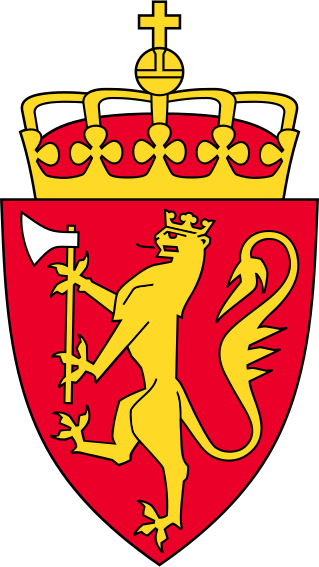

Norway, officially the Kingdom of Norway (Norwegian: Kongeriket Norge in Bokmål, Kongeriket Noreg in Nynorsk), is a Nordic country on the Scandinavian Peninsula in Northern Europe. It shares a long eastern border with Sweden, and is bordered by Finland and Russia to the northeast. Norway's extensive coastline faces the Skagerrak strait, the North Atlantic Ocean, and the Barents Sea. The remote Arctic island of Jan Mayen and the Svalbard archipelago also form part of the kingdom, while Bouvet Island in the Subantarctic is a Norwegian dependency.
Norway has a population of about 5.6 million. Its capital and largest city is Oslo. The country covers a total area of 385,207 square kilometers, much of it mountainous and indented by deep fjords along the western coast. Norway has two official written forms of Norwegian — Bokmål and Nynorsk — both of which are mutually intelligible with Danish and Swedish.
Norway maintains the Nordic welfare model with universal healthcare, comprehensive social security, and values rooted in egalitarian ideals. The country's economy is heavily shaped by its vast reserves of petroleum and natural gas. On a per-capita basis, Norway is the world's largest oil and gas producer outside the Middle East. Its Government Pension Fund Global — commonly called the "oil fund" — is the world's largest sovereign wealth fund, valued at roughly $1.3 trillion. Norway has one of the highest GDP per capita figures in the world.
Norway is a founding member of NATO, the United Nations, the Nordic Council, and the European Free Trade Association. It is not a member of the European Union, having rejected membership in referendums in 1972 and 1994, but participates in the EU's single market through the European Economic Area and is part of the Schengen Area.
1 Etymology✎
The English name "Norway" derives from the Old English word Norþweg, meaning "northern way" or "way leading to the north." This term was used by the Anglo-Saxons around 890 to describe the Atlantic coastline of Scandinavia, based on the account of Ohthere of Hålogaland, a Norwegian chieftain who visited the English court of King Alfred the Great. In Norwegian, the country's two official names are Norge (Bokmål) and Noreg (Nynorsk), both derived from the Old Norse Norðrvegr — "the northern route," referring to the coastal sailing route.
2 History✎
2.1 Prehistory✎
The earliest traces of human habitation in Norway date to 11,000–8,000 BC, when the ice sheets of the last glacial period retreated and coastal settlements appeared. The oldest stone tools, from roughly 9,500–6,000 BC, have been found in Finnmark in the north (Komsa culture) and Rogaland in the southwest (Fosna culture). Between 3,000 and 2,500 BC, Indo-European farmers of the Corded Ware culture arrived in eastern Norway, introducing grain agriculture and livestock.
The Bronze Age (from roughly 1,500 BC) brought burial cairns, stone ships, and rock carvings depicting ships resembling the Hjortspring boat. During the Iron Age, contact with Roman-occupied Gaul introduced metalworking and the runic alphabet — the oldest known Norwegian runic inscription dates to the 3rd century AD.
2.2 Viking Age✎
By the 8th century, Norway consisted of at least 20 petty kingdoms. The Viking Age (roughly 793–1066) saw Norwegian Vikings explore, trade, and settle across vast distances. They discovered Iceland in the 9th century, established settlements in the Faroe Islands and Greenland, and reached Vinland (present-day Newfoundland, Canada) — the first known European contact with North America.
According to tradition, Harald Fairhair unified the Norwegian petty kingdoms into a single realm after the Battle of Hafrsfjord near Stavanger in 872, becoming the first king of a united Norway. His authoritarian rule reportedly drove many Norwegians to emigrate to Iceland, the Faroe Islands, and the British Isles. Christianity was introduced gradually in the late 10th and early 11th centuries by the missionary kings Olaf Tryggvason and Olaf Haraldsson (St. Olaf).
2.3 Medieval period✎
The 11th to 13th centuries were a period of growth, with Norway's population rising from 150,000 to about 400,000. The Archdiocese of Nidaros was established in 1152, and the civil war era (1130–1217) ended when Haakon IV introduced clear succession laws. The 14th century is often described as Norway's golden age, with increased trade — particularly with the British Isles — and the establishment of Norway as a sovereign state with centralized administration.
However, the Black Death struck Norway in 1349, killing between 50% and 60% of the population. The economic and social devastation was even more severe than in other parts of Europe because of Norway's small, scattered population. The Hanseatic League took control of Norwegian trade, establishing a powerful trading center in Bergen.
In 1380, Norway entered a personal union with Denmark when Olaf Haakonsson inherited both thrones. In 1397, the three Scandinavian kingdoms were joined in the Kalmar Union under Queen Margaret I, though Denmark dominated in practice. Norway's political and cultural life increasingly shifted to Copenhagen.
2.4 Denmark-Norway and the "400-Year Night"✎
After Sweden left the Kalmar Union in 1523, Norway remained tied to Denmark. The introduction of Protestantism in 1536 dissolved the archbishopric in Trondheim, and Norway effectively became a subordinate part of Denmark-Norway. This period — sometimes called the "400-Year Night" — lasted until 1814, with all major administrative and intellectual activity centered in Copenhagen.
Norway lost territory to Sweden during the 17th century wars, including the provinces of Bohuslän, Jämtland, and Härjedalen. However, it gained Troms and Finnmark in the north. Famines struck repeatedly: the famine of 1695–1696 killed roughly 10% of Norway's population.
2.5 Independence and union with Sweden✎
After Denmark-Norway allied with Napoleon and lost the Napoleonic Wars, the 1814 Treaty of Kiel forced Denmark to cede Norway to Sweden. Norway seized the opportunity to declare independence, adopted a constitution modeled on American and French principles on May 17, 1814 — a date still celebrated as Syttende Mai (Seventeenth of May), Norway's national day. However, a brief war with Sweden led to the Convention of Moss, and Norway was forced into a personal union with Sweden, keeping its liberal constitution and parliament (the Storting) while sharing a monarch and foreign policy.
The 19th century saw a rise in Norwegian romantic nationalism, expressed through literature (Henrik Ibsen, Bjørnstjerne Bjørnson), music (Edvard Grieg), and the development of Nynorsk as a distinct written form of Norwegian. Women gained the right to inherit property in 1854, and universal suffrage was achieved for men in 1898 and women in 1913.
On June 7, 1905, Norway peacefully dissolved the union with Sweden. A national referendum confirmed the preference for monarchy, and Prince Carl of Denmark was elected king, taking the name Haakon VII.
2.6 World wars✎
Norway remained neutral during World War I, though it lost 1,150 sailors and 436 merchant ships to German submarine attacks.
On April 9, 1940, Nazi Germany invaded Norway despite its declared neutrality. Norwegian forces resisted for two months, including the hard-fought Battles of Narvik in the north. King Haakon VII and the government escaped to London, where they coordinated the resistance and Free Norwegian Forces throughout the war. Nazi collaborator Vidkun Quisling attempted to seize power and later headed a puppet government — his name became synonymous with "traitor" in many languages.
The Norwegian resistance carried out notable operations, including the sabotage of the heavy water plant at Vemork, which disrupted Germany's nuclear program. Norway's fourth-largest-in-the-world merchant marine, organized under Nortraship, served the Allied cause from the Dunkirk evacuation to the Normandy landings. Every December, Norway sends a Christmas tree to the United Kingdom as thanks for British wartime assistance.
2.7 Postwar era and oil✎
After liberation in 1945, Norway joined NATO as a founding member in 1949 and received Marshall Plan aid from the United States. The Labour Party held an absolute majority until 1962 and built a comprehensive welfare state inspired by Keynesian economics.
The discovery of oil at the Ekofisk field in 1969 transformed Norway's economy. The government founded Statoil (now Equinor) in 1973, and by the 1980s petroleum revenues were flowing. Rather than spending the windfall, Norway channeled much of it into the Government Pension Fund Global, which has grown into the world's largest sovereign wealth fund at roughly $1.3 trillion.
Norway twice rejected European Union membership — in 1972 and 1994 — but maintains close ties through the European Economic Area. In 2011, the country was shaken by the terrorist attacks by Anders Behring Breivik, who bombed the government quarter in Oslo and attacked a Labour Party youth camp on Utøya island, killing 77 people.
Jonas Gahr Støre of the Labour Party has served as prime minister since 2021. His party won re-election in the September 2025 parliamentary election, continuing as a minority government with support from left-wing parties.
3 Geography✎
Norway occupies the western portion of the Scandinavian Peninsula, stretching from the Skagerrak strait in the south to the Arctic in the north — a distance of roughly 1,750 kilometers. The country is famous for its deeply carved fjords, steep mountains, and coastal islands. The landscape was shaped by glaciation during the last ice age.
Norway's highest point is Galdhøpiggen at 2,469 meters. Despite its northern latitude, much of Norway's coast remains ice-free year-round thanks to the warming effects of the Gulf Stream. The climate varies from temperate and rainy along the western coast to cold and subarctic in the interior and the far north. Northern Norway lies above the Arctic Circle, experiencing the midnight sun in summer and polar night in winter.
The kingdom also includes the Svalbard archipelago (including Spitsbergen) in the Arctic Ocean, the island of Jan Mayen, and the subantarctic Bouvet Island. Norway also claims the Antarctic territories of Peter I Island and Queen Maud Land.
4 Government and politics✎
Norway is a unitary state with a constitutional monarchy and a parliamentary system, as defined by the 1814 Constitution — one of the oldest still in use worldwide. The monarch — currently King Harald V, who ascended the throne in 1991 — serves as the ceremonial head of state. Legislative power rests with the Storting, a 169-seat parliament.
The Sámi people have a degree of self-governance through the Sámi Parliament of Norway, and the Finnmark Act recognizes indigenous rights over traditional territories in northern Norway.
Norway is administratively divided into counties (fylker) and municipalities (kommuner). The country is a founding member of NATO and the United Nations, and maintains close ties with the European Union through the European Economic Area, though it is not an EU member.
5 Economy✎
Norway's economy is among the world's wealthiest on a per-capita basis. The petroleum industry accounts for about a quarter of GDP, and Norway is the world's largest per-capita oil and gas producer outside the Middle East. Other key sectors include shipping, seafood, renewable energy (hydropower supplies nearly all domestic electricity), and metals.
The Government Pension Fund Global — the sovereign wealth fund built from petroleum revenues — is valued at roughly $1.3 trillion, making it the largest in the world. A longstanding political question is how much of the fund's income the government should spend versus save for future generations.
6 Culture✎
Norway has a rich cultural tradition spanning Viking sagas, medieval stave churches, and modern contributions to literature, music, and the arts. Major cultural figures include playwright Henrik Ibsen, often called the "father of modern drama"; composer Edvard Grieg, known for his Peer Gynt suites; painter Edvard Munch, creator of The Scream; and explorer Roald Amundsen, the first person to reach the South Pole in 1911.
Norway has two official written forms of Norwegian: Bokmål (which evolved from Danish-influenced written Norwegian) and Nynorsk (constructed from Norwegian dialects to create a distinctly Norwegian written standard). Both are used in government, media, and education.
The Nobel Peace Prize is awarded annually in Oslo by a committee appointed by the Norwegian Storting, as stipulated by Alfred Nobel's will — making it the only Nobel Prize not awarded in Sweden.