Ancient Egypt
[ Show/Hide ]
| ||||||||||||||||||||||||||||||||||||
|
Ancient Egypt Infobox
c. 3150 BC – 30 BC
| |||||||||||||||||||||||||||
|---|---|---|---|---|---|---|---|---|---|---|---|---|---|---|---|---|---|---|---|---|---|---|---|---|---|---|---|
[ Show/Hide ]
| |||||||||||||||||||||||||||
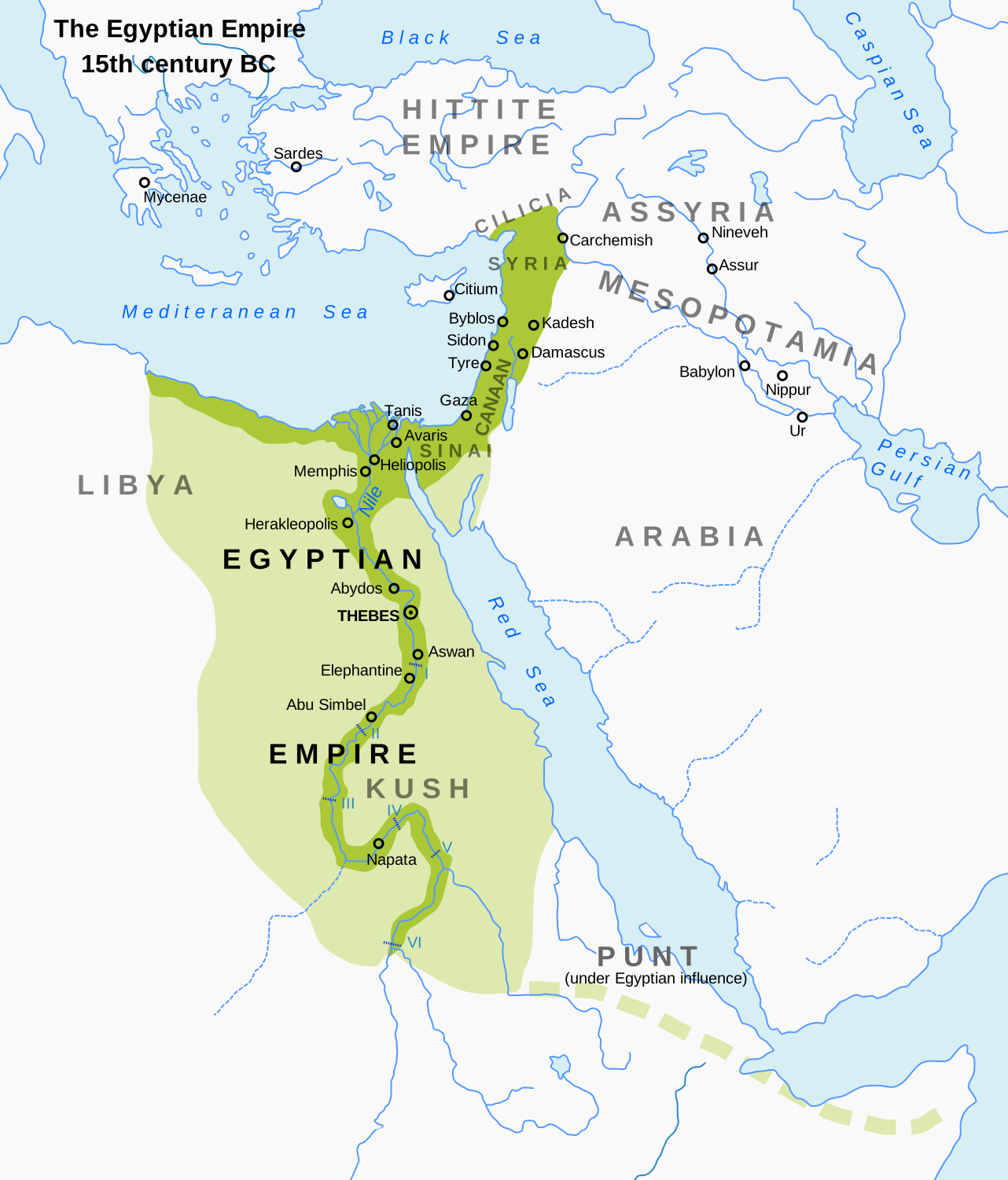
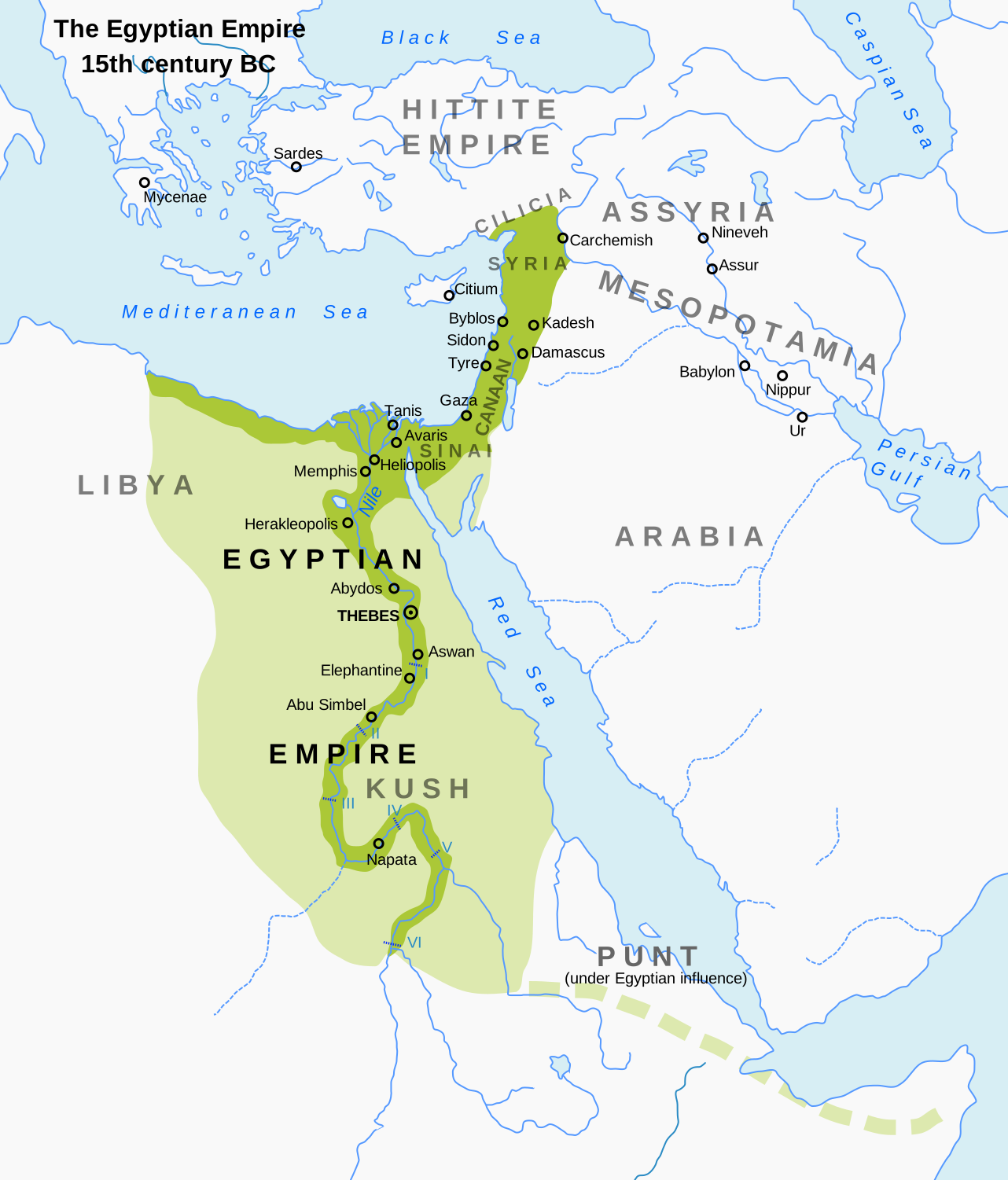
Ancient Egypt was a cradle of civilization concentrated along the lower reaches of the Nile River in Northeast Africa. It emerged from prehistoric Egypt around 3150 BC, when Upper and Lower Egypt were united by Menes, believed by most Egyptologists to have been the same person as Narmer. The history of ancient Egypt unfolded as a series of stable kingdoms interspersed by "Intermediate Periods" of relative instability: the Old Kingdom of the Early Bronze Age, the Middle Kingdom of the Middle Bronze Age, and the New Kingdom of the Late Bronze Age.
The pinnacle of ancient Egyptian power was achieved during the New Kingdom, which extended its rule to much of Nubia and a considerable portion of the Levant. After this period, Egypt entered an era of slow decline, invaded or conquered by the Hyksos, the Kushites, the Assyrians, the Persians, and the Greeks and then the Romans. The end of ancient Egypt is variously defined as the end of the Late Period in 332 BC or the end of the Ptolemaic Kingdom in 30 BC. In AD 642, the Arab conquest of Egypt brought an end to the region's millennium-long Greco-Roman period.
The success of ancient Egyptian civilization came partly from its ability to adapt to the Nile's conditions for agriculture. The predictable flooding of the Nile and controlled irrigation produced surplus crops, supporting a dense population and substantial cultural development. With resources to spare, the administration sponsored mineral exploitation, the development of an independent writing system, collective construction projects, trade, and a military to assert Egyptian dominance. Motivating these activities was a bureaucracy of elite scribes, religious leaders, and administrators under the control of the reigning pharaoh.[3]
Among the many achievements of ancient Egypt are: the construction of monumental pyramids, temples, and obelisks; a system of mathematics; a practical system of medicine; irrigation systems; the first known planked boats; faience and glass technology; new forms of literature; and the earliest known peace treaty, ratified with the Hittite Empire.[4]
1 History✎
 History of Ancient Egypt History of Ancient Egypt | ||||||||||||||||||||||||||||||||||||||||||||||||||||||||||||||||||||||||||||||||||||||||||||||||||||||||||||
|---|---|---|---|---|---|---|---|---|---|---|---|---|---|---|---|---|---|---|---|---|---|---|---|---|---|---|---|---|---|---|---|---|---|---|---|---|---|---|---|---|---|---|---|---|---|---|---|---|---|---|---|---|---|---|---|---|---|---|---|---|---|---|---|---|---|---|---|---|---|---|---|---|---|---|---|---|---|---|---|---|---|---|---|---|---|---|---|---|---|---|---|---|---|---|---|---|---|---|---|---|---|---|---|---|---|---|---|---|
[ Show/Hide ]
| ||||||||||||||||||||||||||||||||||||||||||||||||||||||||||||||||||||||||||||||||||||||||||||||||||||||||||||
The Nile has been the lifeline of its region for much of human history. The fertile floodplain gave humans the opportunity to develop a settled agricultural economy and a more sophisticated, centralized society that became a cornerstone in the history of human civilization.
1.1 Predynastic period✎
 i
i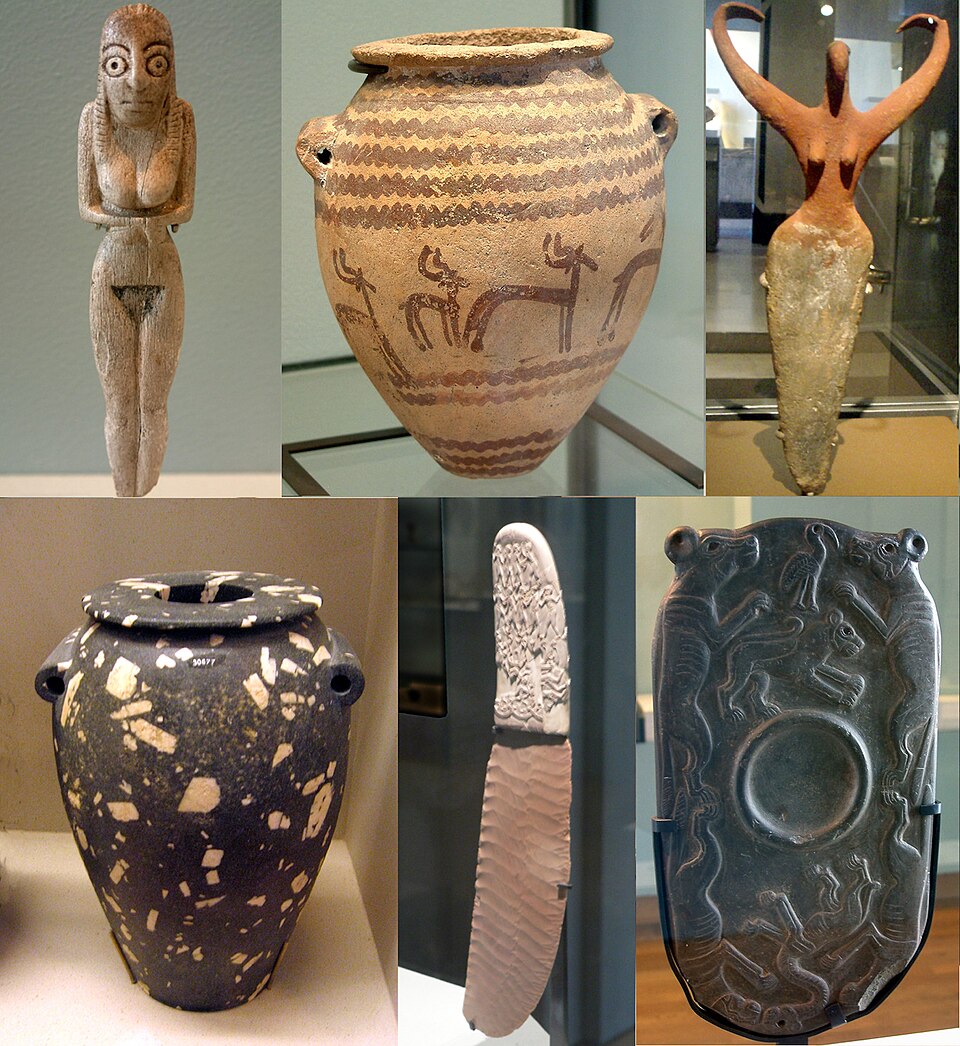
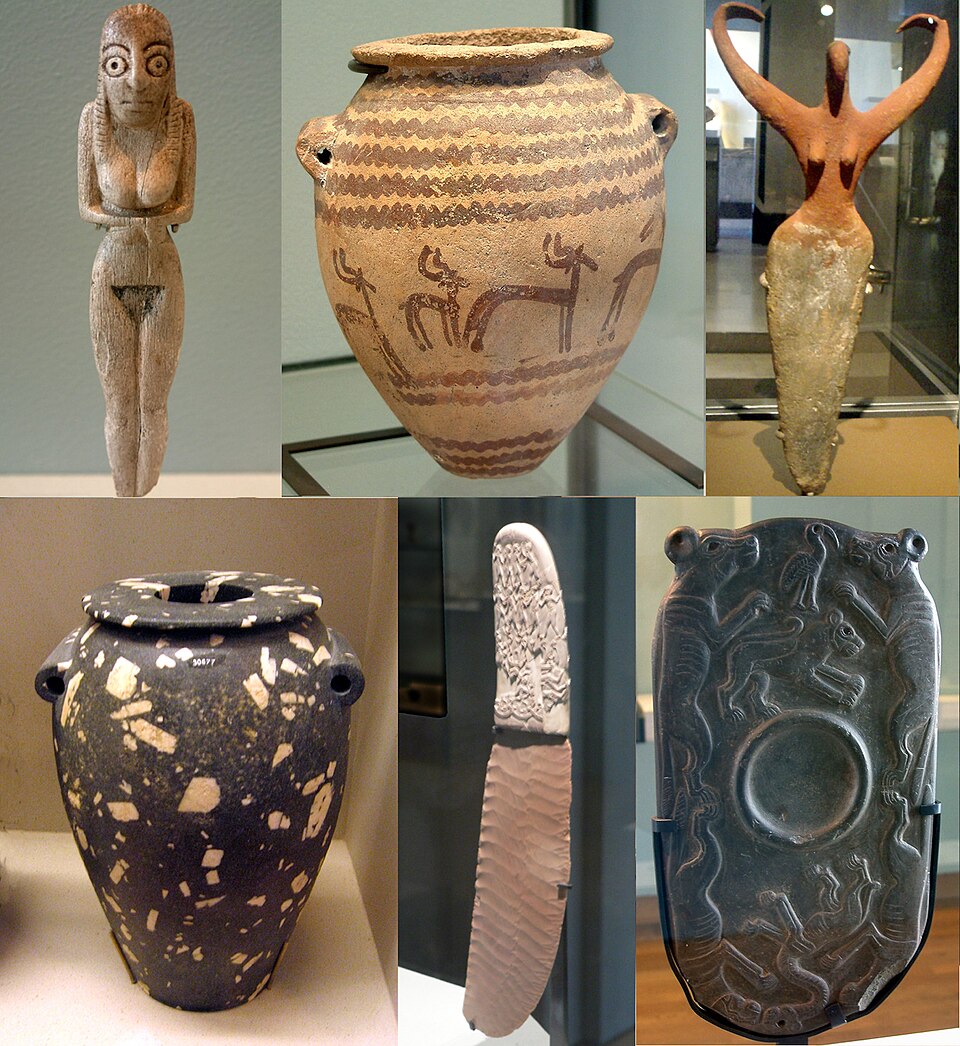
In Predynastic and Early Dynastic times, the Egyptian climate was much less arid than it is today. Large regions of Egypt were savanna and traversed by herds of grazing ungulates. Hunting would have been common, and this is the period when many animals were first domesticated.
By about 5500 BC, small tribes living in the Nile valley had developed into a series of cultures with firm control of agriculture and animal husbandry. The largest of these early cultures in upper Egypt was the Badarian culture, known for its high-quality ceramics, stone tools, and use of copper.
The Badari was followed by the Naqada culture: Naqada I (Amratian), Naqada II (Gerzeh), and Naqada III (Semainean). These brought a number of technological improvements. Over about 1,000 years, the Naqada culture developed from a few small farming communities into a powerful civilization whose leaders controlled the people and resources of the Nile valley. Establishing a power center at Nekhen, Naqada III leaders expanded their control northward along the Nile.
During the last predynastic phase, the Naqada culture began using written symbols that eventually developed into a full system of hieroglyphs.
1.2 Early Dynastic Period (c. 3150–2686 BC)✎
 i
i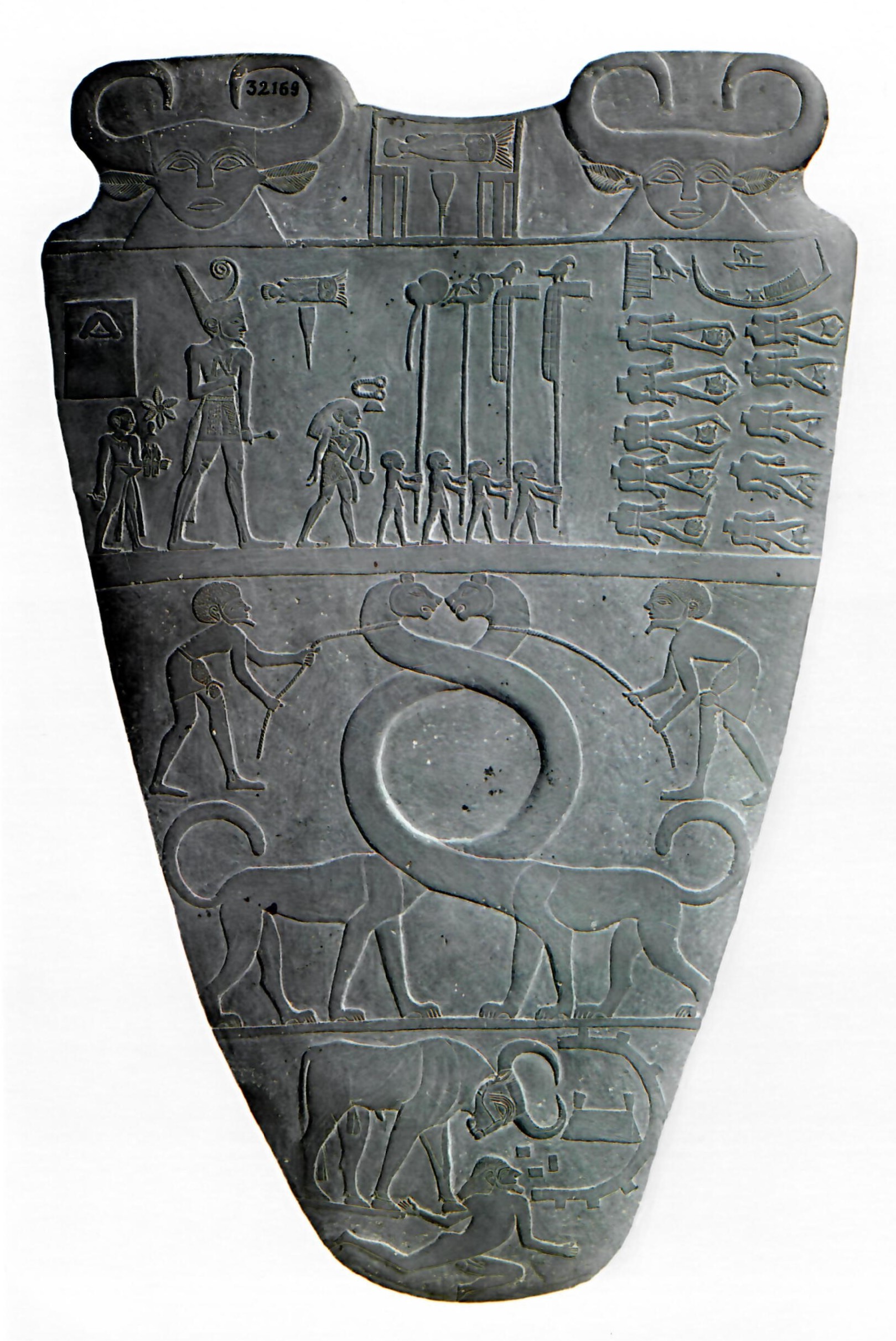
The Early Dynastic Period was approximately contemporary to the early Sumerian-Akkadian civilisation of Mesopotamia. The priest Manetho grouped the long line of kings from Menes to his own time into 30 dynasties, a system still used today. He began his official history with the king named "Meni" (Menes in Greek), who was believed to have united Upper and Lower Egypt.
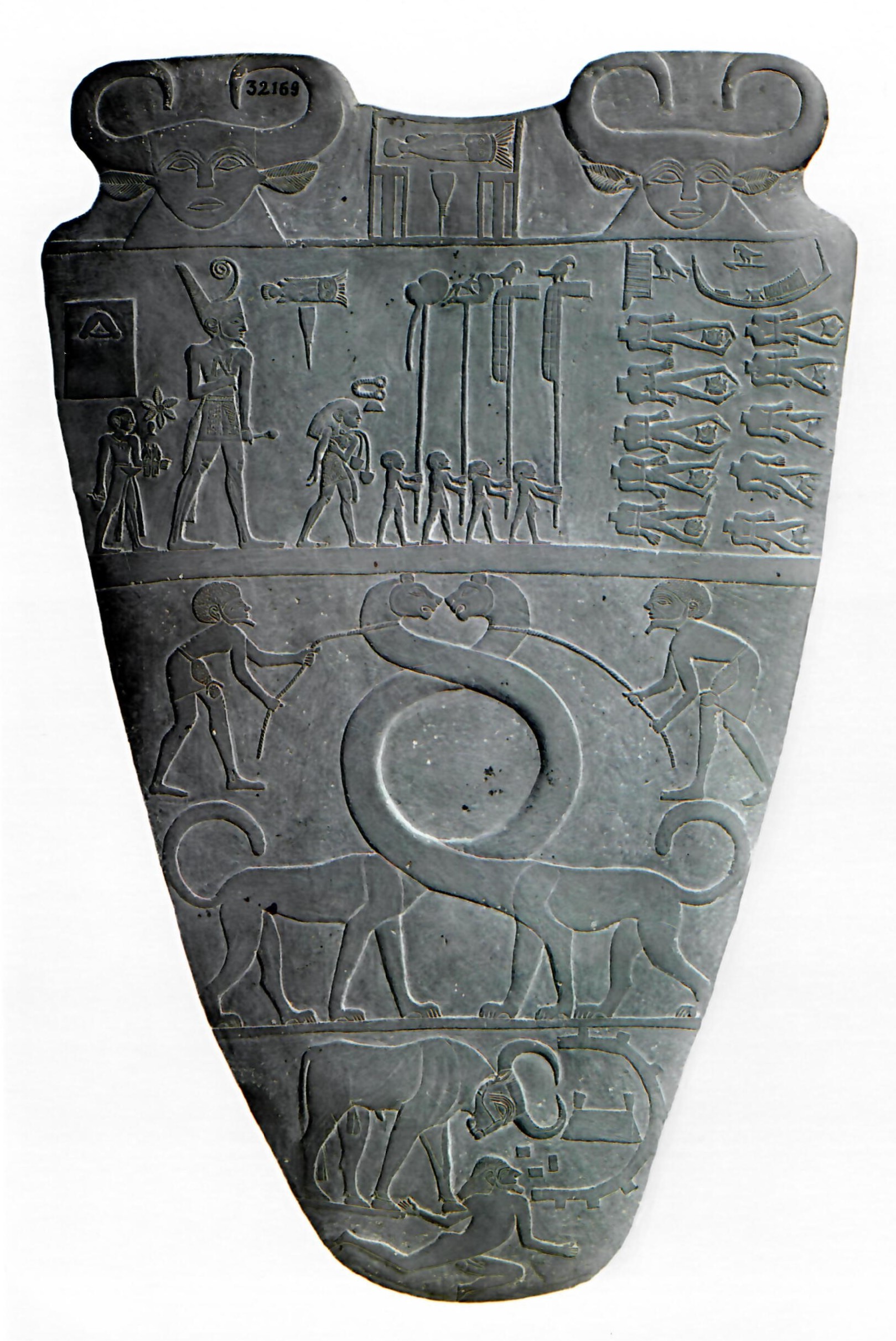
Some scholars now believe the mythical Menes may have been the king Narmer, depicted wearing royal regalia on the ceremonial Narmer Palette. In the Early Dynastic Period, which began about 3000 BC, the first dynastic kings solidified control over Lower Egypt by establishing a capital at Memphis, from which they could control the labour force and agriculture of the fertile delta region, as well as lucrative trade routes to the Levant.
1.3 Old Kingdom (2686–2181 BC)✎
 i
i
Major advances in architecture, art, and technology were made during the Old Kingdom, fueled by increased agricultural productivity and population growth. The Giza pyramids and Great Sphinx were constructed during this period. Under the direction of the vizier, state officials collected taxes, coordinated irrigation projects, and drafted peasants to work on construction projects.
With the rise of central administration, a new class of educated scribes and officials emerged. Over five centuries, the practice of granting land to mortuary cults and temples slowly eroded the economy. As the power of the kings diminished, regional governors called nomarchs began to challenge the office of king. This, coupled with severe droughts between 2200 and 2150 BC, caused the country to enter the First Intermediate Period.
1.4 First Intermediate Period (2181–2055 BC)✎
After Egypt's central government collapsed, food shortages and political disputes escalated into famines and civil wars. Yet local leaders used their independence to establish thriving cultures in the provinces. By 2160 BC, rulers in Herakleopolis controlled Lower Egypt, while the Intef family in Thebes took control of Upper Egypt. Around 2055 BC, the Theban forces under Nebhepetre Mentuhotep II defeated the Herakleopolitan rulers, reuniting the Two Lands and inaugurating the Middle Kingdom.
1.5 Middle Kingdom (2134–1690 BC)✎
The kings of the Middle Kingdom restored stability and saw a resurgence of art, monumental building, and literature. The vizier Amenemhat I shifted the capital to Itjtawy in Faiyum around 1985 BC. The Twelfth Dynasty undertook land reclamation and irrigation schemes, reconquered Nubian territory rich in quarries and gold mines, and built the "Walls of the Ruler" to defend against foreign attack.
The Middle Kingdom displayed an increase in expressions of personal piety. Its literature featured sophisticated themes written in a confident, eloquent style, and the relief and portrait sculpture of the period reached new heights of technical sophistication.
1.6 Second Intermediate Period (1674–1549 BC) and the Hyksos✎
Around 1785 BC, a Western Asian people called the Hyksos seized control of Egypt and established their capital at Avaris. The native Theban kings found themselves trapped between the Hyksos in the north and their Nubian allies, the Kushites, to the south. After years of conflict, Ahmose I permanently eradicated the Hyksos' presence in Egypt. He founded the Eighteenth Dynasty, and the military became a central priority for his successors.
1.7 New Kingdom (1549–1069 BC)✎
 i
i
The New Kingdom pharaohs established unprecedented prosperity by securing borders and strengthening diplomatic ties with neighbours including the Mitanni Empire, Assyria, and Canaan. Military campaigns under Tuthmosis I and Tuthmosis III extended Egypt to its largest-ever empire. Between their reigns, Hatshepsut launched many building projects and sent trading expeditions to Punt and the Sinai.
Around 1350 BC, Amenhotep IV (who changed his name to Akhenaten) instituted radical reforms, touting the sun deity Aten as the supreme deity, suppressing most other deities, and moving the capital to Akhetaten (modern Amarna). After his death, the traditional religious order was restored.
Around 1279 BC, Ramesses II ascended the throne and went on to build more temples, erect more statues, and sire more children than any other pharaoh in history. He led his army against the Hittites in the Battle of Kadesh and agreed to the first recorded peace treaty around 1258 BC.
Egypt's wealth made it a target for invasion, particularly by Libyan Berbers and the Sea Peoples. The military initially repelled these invasions, but Egypt eventually lost control of its remaining territories in southern Canaan. Internal problems such as corruption and civil unrest further weakened the kingdom.
1.8 Third Intermediate Period (1069–653 BC)✎
Following the death of Ramesses XI in 1078 BC, power was divided. Smendes ruled the north from Tanis, while the High Priests of Amun controlled the south. Libyan princes took control of the delta under Shoshenq I in 945 BC. Around 727 BC, the Kushite king Piye invaded northward, establishing the 25th Dynasty, which built or restored temples and monuments throughout the Nile valley.
Between 671 and 667 BC, the Assyrians began their conquest of Egypt, ultimately pushing the Kushites back into Nubia and sacking the temples of Thebes.
1.9 Late Period (653–332 BC)✎
The Saite king Psamtik I ousted the Assyrians by 653 BC with the help of Greek mercenaries. The Saite kings saw a brief resurgence in economy and culture, but in 525 BC, the Persian Empire conquered Egypt at the Battle of Pelusium. Egypt regained independence in 402 BC under native dynasties, but the Thirtieth Dynasty proved to be the last native royal house. In 332 BC, the Persian ruler Mazaces handed Egypt over to Alexander the Great without a fight.
1.10 Ptolemaic period (332–30 BC)✎
Alexander the Great conquered Egypt with little resistance and was welcomed as a deliverer. His successors, the Macedonian Ptolemies, established an administration based on an Egyptian model, with the new capital city of Alexandria as a centre of learning and culture, featuring the famous Library of Alexandria.
The Ptolemies supported time-honoured Egyptian traditions, built new temples in Egyptian style, and portrayed themselves as pharaohs. Some traditions merged, as Greek and Egyptian gods were syncretised into composite deities such as Serapis. Despite these efforts, the Ptolemies were challenged by native rebellion, family rivalries, and mob violence. As Rome relied more heavily on Egyptian grain imports, the Romans took increasing interest in the country, eventually annexing it as a province.
1.11 Roman period (30 BC – AD 642)✎
 i
i
Egypt became a province of the Roman Empire in 30 BC, following the defeat of Mark Antony and Queen Cleopatra VII by Octavian at the Battle of Actium. Some traditions such as mummification continued, and some Roman emperors had themselves depicted as pharaohs.
From the mid-first century AD, Christianity took root in Egypt. In 391, the emperor Theodosius banned pagan rites and closed temples. Egypt's native religious culture declined, the ability to read hieroglyphic writing slowly disappeared, and temples were sometimes converted to churches or abandoned.
2 Government and economy✎
2.1 Administration and commerce✎
The pharaoh was the absolute monarch, wielding complete control of the land and its resources. His second in command, the vizier, coordinated land surveys, the treasury, building projects, the legal system, and the archives. The country was divided into as many as 42 administrative regions called nomes, each governed by a nomarch. The temples formed the backbone of the economy, collecting and storing the kingdom's wealth.
The ancient Egyptians did not use coinage until the Late Period, instead using a barter system with standard sacks of grain and the deben (a weight of roughly 91 grams of copper or silver) as a common denominator. Workers were paid in grain.
2.2 Social status✎
Egyptian society was highly stratified. Farmers made up the bulk of the population but were subject to labour taxes. Scribes and officials formed the upper class, known as the "white kilt class." The ancient Egyptians viewed men and women as essentially equal under the law. Both had the right to own and sell property, make contracts, marry and divorce, receive inheritance, and pursue legal disputes. Women such as Hatshepsut and Cleopatra VII even became pharaohs.
2.3 Legal system✎
The pharaoh was head of the legal system, responsible for enacting laws and maintaining Ma'at (order). Egyptian law emphasised reaching agreements and resolving conflicts rather than strictly adhering to complicated statutes. Local councils called Kenbet handled minor disputes, while more serious cases were referred to the Great Kenbet presided over by the vizier or pharaoh. Beginning in the New Kingdom, oracles played a major role in dispensing justice.
2.4 Agriculture✎
The rich fertile soil from annual Nile inundations was the most important factor in ancient Egyptian success. Farmers recognised three seasons: Akhet (flooding, June to September), Peret (planting, October to February), and Shemu (harvesting, March to May). The ancient Egyptians cultivated emmer and barley for bread and beer, grew flax for linen, and used papyrus for paper. Vegetables, fruits, and grapes for wine were grown in garden plots.
Cattle were the most important livestock. The Egyptians also kept sheep, goats, pigs, and poultry. Bees were domesticated from at least the Old Kingdom. Horses were introduced by the Hyksos; camels were not used as beasts of burden until the Late Period.
2.5 Natural resources✎
Egypt is rich in building and decorative stone, copper and lead ores, gold, and semiprecious stones. There were extensive gold mines in Nubia. Copper, the most important metal for toolmaking, was smelted from malachite ore mined in the Sinai. High-quality building stones including limestone, granite, basalt, and sandstone were quarried throughout the country.
2.6 Trade✎
The ancient Egyptians traded with Nubia for gold and incense, with Palestine, Byblos for timber, Punt for gold, aromatic resins, ebony, and ivory, and Anatolia for tin and copper. The blue stone lapis lazuli was imported from far-away Afghanistan. Mediterranean trade partners included Greece and Crete.
3 Language✎
3.1 Historical development✎
The Egyptian language is a northern Afro-Asiatic language closely related to the Berber and Semitic languages. It has the longest known history of any language, having been written from c. 3200 BC to the Middle Ages and spoken for even longer. The phases of ancient Egyptian are Old Egyptian, Middle Egyptian (Classical Egyptian), Late Egyptian, Demotic, and Coptic.
Ancient Egyptian was a synthetic language that became more analytic over time. The hieroglyphic, hieratic, and demotic scripts were eventually replaced by the Coptic alphabet. Coptic is still used in the liturgy of the Egyptian Orthodox Church.
3.2 Writing✎
 i
i
Hieroglyphic writing dates from c. 3000 BC and is composed of hundreds of symbols. A hieroglyph can represent a word, a sound, or a silent determinative. In day-to-day writing, scribes used a cursive form called hieratic. A later form, Demotic, became the prevalent writing style.
As traditional religious establishments were disbanded, knowledge of hieroglyphic writing was mostly lost. Only in the 1820s, after the discovery of the Rosetta Stone and research by Thomas Young and Jean-François Champollion, were hieroglyphs substantially deciphered.
3.3 Literature✎
Some of the best-known pieces of ancient Egyptian literature include the Pyramid and Coffin Texts. The Story of Sinuhe, written in Middle Egyptian, is considered the classic of Egyptian literature. The Instruction of Amenemope is considered a masterpiece of Near Eastern literature. From about 700 BC, narrative stories and documents were written in the demotic script.
4 Culture✎
4.1 Daily life✎
Most ancient Egyptians were farmers. Their dwellings were constructed of mudbrick. The Egyptians placed great value on hygiene and appearance; most bathed in the Nile and used a pasty soap made from animal fat and chalk. Clothing was made from simple linen sheets. Children went without clothing until about age 12.
Music and dance were popular entertainments. Early instruments included flutes and harps; bells, cymbals, tambourines, drums, lutes, and lyres came later. Board games such as Senet and Hounds and Jackals were popular. The wealthy enjoyed hunting, fishing, and boating.
4.2 Cuisine✎
The staple diet consisted of bread and beer, supplemented with vegetables such as onions and garlic, and fruit such as dates and figs. Wine and meat were enjoyed by all on feast days. Fish, meat, and fowl could be salted, dried, stewed, or roasted.
4.3 Architecture✎
The architecture of ancient Egypt includes some of the most famous structures in the world: the Great Pyramids of Giza and the temples at Thebes. Using simple but effective tools, architects could build large stone structures with great accuracy. Domestic dwellings were constructed from mudbricks and wood and have not survived. Important structures such as temples and tombs were built of stone.
The earliest temples consisted of single, enclosed halls with roof slabs supported by columns. In the New Kingdom, architects added the pylon, open courtyard, and enclosed hypostyle hall. The step pyramid of Djoser is a series of stone mastabas stacked on top of each other. Most later rulers abandoned pyramids in favour of rock-cut tombs.
4.4 Art✎
For over 3,500 years, artists adhered to artistic forms developed during the Old Kingdom: simple lines, shapes, flat areas of colour, and the characteristic flat projection of figures with no indication of spatial depth. Images and text were intimately interwoven on tomb and temple walls, coffins, stelae, and statues.
Artisans used stone for carving statues and reliefs, and wood as a cheaper substitute. Paints were obtained from minerals such as iron ores, copper ores, soot, and limestone. Common citizens had access to funerary art such as shabti statues and books of the dead. During the Middle Kingdom, wooden or clay models depicting everyday life became popular tomb additions.
4.5 Religious beliefs✎
 i
i
Beliefs in the divine and the afterlife were ingrained in Egyptian civilisation from its inception. The Egyptian pantheon was populated by gods with supernatural powers. Priests made no effort to organise the diverse myths into a coherent system; different conceptions of divinity were seen as layers in the multiple facets of reality.
Temples were not places of public worship. The god's domain was sealed off from the outside world, accessible only to temple officials. Common citizens could worship private statues in their homes.
The Egyptians believed every person had a shadow (šwt), a soul (ba), a life-force (ka), and a name. The heart was considered the seat of thoughts and emotions. After death, the deceased had to be judged worthy in a trial where the heart was weighed against a "feather of truth."
4.6 Burial customs✎
 i
i
The ancient Egyptians maintained elaborate burial customs they believed necessary for immortality after death. These involved preserving the body by mummification, performing burial ceremonies, and interring goods for the afterlife.
By the New Kingdom, the best mummification technique took 70 days and involved removing internal organs, removing the brain through the nose, and desiccating the body in natron salts. The body was then wrapped in linen with protective amulets and placed in a decorated anthropoid coffin.
5 Military✎
The ancient Egyptian military defended against foreign invasion and maintained Egypt's domination in the ancient Near East. Equipment included bows and arrows, spears, and shields made from animal skin over wooden frames. In the New Kingdom, the military adopted chariots (introduced by the Hyksos) and bronze weapons including the khopesh. Soldiers were recruited from the general population, and mercenaries from Nubia, Kush, and Libya were increasingly hired.
6 Technology, medicine, and mathematics✎
6.1 Faience and glass✎
The ancient Egyptians developed a glassy material known as faience, a non-clay ceramic made of silica, small amounts of lime and soda, and a colorant (typically copper). They also produced Egyptian blue pigment by fusing silica, copper, lime, and an alkali. The Egyptians could fabricate a wide variety of glass objects, producing colours including yellow, red, green, blue, purple, and white.
6.2 Medicine✎
Living near the Nile brought hazards from malaria and schistosomiasis parasites. Adult life expectancy was about 35 for men and 30 for women, and about one-third of the population died in infancy.
Ancient Egyptian physicians were renowned for their healing skills. Wounds were treated with bandaging, honey to prevent infection, and sutures. Opium, thyme, and belladonna were used for pain relief. Surgeons stitched wounds, set broken bones, and amputated diseased limbs, but recognised that some injuries could only be made comfortable until death.
6.3 Maritime technology✎
Early Egyptians mastered advanced shipbuilding as early as 3000 BC. The oldest known planked ships are the Abydos boats, constructed of wooden planks "sewn" together. The "Khufu ship," a 43.6-metre vessel sealed in the Giza pyramid complex around 2500 BC, is a full-size surviving example. Large seagoing ships were heavily used in trade with the eastern Mediterranean, especially Byblos, and in expeditions to the Land of Punt.
6.4 Mathematics✎
The earliest mathematical calculations date to the predynastic Naqada period. The ancient Egyptians could perform addition, subtraction, multiplication, and division, use fractions, calculate areas and volumes, and solve simple systems of equations. Their mathematical notation was decimal, based on hieroglyphic signs for each power of ten up to one million. They knew the Pythagorean theorem as an empirical formula and could estimate the area of a circle with reasonable accuracy.
7 Population✎
Estimates of the population range from 1–1.5 million in the 3rd millennium BC to possibly 2–3 million by the 1st millennium BC. Historical scholarship has generally regarded the peopling of the Egyptian Nile Valley as the result of interaction between coastal northern Africans, Saharan groups, Nilotic hunters, and proto-Nubians, with some influence from the Levant.
The UNESCO General History of Africa series positions Egypt as an indigenous African civilisation with a mixed population originating largely in the Sahara. Upper Egypt has been positioned as the origin point of Pharaonic unification, with archaeological, anthropological, genetic, and linguistic evidence identifying close affinities between Upper Egypt and other Sub-Saharan African populations.
7.1 Archaeogenetics✎
The genetic history of Ancient Egypt remains a developing field. A 2025 study published in Nature analysed the whole genome of an Old Kingdom adult male (codenamed NUE001, radiocarbon-dated to 2855–2570 BC) excavated at Nuwayrat, 265 km south of Cairo. Most of his genome was associated with North African Neolithic ancestry, but about 20% could be sourced to the eastern Fertile Crescent, including Mesopotamia. The study acknowledged limitations, as it derived from a single genome.[5]
Earlier partial genomic analyses on later specimens from Abusir el-Meleq (787 BC – 23 AD) pointed to genetic continuity with modern Egyptians and a close affinity with Middle Eastern populations, especially from the Levant. Ancient Egyptians also displayed affinities to Nubians to the south.
Pharaonic Egypt featured a physical gradation across regional populations, with Upper Egyptians sharing more biological affinities with Sudanese and southerly African populations, whereas Lower Egyptians had closer genetic links with Levantine and Mediterranean populations.
8 Legacy✎
Egyptian civilisation significantly influenced the Kingdom of Kush and Meroë, both of which adopted Egyptian religious and architectural norms and used Egyptian writing as the basis of the Meroitic script. The cult of the goddess Isis became popular in the Roman Empire, and obelisks and other relics were transported to Rome. Early historians such as Herodotus, Strabo, and Diodorus Siculus studied and wrote about the land.
During the Middle Ages, interest in Egyptian antiquity continued in the writings of medieval scholars. In the seventeenth and eighteenth centuries, European travellers brought back antiquities, leading to a wave of Egyptomania across Europe. Napoleon arranged the first systematic studies in Egyptology, published in the Description de l'Égypte.
In the 20th and 21st centuries, the Egyptian Government and archaeologists have emphasised the importance of cultural respect and integrity in excavations.
9 References✎
10 Further reading✎
- Baines, John; Málek, Jaromír. Cultural Atlas of Ancient Egypt (2000). Checkmark Books. ISBN 978-0-8160-4036-0.
- Grimal, Nicolas. A History of Ancient Egypt (1994). Wiley. ISBN 978-0-631-19396-8.
- Shaw, Ian (ed.). The Oxford History of Ancient Egypt (2003). Oxford University Press. ISBN 978-0-19-280458-7.
- Wilkinson, R.H. The Complete Temples of Ancient Egypt (2000). Thames and Hudson. ISBN 978-0-500-05100-9.
- Wilkinson, R.H. The Complete Gods and Goddesses of Ancient Egypt (2003). Thames and Hudson. ISBN 978-0-500-05120-7.
- Dates per Shaw (2000).
- Following the death of [[Cleopatra VII]].
- James (2005), p. 8; Manuelian (1998), pp. 6–7.
- Clayton (1994), p. 153.
- Morez Jacobs et al. (2025), "Whole-genome ancestry of an Old Kingdom Egyptian," Nature, 644(8077), pp. 714–721.