iOS
| iOS | ||||||||||||||||||||||||
|---|---|---|---|---|---|---|---|---|---|---|---|---|---|---|---|---|---|---|---|---|---|---|---|---|
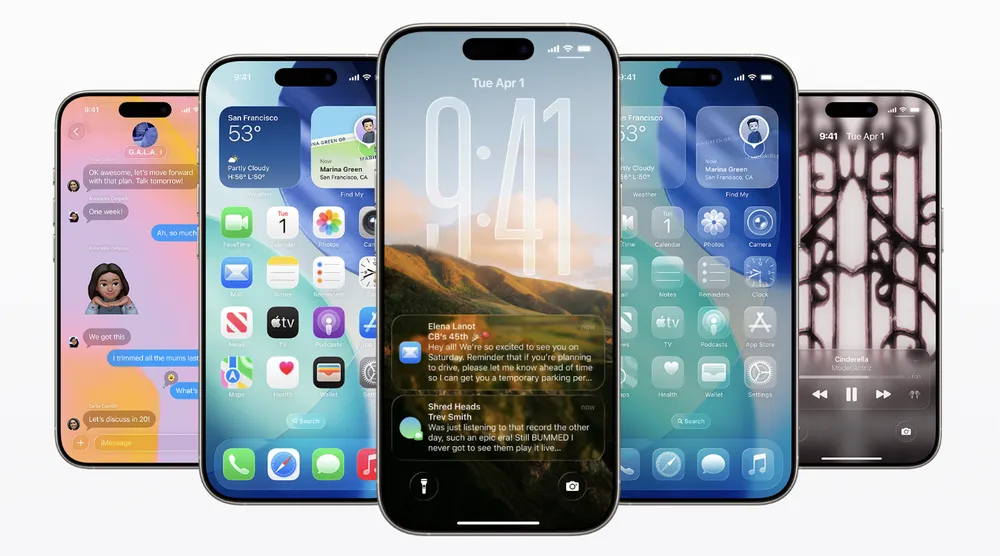 i iiOS 26, the most recent version | ||||||||||||||||||||||||
[info]
|
iOS is a mobile operating system made by Apple for its iPhone line of smartphones. It was first shown to the public in January 2007 and released with the original iPhone in June 2007. iOS is one of the two operating systems that most of the world's smartphones run on, the other being Android.
The name "iOS" was first used in 2010. Before then, it was called "iPhone OS." Because the Cisco company already owned a trademark for "IOS" (used for its network routers), Apple had to license the name from Cisco to use it.
iOS is built on the same foundation as macOS, Apple's operating system for Mac computers. Both share a core called Darwin, which makes iOS a Unix-like system. However, iOS was designed from the start around multi-touch gestures like tapping, swiping, and pinching, which was a new idea for phones when it launched. Over time, iOS became the starting point for several other Apple operating systems, including iPadOS for the iPad, watchOS for the Apple Watch, and tvOS for the Apple TV.
Apps for iOS are sold through the App Store, which opened in July 2008. Apple does not allow iOS to be installed on non-Apple devices, and apps generally have to be approved by Apple before they can be sold. This closed approach is often compared to Android's more open one.
1 History✎
iOS began as a secret project inside Apple in the mid-2000s. The company was looking for a new kind of device, and at least two prototypes were built: a lightweight system based on Linux, and a stripped-down version of Mac OS X codenamed "Purple." Apple eventually chose the Mac OS X approach because it could reuse many of the tools Apple's engineers already knew.
1.1 Launch and early years (2007–2010)✎
When Steve Jobs introduced the first iPhone in January 2007, he described it as running a version of Mac OS X, but did not give the software a specific name. At launch, the system had no App Store and no way for outside developers to make apps. Jobs suggested that developers could build web applications that would look like native apps instead.
Public demand for real apps was strong, and Apple changed course. In March 2008, Apple released the first version of the iPhone software development kit (SDK), which let outside developers make native apps. It also gave the operating system an official name: iPhone OS. The App Store opened a few months later, in July 2008, alongside iPhone OS 2. The store quickly became a major success and helped create a whole new industry of mobile apps.
In 2010, Apple released the iPad, which also used iPhone OS. That same year, Apple renamed the system iOS to reflect that it now ran on more than just the iPhone. iOS 4, released in June 2010, was the first version to use the new name.
1.2 Growth and redesign (2011–2019)✎
Each new version of iOS added major features. iOS 5 introduced iCloud and iMessage. iOS 6 brought Siri, Apple's voice assistant, and replaced Google Maps with Apple's own Apple Maps. The switch to Apple Maps was a rough one: early users found wrong directions and landmarks placed in the wrong spots, and CEO Tim Cook issued a public apology. Apple has improved the app with every update since.
iOS 7, released in 2013, gave the whole system its biggest visual change up to that point. The older look, which copied real-world textures like leather and paper, was replaced with a flatter, simpler style. iOS 7 was also the first version to support 64-bit processors, starting with the Apple A7 chip in the iPhone 5s.
In 2019, Apple split the iPad version of iOS into its own operating system called iPadOS. Although the two systems share most of their code, the new name let Apple highlight tablet-specific features like better multitasking and mouse support.
1.3 Liquid Glass era (2025–present)✎
At the Worldwide Developers Conference in June 2025, Apple announced iOS 26. It was released to the public on September 15, 2025. iOS 26 skipped several numbers (the previous version was iOS 18) so that all of Apple's operating systems would share the same version number based on the year.
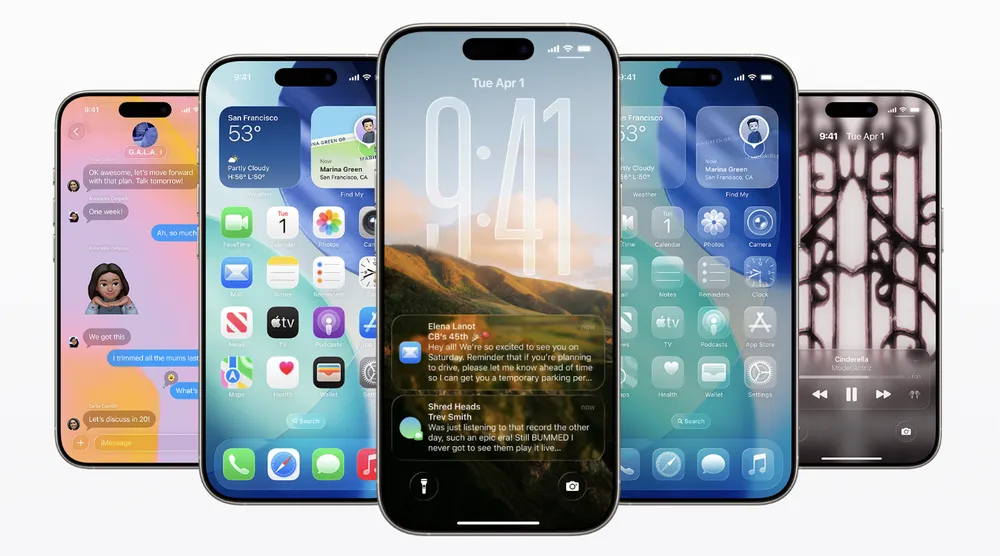
iOS 26 also introduced a new design language called Liquid Glass. It was the biggest visual change since iOS 7, built around glass-like effects for buttons, menus, and windows. Apple applied the same design to iPadOS, macOS, watchOS, tvOS, and visionOS at the same time. It was the first time Apple used one unified design across all of its platforms.
2 Technical foundation✎
iOS has four main layers that developers build on:
- Core OS — the lowest layer, handling hardware, memory, and security.
- Core Services — basic features like networking, file access, and contacts.
- Media — audio, video, and graphics.
- Cocoa Touch — the top layer, which handles the user interface and touch input.
At the heart of iOS is a kernel called XNU, which is also used in macOS. A kernel is the core part of an operating system that controls everything else. XNU combines two different approaches: a microkernel from Mach (a research project from Carnegie Mellon University) and parts of FreeBSD, a free Unix-like system. This combination is called a "hybrid kernel."
Because iOS shares so much with macOS, Apple can often bring new Mac features to iOS and the other way around. Apple releases some parts of the system as open source under the Apple Public Source License, but iOS as a whole is proprietary software.
3 User interface✎
The iOS interface is based on direct manipulation — users touch what they want to change, and the screen reacts right away. Common gestures include tapping, swiping, pinching to zoom out, and reverse-pinching to zoom in. Some apps also use the device's motion sensors: shaking the phone is often used to undo an action, and rotating it switches between upright (portrait) and sideways (landscape) views.
The home screen, which is drawn by a program called SpringBoard, shows app icons and a dock at the bottom for the user's favorite apps. A status bar across the top shows the time, battery level, and signal strength. Since iOS 4, users can group apps into folders by dragging one app onto another.
The default font for iOS is San Francisco, a font Apple designed itself to be easy to read on small screens. Before iOS 9, the system used Helvetica instead.
3.1 Accessibility✎
iOS includes many features to help users with disabilities. VoiceOver reads aloud what is on the screen so blind users can navigate by touch. Other features let users change text size, enable high-contrast colors, control the phone with their voice, or use a switch instead of tapping. Apple has been praised for making many of these features available on every device, not just special models.
4 Apps and the App Store✎
Apps for iOS are distributed through the App Store, which opened in July 2008. By late 2023, the store held more than 3.8 million apps, which had been downloaded over 130 billion times in total. Most apps go through a review process where Apple checks them for bugs, security problems, and rule violations before they are allowed on the store.
For a long time, the App Store was the only way to install apps on an iPhone. In 2024, changes to European Union law forced Apple to allow other app stores in the EU, though the standard App Store remains the main source of apps in most of the world.
5 Relationship to other Apple systems✎
iOS is the foundation for several other Apple operating systems:
- iPadOS — for the iPad, split off from iOS in 2019.
- watchOS — for the Apple Watch, introduced in 2015.
- tvOS — for the Apple TV, introduced in 2015.
- visionOS — for the Apple Vision Pro headset, introduced in 2023.
All of these share code with iOS and macOS, which is why Apple can update them all on a similar yearly schedule.
6 Other wikis✎
- iOS on Wikipedia
- iOS version history on Wikipedia