Super Mario Bros.
|
Super Mario Bros.
スーパーマリオブラザーズ
| |
 i i
| |
| Developer | Nintendo R&D4 / SRD |
|---|---|
| Publisher | Nintendo |
| Director | Shigeru Miyamoto |
| Designer | Shigeru Miyamoto, Takashi Tezuka |
| Programmer | Toshihiko Nakago |
| Composer | Koji Kondo |
| Platform | NES / Famicom |
| Release date | JP: September 13, 1985 NA: October 18, 1985 EU: May 15, 1987 AU: July 1, 1987 |
| Genre | Platform game |
| Mode | 1–2 players (alternating) |
| Copies sold | Over 58 million worldwide |
| Series | Super Mario series |
| Franchise | Super Mario franchise |


This article is about the 1985 video game. For the wider game series, see Super Mario series. For the overall franchise, see Super Mario franchise.
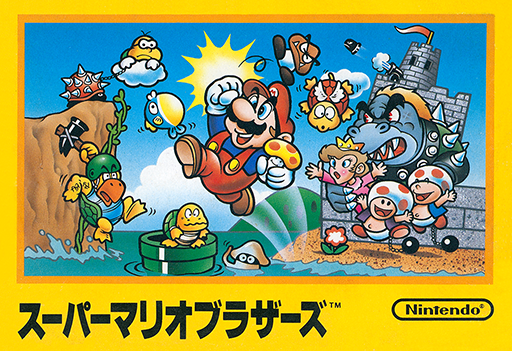
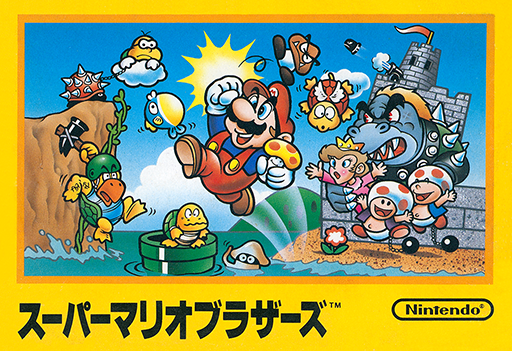
Super Mario Bros. is a platform game developed and published by Nintendo for the Nintendo Entertainment System (NES), first released in Japan on September 13, 1985. Directed and produced by Shigeru Miyamoto and designed alongside Takashi Tezuka, the game follows Mario (or his brother Luigi in the two-player mode) on a quest through the Mushroom Kingdom to rescue Princess Toadstool from the villainous King Koopa. Players run and jump through side-scrolling levels, defeat enemies, and collect power-ups like the Super Mushroom and Fire Flower across eight worlds of increasingly difficult challenges.
Super Mario Bros. is widely considered one of the most important and influential video games ever made. It helped revive the North American video game industry after the devastating crash of 1983, turned Mario into a global pop culture icon, and popularized the side-scrolling platform genre that would dominate gaming throughout the late 1980s and 1990s. With over 58 million copies sold worldwide, it remains one of the best-selling video games of all time. Its soundtrack, composed by Koji Kondo, is among the most recognized pieces of video game music in the world.
1 Gameplay✎
Super Mario Bros. is a side-scrolling platform game. The player moves Mario from left to right across each level, jumping over gaps, dodging obstacles, and defeating enemies to reach a flagpole at the end. A timer counts down for each level, and Mario loses a life if time runs out, if he falls into a pit, or if he takes damage while in his small form.
1.1 Controls and movement✎
Mario can walk, run (by holding the B button), and jump. Running before jumping allows Mario to leap further and higher, which is essential for crossing wide gaps. This momentum-based movement was groundbreaking for the time, as earlier platform games typically had characters that moved at a fixed speed. The game's controls are often praised for feeling tight and responsive, giving the player a strong sense of control over Mario's actions.
In the two-player mode, players take turns: Player 1 controls Mario and Player 2 controls Luigi. They alternate whenever one player loses a life.
1.2 Power-ups✎
Power-ups are special items found inside "?" Blocks and certain hidden blocks. They are a core part of the game's design:
| Power-Up | Effect |
|---|---|
| Super Mushroom | Transforms small Mario into "Super Mario," doubling his size. Super Mario can break brick blocks by hitting them from below and can survive one hit from an enemy (shrinking back to small Mario instead of dying). |
| Fire Flower | Only available when Mario is already Super Mario. Gives him a color-swapped outfit and the ability to throw bouncing fireballs that defeat most enemies on contact. |
| Starman | Grants Mario temporary invincibility, allowing him to defeat any enemy simply by touching them. Starmen are usually hidden in invisible blocks. |
| 1-Up Mushroom | A green mushroom that gives Mario an extra life. These are rare and often hidden in secret locations. |
1.3 Worlds and levels✎
The game consists of eight worlds, each containing four levels (sometimes called "stages"), for a total of 32 levels. Each world follows a general pattern:
| Stage | Typical Setting |
|---|---|
| X-1 | An outdoor overworld level (grassy plains, treetops, snowy hills, or mushroom platforms) |
| X-2 | An underground or underwater level |
| X-3 | An athletic "treetop" or elevated platform level |
| X-4 | A castle level, ending with a boss fight against Bowser (or one of his decoys) |
The first seven castle bosses are actually enemies disguised as Bowser. The real Bowser waits in the final castle of World 8. To defeat any Bowser, the player can either dodge past him and reach the axe at the end of the bridge (which collapses the bridge and drops Bowser into the lava below) or hit him with five fireballs.
The game also features hidden Warp Zones, which are secret pipes that allow the player to skip ahead to later worlds. Experienced players can use these shortcuts to reach the final world in just a few minutes.
After completing the game, the player unlocks a harder second playthrough where all Goombas are replaced with Buzzy Beetles (enemies that cannot be defeated with fireballs) and enemies move faster.
1.4 Enemies✎
Super Mario Bros. introduced many enemies that would become staples of the Super Mario franchise:
| Enemy | Description |
|---|---|
| Goomba | Small, brown mushroom-like creatures that walk forward. Mario can defeat them by jumping on them. They are the first enemy encountered in the game and the most common. |
| Koopa Troopa | Turtle-like soldiers of Bowser's army. When stomped, they retract into their shells. Mario can then kick the shell to slide it across the ground, defeating other enemies in its path, though it can also bounce back and hurt him. |
| Piranha Plant | Carnivorous plants that pop in and out of pipes. They cannot be stomped and must be avoided or defeated with fireballs. |
| Bullet Bill | Large bullet-shaped enemies fired from cannons. They fly in a straight line and can be defeated by jumping on them. |
| Hammer Bro | Koopas that throw hammers in arcs. Among the most dangerous regular enemies in the game. |
| Lakitu | A Koopa riding a cloud who throws Spinies (small spiked enemies) down at Mario. |
| Blooper | Squid-like enemies found in underwater levels. They move erratically and cannot be stomped. |
| Cheep Cheep | Fish enemies found in underwater levels and occasionally leaping out of water in bridge levels. |
2 Story✎
The story, as described in the game's instruction manual, is straightforward. The Mushroom Kingdom has been invaded by the Koopas, a tribe of turtles led by King Koopa (Bowser). Using dark magic, the Koopas have transformed the Mushroom Kingdom's peaceful inhabitants into blocks, bricks, and plants. The only person who can reverse the spell is Princess Toadstool, but she has been kidnapped by Bowser himself.
Mario and his brother Luigi learn of the kingdom's plight and set out to rescue the princess. They travel through eight worlds, battling Bowser's forces along the way. At the end of each castle, they find a rescued Toad retainer who delivers the now-famous line: "Thank you Mario! But our princess is in another castle!" Finally, in the last castle of World 8, Mario defeats the real Bowser, frees Princess Toadstool, and restores peace to the Mushroom Kingdom.
This simple rescue storyline established the template that most future Super Mario games would follow, with Mario saving Princess Peach from Bowser remaining the series' most recurring plot.
3 Development✎
3.1 Design origins✎
Super Mario Bros. was designed by Shigeru Miyamoto and Takashi Tezuka of Nintendo's Creative Department, with programming led by Toshihiko Nakago of SRD (a longtime Nintendo partner studio). Development began in the fall of 1984, at the same time as The Legend of Zelda, and the two projects actually shared some ideas. For example, the spinning fire bars found in castle levels originally started as objects designed for Zelda.
The game grew out of the team's experience working on several earlier titles: Devil World, Excitebike, and Kung Fu (the NES port of Kung-Fu Master). These games taught the team how to handle scrolling graphics and action gameplay on the Famicom hardware. Miyamoto wanted to create what he called an "athletic game" (his term for platform games) with a colorful scrolling world and characters larger than those seen in the original Mario Bros., which had been limited to a single static screen with a black background.
The side-scrolling game engine that powered Super Mario Bros. was actually adapted from Excitebike, a racing game the team had previously developed. This engine allowed Mario to smoothly accelerate from a walk to a run, rather than moving at one constant speed like characters in older platform games. Pac-Land (1984), an early scrolling platformer by Namco, is also cited as an influence.
Miyamoto also saw the game as a final showcase for the NES's ROM cartridge format, since Nintendo was preparing to release the Famicom Disk System (a floppy disk add-on) and wanted an impressive cartridge game to cap off that era.
3.2 Building the game✎
In December 1984, the team created an early prototype: a simple test where the player moved a small rectangle around a single screen. Tezuka suggested using Mario as the main character after seeing how well Mario Bros. had sold. By February 1985, after the team implemented the Super Mushroom power-up (which makes Mario grow larger), they settled on the title Super Mario Bros.
An early concept had Mario or Luigi flying a rocket ship and shooting at enemies from the sky. While this idea was scrapped, it survived in a reduced form as the game's sky-based bonus areas.
The team originally designed all the levels around a small Mario, planning to make him bigger later. However, they realized it would be more satisfying to let the player start small and grow bigger through a power-up. As Miyamoto later explained, showing the player a small Mario first made the transformation into Super Mario feel much more rewarding.
Many of the game's recurring design elements were imported from earlier Nintendo titles. Slopes and lifts came from Donkey Kong, ropes and springs from Donkey Kong Jr., and enemy behavior patterns from Mario Bros. The development team that assembled in February 1985 included veterans who had worked on all of these games.
3.3 Technical constraints✎
The entire game had to fit on a cartridge with just 256 kilobits (32 KB) of program data and 64 kilobits (8 KB) of graphics. For comparison, a single photo on a modern smartphone is thousands of times larger. This extremely tight memory limit forced the team to be creative with every byte.
One famous space-saving trick: the clouds and bushes in the game's backgrounds are actually the exact same sprite, just drawn in different colors. Background tiles were also generated using an automatic algorithm rather than being drawn individually. Sound effects were reused across different actions. The sound Mario makes when entering a pipe is the same sound used when he takes damage, and the swimming stroke sound is the same as the enemy-stomp sound.
The Goombas, which are now among the most iconic enemies in all of gaming, were actually the very last enemy added to the game. By the time the team realized they needed a simple introductory enemy (rather than starting players off against the more complex Koopa Troopas), the cartridge was almost full. They solved this by creating Goombas from a single image that was simply flipped back and forth to create the illusion of walking, using minimal memory.
After the music was added, only about 20 bytes of free space remained on the cartridge. Miyamoto used this last sliver of memory to add a crown icon that would appear next to the player's life counter after reaching 10 extra lives. The game was sent to manufacturing in August 1985.
3.4 World 1-1: teaching without tutorials✎
In the mid-1980s, on-screen tutorials were almost unheard of in video games. Instead, Super Mario Bros. teaches players how to play through its level design alone. The game's very first level, World 1-1, is specifically designed so that players naturally learn the game's mechanics just by playing.
The opening moments place Mario in an open space with a Goomba approaching. The player quickly learns that jumping is essential. The nearby "?" Blocks teach the player to hit blocks from below. The first Super Mushroom is placed so that it is very difficult to avoid once released, ensuring new players discover the power-up system. Each new obstacle builds on what the player has already learned.
Miyamoto designed World 1-1 to contain everything a player needs to "gradually and naturally understand what they're doing." Once players understand the mechanics, they can experiment and play more freely. This approach to level design, where the game itself is the tutorial, was highly innovative and became hugely influential in game design.
4 Music✎
The game's soundtrack was composed by Koji Kondo, who created all six tracks and every sound effect. At the time, most video game music existed mainly to attract attention in noisy arcades. Kondo took a different approach: he wrote music designed to complement and enhance the gameplay experience.
Kondo composed the music using a small piano, creating melodies to fit the feel of each environment. After seeing the game in motion, he realized his initial compositions did not match the fast pace of the gameplay and increased the tempos. The music was further refined based on feedback from Nintendo's playtesters.
The main overworld theme (often called the "Ground Theme" or simply the Super Mario Bros. theme) became one of the most recognizable pieces of music in the world. Its upbeat, energetic melody perfectly matches the feeling of running and jumping through the Mushroom Kingdom. The underground theme, underwater theme, and castle theme each set a distinct mood for their environments. The soundtrack is widely regarded as one of the most important in video game history, and it helped establish the idea that game music could be an art form in its own right.
5 Release✎
5.1 Original release✎
Super Mario Bros. was first released in Japan on September 13, 1985, for the Family Computer (Famicom). In North America, Nintendo officially lists the release date as October 18, 1985, coinciding with the NES's limited test-market launch in New York City. However, the exact North American release date has been the subject of debate among historians, with some sources suggesting it arrived slightly later. Regardless, it was available during the NES's initial rollout and was one of the console's original 17 launch titles. The game reached Europe on May 15, 1987.
An arcade version, VS. Super Mario Bros., was released on the Nintendo VS. System in early 1986. This version featured rearranged and more difficult levels and was the first way many players outside Japan experienced the game.
In 1988, Super Mario Bros. was re-released on a combined cartridge with Duck Hunt as part of the NES Action Set bundle. Millions of copies of this version were manufactured, making it one of the most widely distributed video games ever.
5.2 Later re-releases✎
Super Mario Bros. has been re-released and ported to many Nintendo platforms over the decades:
| Version | Details |
|---|---|
| Famicom Disk System (1986) | A Japanese-only port to Nintendo's floppy disk add-on. |
| Super Mario All-Stars (1993) | An enhanced remake for the Super NES with updated 16-bit graphics and sound, bundled together with Super Mario Bros. 2, Super Mario Bros. 3, and Super Mario Bros.: The Lost Levels. |
| Super Mario Bros. Deluxe (1999) | A Game Boy Color port with additional features including a challenge mode, a Boo race mode, and printable pictures. |
| Classic NES Series (2004) | A direct port for the Game Boy Advance. |
| Virtual Console (2006–2014) | Available for download on the Wii, Nintendo 3DS, and Wii U. |
| NES Classic Edition (2016) | Pre-installed on Nintendo's miniature NES replica console. |
| Nintendo Switch Online (2018) | Available as part of the NES library included with a Nintendo Switch Online subscription. |
6 Legacy✎
6.1 Reviving the video game industry✎
By 1985, the North American video game market was in severe decline. The video game crash of 1983, caused by a flood of low-quality games and market oversaturation, had devastated consumer confidence in home consoles. Retailers were reluctant to stock video game products, and many believed the home video game industry was finished.
Super Mario Bros., bundled with the NES, was a key factor in reversing this decline. The game demonstrated that home consoles could deliver polished, engaging experiences. Its success convinced retailers and consumers that video games were worth investing in again. Together, Super Mario Bros. and the NES effectively rebuilt the North American video game market and laid the foundation for the modern gaming industry.
6.2 Influence on game design✎
Super Mario Bros. popularized the side-scrolling platform genre, which would go on to dominate video gaming for nearly a decade. Its design principles, particularly the use of level design to teach players without explicit tutorials, influenced countless games across all genres. The concept of power-ups that transform the player character's abilities became a standard feature in action games.
The game also established many conventions of the Super Mario franchise that persist to this day: Mario rescuing Princess Peach from Bowser, the Mushroom Kingdom setting, and iconic enemies like Goombas and Koopa Troopas all originated here.
6.3 Sales and recognition✎
With over 58 million copies sold across all versions, Super Mario Bros. is one of the best-selling video games of all time. The original NES version alone sold over 40 million copies, making it the best-selling NES game ever.
The game is consistently ranked among the greatest video games in history by critics and publications worldwide. In 2005, a sealed copy of the original NES release sold at auction for $2 million, underscoring its status as a cultural artifact.
6.4 Cultural impact✎
Super Mario Bros. turned Mario into one of the most recognizable fictional characters in the world. The game spawned a massive multimedia franchise including sequels, animated television series, feature films, and mountains of merchandise. The Super Mario Bros. theme music is recognized globally, even by people who have never played a video game.
The game's famous line, "Thank you Mario! But our princess is in another castle!", has become one of the most quoted phrases in gaming history and a widely used cultural reference.
7 See also✎
- Super Mario series
- Super Mario franchise
- Mario
- Shigeru Miyamoto
- Koji Kondo
- Nintendo Entertainment System
- World 1-1
- Super Mario Bros. theme
Super Mario franchise Template Super Mario franchise games Template