Lupin III: The Castle of Cagliostro


 i i
The Castle of Cagliostro
ルパン三世 カリオストロの城
| |
|---|---|
| Director | Hayao Miyazaki |
| Screenplay | Hayao Miyazaki, Haruya Yamazaki |
| Based on | Lupin III by Monkey Punch |
| Animation director | Yasuo Ōtsuka |
| Music | Yuji Ohno |
| Studio | Tokyo Movie Shinsha |
| Distributor | Toho |
| Release date | December 15, 1979 |
| Running time | 100 minutes |
| Budget | ¥500 million |
| Box office | ¥610 million (Japan, 1979) |
| Franchise | Lupin III |
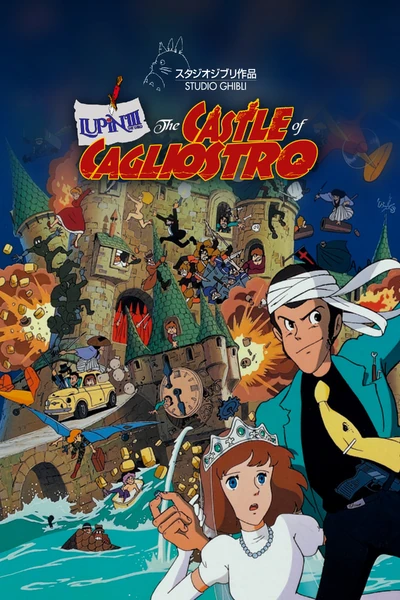
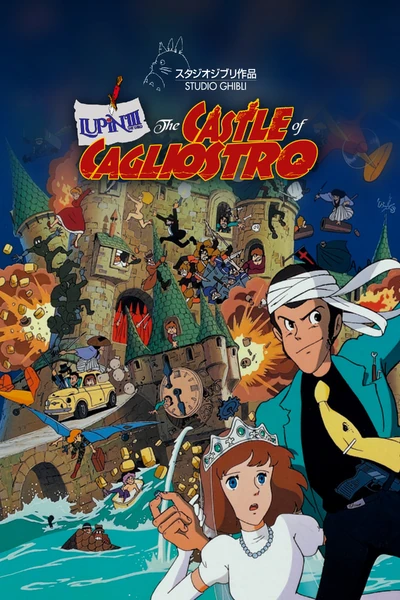
The Castle of Cagliostro (ルパン三世 カリオストロの城) is a 1979 Japanese animated action-adventure film co-written and directed by Hayao Miyazaki. It is the second animated feature film based on Monkey Punch's Lupin III manga and was Miyazaki's debut as a feature film director. Produced by Tokyo Movie Shinsha and distributed by Toho, the film follows master thief Lupin III as he infiltrates the fortress of the sinister Count Cagliostro to rescue Princess Clarisse and uncover the source of a massive counterfeiting operation.
The film was made in just five months, with a production budget of ¥500 million — at the time, the most expensive anime film ever produced. Despite underperforming at the Japanese box office on its initial release (earning ¥610 million), it developed a strong cult following through home video releases and television broadcasts. Readers of Animage magazine voted it "the best anime in history" in 2001, and it holds a 96% approval rating on Rotten Tomatoes.
The Castle of Cagliostro is widely considered the most beloved entry in the entire Lupin III franchise, and its influence extends far beyond anime. Filmmakers at Walt Disney Animation Studios have cited it as an inspiration for films of the Disney Renaissance, and Pixar co-founder John Lasseter has called it one of the greatest adventure films ever made. However, some longtime Lupin III fans have criticized Miyazaki's depiction of Lupin as a chivalrous, good-natured hero, arguing it strays too far from the character's original portrayal as a ruthless and lecherous thief in Monkey Punch's manga.
1 Plot✎
Master thief Lupin III and his partner Daisuke Jigen rob the Monte Carlo Casino, only to discover that their entire haul is made up of remarkably high-quality counterfeit bills. Lupin recognizes them as "goat bills" — legendary counterfeits that have destabilized national economies for centuries — and traces their origin to the tiny Grand Duchy of Cagliostro.
Upon arriving, the pair encounter a young woman in a wedding dress fleeing from armed thugs in a car. They rescue her, but she is recaptured during the chase, leaving Lupin with only her signet ring. He recognizes the woman as Princess Clarisse, who saved his life ten years earlier during a failed attempt to find the legendary treasure of Cagliostro. Count Cagliostro, the country's regent, plans to force Clarisse into marriage to unite their two ancestral rings — the key to unlocking the treasure.
Lupin summons his ally Goemon and deliberately tips off his longtime pursuer, Inspector Zenigata, to create a distraction. Disguised as Zenigata, Lupin infiltrates the castle and reaches Clarisse, but the Count drops him through a trapdoor into the catacombs below. There, Lupin encounters the real Zenigata, and the two form an unlikely alliance. Together they discover the Count's underground counterfeiting operation — a printing press network that has served as the source of Cagliostro's wealth and global influence for generations.
After a daring escape using the Count's own autogyro, a wounded Lupin recovers while his team prepares a final plan. Fujiko Mine, who has been posing as Clarisse's lady-in-waiting, provides intelligence on the castle's layout. Meanwhile, Zenigata attempts to get Interpol to act against the Count, but his superiors shut down the investigation out of fear of political consequences.
On the day of the forced wedding, Lupin crashes the ceremony and escapes with Clarisse and both rings. The Count pursues them to the castle's great clock tower. In the climactic confrontation, the Count seizes the rings and activates the tower's hidden mechanism — but is crushed to death between the converging clock hands. The mechanism drains the lake surrounding the castle, revealing magnificent ancient Roman ruins beneath: the true treasure of Cagliostro.
Clarisse, now the rightful ruler of the duchy, asks Lupin to stay, but he gently declines. As the gang departs, Zenigata resumes his eternal pursuit — this time for the crime of "stealing Clarisse's heart" — while Fujiko slips away with the counterfeit printing plates.
2 Production✎
2.1 Development✎
Miyazaki was offered the directing role following the commercial success of the first Lupin III film, Lupin VS the Clone (1978). He had previously co-directed episodes of the first Lupin TV series alongside Isao Takahata in the early 1970s. Production began in May 1979 with script development and storyboarding, and animation work started in July — before the storyboards were even a quarter finished. The entire film was completed in approximately five months, premiering on December 15, 1979.
Miyazaki began the process by drawing a bird's-eye view of the entire setting before writing the story. The script was divided into four parts, but changes had to be made at the storyboard phase to keep the film within its target running time. Miyazaki served not only as director but also as co-writer, designer, and storyboard artist.
2.2 Influences✎
The film draws on a wide range of sources. The fictional country of Cagliostro and its counterfeiting plot echo elements from Maurice Leblanc's original Arsène Lupin novels, particularly La Justice d'Arsène Lupin (which involves forged banknotes) and The Green-eyed Lady (which features a treasure hidden at the bottom of a lake). The castle's clock tower mechanisms and secret passages were inspired by Ghost Tower by Edogawa Ranpo.
Visually, the castle takes heavy inspiration from the 1952 French animated film The King and the Mockingbird (originally released unfinished as The Shepherdess and the Chimney Sweep), which also features an evil ruler's palace full of traps and a plot centered on rescuing a young woman from a forced marriage.
Personal touches from the staff appear throughout the film. Lupin's iconic yellow Fiat 500 belonged to head animator Yasuo Ōtsuka in real life, while Clarisse's Citroën 2CV was Miyazaki's own first car.
2.3 Music✎
The score was composed by Yuji Ohno, who had been the regular composer for the Lupin III franchise since the second TV series. The soundtrack blends jazz, romance, and orchestral styles, and incorporates variations on Lupin III's iconic TV theme. The music was performed by You & The Explosion Band. The main vocal track, "Fire Treasure," was performed by Bobby (Toshie Kihara). A complete score release, including 13 unused cues, was finally issued in 2003.
"Fire Treasure" Soundtrack, Youtube
2.4 Character changes✎
Miyazaki significantly softened the personalities of the Lupin III cast to fit his vision of a heroic adventure. Lupin became a happy-go-lucky, chivalrous thief driving a humble Fiat 500 — a stark departure from the scheming, lecherous character of the manga who drives a Mercedes-Benz SSK. Jigen and Goemon were made friendlier and more humorous, and the overtly sexual elements typically associated with Fujiko Mine were toned down. Monkey Punch, the manga's creator, called the film "excellent" but acknowledged that Miyazaki's Lupin was quite different from his own.
3 Release✎
3.1 Japan✎
The film premiered in Japanese theaters on December 15, 1979, distributed by Toho. It earned ¥610 million at the domestic box office and sold around 900,000 tickets. While not a blockbuster on initial release, it became enormously popular through repeated television broadcasts and home video releases. A digitally remastered version received a limited theatrical re-release in 2014, and an MX4D version followed in 2017 for the franchise's 50th anniversary.
3.2 International✎
In North America, the film was screened at festivals throughout the early 1980s, including the World Science Fiction Convention in Boston and FILMEX 82 in Los Angeles. However, these screenings attracted little attention — as anime historian Fred Patten noted, audiences largely dismissed it as "only an animated cartoon." Before a proper release, footage from the film was adapted into the arcade laserdisc game Cliff Hanger (1983), combined with footage from the previous Lupin film.
The American theatrical debut came on April 3, 1991, via Streamline Pictures, with a home video release following in October 1992. Due to copyright issues with the estate of Maurice Leblanc (creator of the original Arsène Lupin), the Streamline dub renamed Lupin to "Wolf." A more faithful English dub was produced by Manga Entertainment in 2000, restoring the correct character names.
Discotek Media acquired the North American rights in 2014 and has since released the film on DVD, Blu-ray, and 4K UHD. Their releases include both the Streamline and Manga dubs, multiple subtitle options, interviews, and extensive extras. A third English dub produced by Epcar Entertainment using the voice cast from Part IV was announced in 2025.
4 Reception and legacy✎
Despite its modest initial box office performance, The Castle of Cagliostro has become one of the most acclaimed anime films ever made. It holds a 96% approval rating on Rotten Tomatoes based on 23 reviews, and readers of Animage magazine voted it the greatest anime of all time in 2001. The film received the Ōfuji Noburō Award at the 1979 Mainichi Film Concours.
The film's influence on Western animation has been widely documented. The clock tower climax has been cited as an inspiration for similar sequences in Disney's The Great Mouse Detective (1986) and Batman: Mask of the Phantasm (1993). John Lasseter, co-founder of Pixar, has repeatedly praised the film, and several Disney Renaissance films show its stylistic influence in their adventure sequences and character dynamics.
Within the Lupin III franchise, the film set the template for Miyazaki's later works at Studio Ghibli, which he co-founded with Takahata and producer Toshio Suzuki in 1985. Themes of a resourceful hero rescuing an innocent figure from a corrupt power, elaborate European settings, and thrilling chase sequences recur throughout Miyazaki's filmography, from Castle in the Sky to Howl's Moving Castle. The 2019 CGI film Lupin III: The First was directly modeled on Cagliostro's plot structure.