California
|
California
State of California
| |
|
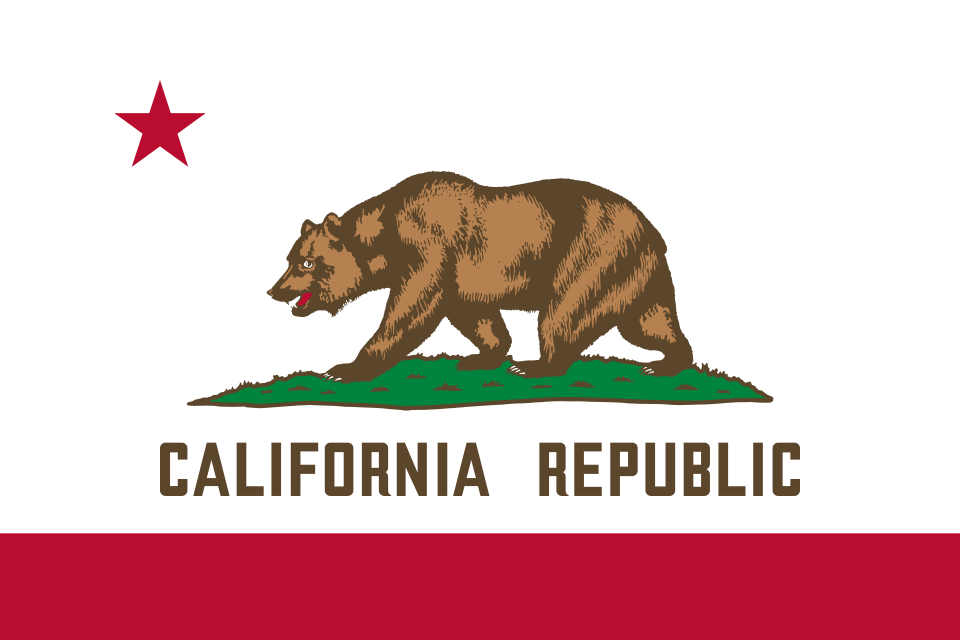
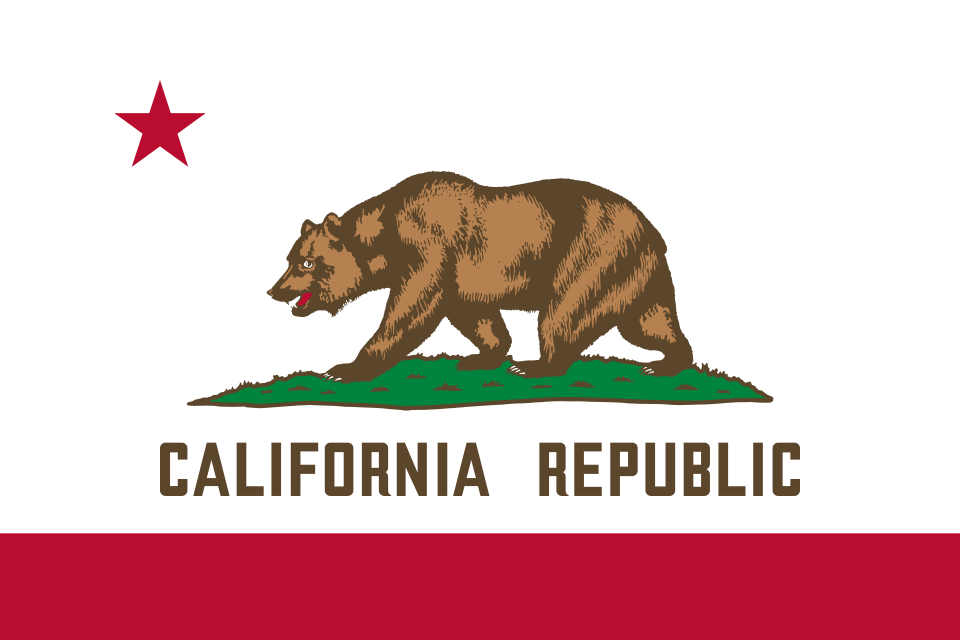
State flag
State seal
| |
| Nickname | The Golden State |
|---|---|
| Motto | "Eureka" |
| Country | United States |
| Region | West Coast |
| Admitted to the Union | 1850.09.09 (31st state) |
| Capital | Sacramento |
| Largest city | Los Angeles |
| Governor | Gavin Newsom |
| Legislature | State Legislature Senate · Assembly |
| Population | 39,431,263 (2024 est., 1st in the U.S.) |
| Area | 423,970 km² (163,696 sq mi, 3rd in the U.S.) |
| Highest point | Mount Whitney 14,505 ft (4,421 m) |
| Lowest point | Badwater Basin −279 ft (−85 m) |
| Time zone | UTC−8 (Pacific) Summer: UTC−7 (PDT) |
| Abbreviation | CA (postal) · US-CA (ISO 3166) |
| Website | ca.gov |

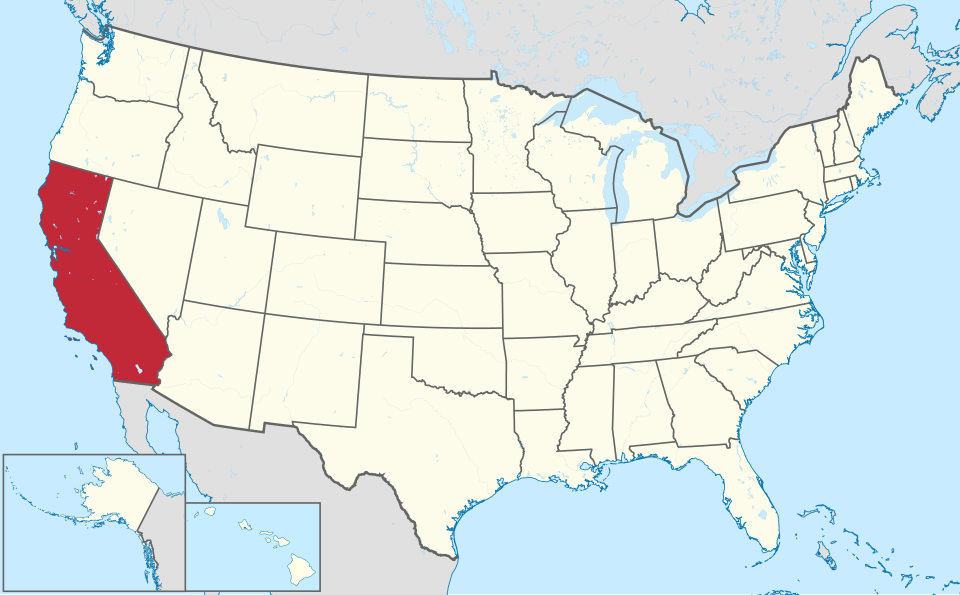
| Location |
|---|
 i i
|

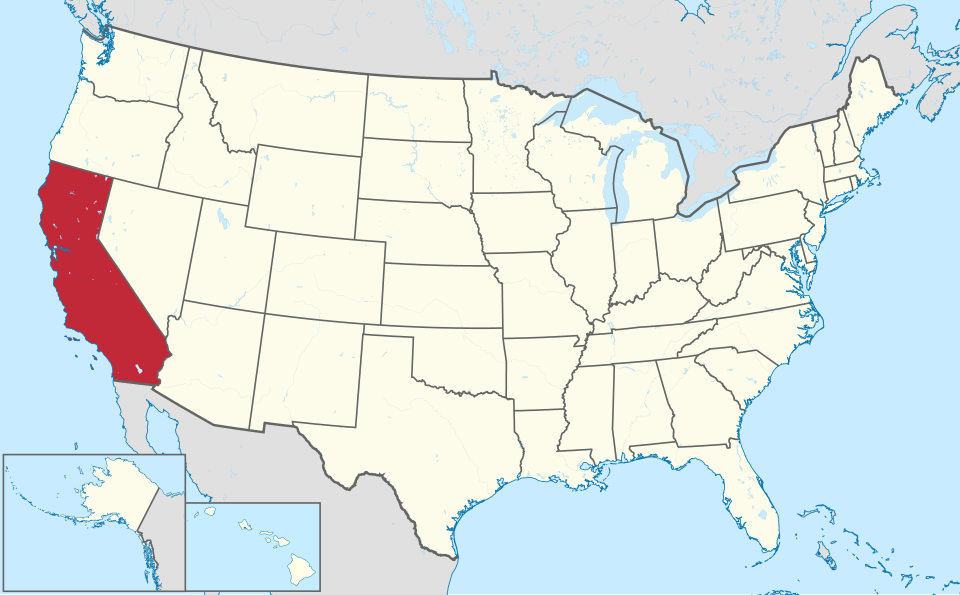
California is a state on the west coast of the United States. About 39 million people live there, which is more than any other state. It is also the third-largest state by land area, after Alaska and Texas.
California borders Oregon to the north, Nevada and Arizona to the east, and the Mexican state of Baja California to the south. The Pacific Ocean runs along its entire western edge. Its capital is Sacramento, and its biggest city is Los Angeles.
The state is famous for a few things in particular. Hollywood, in Los Angeles, has been a center of the movie industry for about a hundred years. Silicon Valley, south of San Francisco, is home to many of the world's largest technology companies. California also grows more food than any other state, especially fruit, nuts, and vegetables from the Central Valley.
California's economy is the largest of any U.S. state. If California were its own country, it would have one of the biggest economies in the world.
1 Name✎
The name "California" probably comes from a made-up place in a Spanish adventure novel. In 1510, a writer named Garci Rodríguez de Montalvo published a story about an island called California, ruled by a queen named Calafia. In the story, the island was full of gold and pearls.
Spanish explorers used the name for the long peninsula that is now Baja California in Mexico. As they explored farther north, the name spread to cover more land. The northern part became known as Alta California ("Upper California"), and that region later became the U.S. state.
For a long time, European mapmakers thought California was an island. Maps showing it that way were still being printed in the 1700s, long after explorers had walked its coastline.
2 History✎
2.1 Native peoples✎
Before Europeans arrived, California was one of the most diverse places in North America. More than 70 different Native groups lived there, speaking dozens of separate languages. Historians think at least 300,000 people lived in California before European contact.
These groups lived very differently depending on where they were. Some lived in the mountains, some in deserts, some along the coast, and some in redwood forests. Coastal groups like the Chumash built large, well-organized communities supported by rich fishing grounds.
Native Californians managed the land carefully. They set small, controlled fires on purpose to clear out dead brush. This kept huge wildfires from starting later. The practice was banned in 1911, but California recognized it as useful again in 2022 and now works with tribes to bring it back.
2.2 Spanish and Mexican rule✎
The first Europeans to see the California coast arrived in 1542, on a Spanish expedition led by the Portuguese captain Juan Rodríguez Cabrillo. But Spain did not really settle the area for another 200 years.
That changed in 1769, when the Portolá expedition traveled north from Mexico. Soldiers led by Gaspar de Portolá and priests led by Father Junípero Serra built the first Spanish settlements. Over the following decades, they set up 21 missions along a route called El Camino Real ("The Royal Road"). Several of California's biggest cities grew from these missions, including San Francisco, San Diego, and Santa Barbara.
The missions were hard on Native people. Many were forced to live and work at them, and huge numbers died from European diseases they had no immunity to.
In 1821, Mexico won independence from Spain, and California became Mexican territory. The Mexican government broke up the mission lands and gave large parcels to private owners. These became enormous cattle ranches called ranchos, run by Spanish-speaking Californians known as Californios.
2.3 Becoming a U.S. state✎
In 1846, American settlers near Sonoma rebelled against Mexican rule. They raised a homemade flag with a bear and a star on it and declared a "California Republic." The republic lasted less than a month, but the flag design is still used as California's state flag today.
That same year, the Mexican–American War broke out. U.S. forces took control of California, and Mexico formally gave up the territory in 1848 under the Treaty of Guadalupe Hidalgo.
Just weeks before that treaty was signed, a carpenter found gold at Sutter's Mill. News spread fast, and the California Gold Rush began. Hundreds of thousands of people poured in from the eastern United States, Europe, Latin America, and Asia. San Francisco grew from about 500 people in 1847 to 150,000 by 1870.
The rush changed California permanently. It also made statehood urgent. On September 9, 1850, California joined the United States as the 31st state, entering as a free state under the Compromise of 1850.
2.4 The California genocide✎
The years after statehood were catastrophic for California's Native peoples.
California's first governor, Peter Hardeman Burnett, openly told the state legislature in 1851 that he expected Native Californians to be wiped out. Between 1850 and 1860, the state government spent roughly $1.5 million hiring armed militias. These militias carried out repeated massacres.
Native people were also driven off their land and forced onto small reservations without enough resources to survive. An 1850 state law allowed Native people described as "loitering" or "orphaned" to be held in what amounted to slavery.
Historians estimate that between 1846 and 1873, at least 9,400 Native Californians were killed, with some estimates running far higher. Many scholars, and Governor Gavin Newsom in 2019, have described this as a genocide.
2.5 1900 to today✎
California grew explosively in the 20th century. In 1900 it had under a million people. By 1965 it had more than any other state.
A lot of that growth came from new industry. Film studios moved to Hollywood in the 1920s, drawn by cheap land, varied scenery, and reliable sunshine. During World War II, California built ships and aircraft on a massive scale, and workers moved in by the hundreds of thousands. After the war, Stanford University pushed its graduates to start companies nearby instead of leaving, and the region that became Silicon Valley took shape.
Building for all these people meant enormous engineering projects: the Golden Gate Bridge, the Bay Bridge, the Shasta and Oroville dams, and long aqueducts to move water south.
The state has also been shaped by disaster. The 1906 San Francisco earthquake and the 1928 St. Francis Dam collapse are among the deadliest disasters in U.S. history. In recent decades, drought and wildfires have gotten worse. A drought from 2011 to 2017 was the worst on record, and the 2018 fire season was the state's deadliest.
3 Geography✎
California is long and narrow, stretching about 760 miles (1,220 km) from north to south. Its geography is unusually varied, and you can go from a beach to a desert to a snowy mountain range in a single day's drive.
3.1 Main regions✎
- The coast — Runs the full length of the state. Cool and foggy in summer near the ocean.
- The Central Valley — A huge flat farming region in the middle of the state, boxed in by mountains on both sides. It is drained by the Sacramento River in the north and the San Joaquin River in the south.
- The Sierra Nevada — A tall mountain range along the eastern edge. It contains Yosemite, Lake Tahoe, and the giant sequoia groves.
- The deserts — The Mojave Desert and Death Valley in the southeast. Very hot and very dry.
3.2 Extremes✎
California contains both the highest and lowest points in the lower 48 states, and they are less than 90 miles apart.
Mount Whitney, in the Sierra Nevada, rises to 14,505 feet (4,421 m). Badwater Basin, in Death Valley, sits 279 feet (85 m) below sea level. Death Valley also holds the highest air temperature ever reliably recorded on Earth: 134 °F (56.7 °C), measured on July 10, 1913.
About 45% of California is covered in forest. Some of the trees are astonishingly old. A bristlecone pine in the White Mountains is more than 5,000 years old, making it one of the oldest known living things on the planet.
3.3 Earthquakes✎
California sits on the Pacific Ring of Fire and is crossed by many fault lines, the biggest being the San Andreas Fault. About 37,000 earthquakes are recorded in California every year, though almost all are too small to feel.
Roughly two-thirds of the United States' total earthquake risk is in California.
3.4 Climate✎
Most of California has a Mediterranean climate: mild wet winters and dry summers. But the state is big enough that this varies a lot.
The coast stays cool because of a cold ocean current running along it. Summer temperatures in Los Angeles and San Francisco are actually among the coolest of any big U.S. city. Move a few miles inland, though, and it gets much hotter. The mountains get real snow in winter. The deserts get very little rain at all.
Northern California gets much more rain than Southern California. Water is a constant political issue because of it.
4 People✎
About one in every nine people in the United States lives in California.
The state grew steadily for over a century, from 1900 to about 2020. Since then, the population has dipped slightly. More people have been moving out of California than moving in, mostly because housing is expensive.
4.1 Race and ethnicity✎
California is a majority-minority state, meaning no single racial or ethnic group makes up more than half the population.
Hispanic or Latino Californians are the largest group, at roughly 39% of the population as of the 2020 census. Non-Hispanic white Californians are about 35%. Asian Californians are about 15%, and Black Californians about 5%.
California has the largest Asian American population of any state — about a third of the entire national total. It also has the largest Native American population of any state.
The mix has changed a lot over time. In 1970, non-Hispanic white residents were about 76% of the state. Today they are about a third.
4.2 Languages✎
English is California's official language, and a little over half of residents speak only English at home.
Spanish is the second most spoken language, used at home by more than 10 million people. Spanish has been spoken in California since 1542 and was the official language of government under Spanish and Mexican rule. California's first constitution, written in 1849, was published in both English and Spanish.
Other widely spoken languages include Chinese, Tagalog, Vietnamese, and Korean. California has more Chinese, Vietnamese, and Punjabi speakers than any other state.
California once had more than 70 Native languages. All of them are now endangered, though tribes are working to bring them back.
5 Economy✎
California has the largest economy of any U.S. state, worth over $4 trillion. If it were a country, it would rank among the top few economies in the world.
5.1 Technology✎
Silicon Valley, in the San Francisco Bay Area, is the world's most important technology hub. Companies headquartered in or near it include Apple, Google, Meta, Nvidia, Intel, and Netflix.
5.2 Entertainment✎
The Los Angeles area is the global center of the film and television industry. The major American movie studios — Disney, Universal, Warner Bros., Paramount, and Sony — are all based there, along with most large animation studios and the major TV networks' production operations.
California is also the birthplace of a long list of music genres, including surf music, West Coast hip hop, punk rock offshoots, and thrash metal.
5.3 Agriculture✎
California produces more food than any other state, and it is not close. The three biggest products by value are milk and cream, almonds, and grapes. Most of it is grown in the Central Valley.
Farming uses a huge amount of the state's water, which is why droughts turn into political fights so quickly.
5.4 Ports✎
The Port of Los Angeles and the Port of Long Beach sit next to each other and together handle around 40% of everything imported into the United States by container. They are the two busiest ports in the country.
6 Government✎
California's government has three branches, like the federal government:
- Executive — Led by the governor, currently Gavin Newsom, plus seven other elected officials.
- Legislative — The California State Legislature, made up of a 40-member Senate and an 80-member Assembly.
- Judicial — Headed by the Supreme Court of California.
California is unusual in how much power voters have directly. Through ballot propositions, voters can pass laws themselves, repeal laws the legislature passed, and even remove the governor from office. California has recalled a sitting governor once, in 2003.
Some famous propositions include Proposition 13 (1978), which capped property taxes, and Proposition 8 (2008), which briefly banned same-sex marriage before courts struck it down.
6.1 Local government✎
California is divided into 58 counties. Inside them are 483 incorporated cities and towns. Under California law, "city" and "town" mean exactly the same thing.
San Francisco is the only place in California where the city and county governments are merged into one.
Schools are run by about 1,100 separate school districts that are independent of both cities and counties.
6.2 Politics✎
California leans strongly Democratic today, but this is fairly recent. From 1952 through 1988, it voted Republican in every presidential election but one. Both Richard Nixon and Ronald Reagan were Southern California Republicans who went on to become president.
Since 1992, California has voted Democratic in every presidential election. Democrats currently hold supermajorities in both houses of the state legislature.
Politically, the coastal cities lean strongly Democratic, while inland and eastern parts of the state lean Republican.
California sends 52 representatives to the U.S. House — more than any other state — and has 54 electoral votes.
7 Education✎
California has more public school students than any other state, over six million.
Public universities are organized into three separate systems:
| System | What it does |
|---|---|
| University of California (UC) | The research university system. Ten campuses, including Berkeley, UCLA, and UC San Francisco (which is medical only). Grants bachelor's, master's, and doctoral degrees. |
| California State University (CSU) | The largest four-year system, with around 430,000 students. Mostly bachelor's and master's degrees. |
| California Community Colleges | 112 colleges and over 2 million students — the largest higher education network in the country. Two-year degrees, job training, and transfer programs. |
California is also home to major private universities, including Stanford University, Caltech, and the University of Southern California.
8 Sports✎
California has 18 major professional sports teams, far more than any other state. The Greater Los Angeles Area alone has ten.
| League | Teams |
|---|---|
| NFL (football) | Los Angeles Rams · Los Angeles Chargers · San Francisco 49ers |
| MLB (baseball) | Los Angeles Dodgers · Los Angeles Angels · San Francisco Giants · San Diego Padres |
| NBA (basketball) | Golden State Warriors · Los Angeles Lakers · Los Angeles Clippers · Sacramento Kings |
| NHL (hockey) | Anaheim Ducks · Los Angeles Kings · San Jose Sharks |
| MLS (soccer) | LA Galaxy · Los Angeles FC · San Jose Earthquakes · San Diego FC |
California is the only U.S. state to have hosted both the Summer and Winter Olympics. Los Angeles held the Summer Games in 1932 and 1984, and will host again in 2028. Squaw Valley (now Palisades Tahoe) hosted the Winter Games in 1960.
Several sports were invented in California, including surfing, skateboarding, and snowboarding.
9 Transportation✎
California is known for car culture, and its cities are known for traffic. The state highway system is run by the California Department of Transportation, usually just called Caltrans.
The Golden Gate Bridge, finished in 1937, had the longest suspension bridge span in the world until 1964. It is one of the most recognizable structures on Earth.
Los Angeles International Airport (LAX) is one of the busiest airports in the world.
The state is building a high-speed rail line to connect its major cities. Voters approved it in 2008 and construction started in 2015, but the project has been slowed by funding problems.
10 See also✎
- United States
- Los Angeles
- San Francisco
- Silicon Valley
- California Gold Rush
- Official State of California website
- U.S. Census Bureau — California QuickFacts