Rashomon
| Rashomon (1950) 羅生門 | |
|---|---|
 i i
| |
| Directed by | Akira Kurosawa |
| Screenplay by | Akira Kurosawa Shinobu Hashimoto |
| Based on | "In a Grove" and "Rashōmon" by Ryūnosuke Akutagawa |
| Produced by | Minoru Jingo |
| Starring | Toshiro Mifune Machiko Kyō Masayuki Mori Takashi Shimura |
| Cinematography | Kazuo Miyagawa |
| Edited by | Akira Kurosawa |
| Music by | Fumio Hayasaka |
| Production company |
Daiei Film |
| Release date | 1950.08.25 (Japan) |
| Running time | 88 minutes |
| Country | Japan |
| Language | Japanese |
| Streaming (US) | YouTube (Free) · HBO Max · Criterion Channel · Kanopy |
| Budget | ¥15–20 million (est.) |
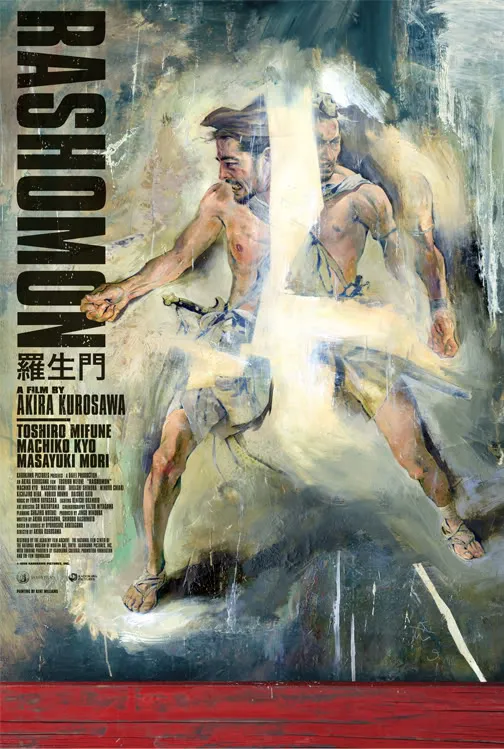
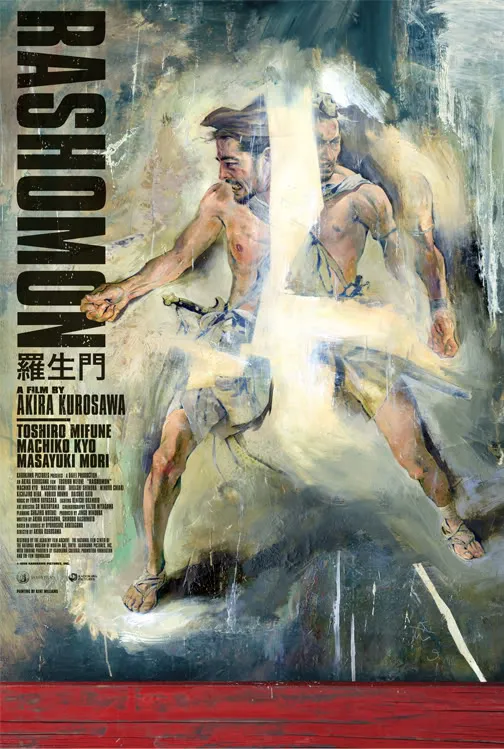
Rashomon (羅生門, Rashōmon) is a 1950 Japanese period drama and psychological thriller directed by Akira Kurosawa, from a screenplay he co-wrote with Shinobu Hashimoto. The plot and characters are drawn from Ryūnosuke Akutagawa's short story "In a Grove," while the title and framing device come from Akutagawa's "Rashōmon." Starring Toshiro Mifune, Machiko Kyō, Masayuki Mori, and Takashi Shimura, the film follows several witnesses and participants who give mutually contradictory accounts of how a samurai came to be murdered in a forest.
Made on a modest budget for the Daiei studio, Rashomon became Kurosawa's first major international success. It won the Golden Lion at the 1951 Venice International Film Festival and an Honorary Academy Award for the most outstanding foreign language film, marking the first time a Japanese film achieved significant recognition in the West and helping open international markets to Japanese cinema. Its central device — a single event recounted in incompatible versions, with no version confirmed as true — became so influential that the term "Rashomon effect" entered common usage to describe contradictory interpretations of the same event.
1 Plot✎
Three men — a woodcutter, a priest, and a commoner — shelter from a downpour beneath the ruined Rashomon gate in Kyoto. The woodcutter and priest, deeply disturbed, recount a crime they have just testified about in court. The film presents the events through four conflicting accounts.
The bandit Tajōmaru claims he tricked and bound the samurai, seduced his wife, and then killed the samurai in an honorable duel of crossed swords. The wife's account describes fainting after the assault and waking to find her husband dead, overcome by guilt and her husband's contemptuous gaze. The dead samurai, testifying through a spirit medium, claims he took his own life with his wife's dagger after she urged the bandit to kill him. Finally, the woodcutter — who admits he witnessed the whole event — describes a clumsy, cowardly fight in which neither man was the warrior he claimed to be.
Back at the gate, the commoner exposes the woodcutter's own dishonesty: he had concealed that he stole the wife's valuable dagger from the scene. As the rain stops, the men discover an abandoned baby. The woodcutter offers to raise the child alongside his own, restoring some measure of the priest's faith in humanity, and departs into the clearing light.
2 Cast✎
- Toshiro Mifune as Tajōmaru, the bandit
- Machiko Kyō as Masako, the samurai's wife
- Masayuki Mori as Takehiro, the samurai
- Takashi Shimura as the woodcutter
- Minoru Chiaki as the priest
- Kichijirō Ueda as the commoner
- Noriko Honma as the medium
- Daisuke Katō as the policeman
Kurosawa had initially hoped to cast only previous collaborators. He offered the role of the wife to Setsuko Hara, but she was not cast after her brother-in-law objected; Daiei executives instead recommended Machiko Kyō, believing her casting would make the film easier to market. Kurosawa agreed after Kyō demonstrated her commitment by shaving her eyebrows before a makeup test. To develop Tajōmaru's animalistic physicality, Mifune reportedly modeled the performance on a lion Kurosawa had seen in a documentary.
3 Production✎
Development began in 1948 at Kurosawa's regular studio, Toho, but was cancelled as too great a financial risk. Two years later, after Kurosawa completed Scandal, producer Sōjirō Motoki pitched the project to Daiei. The studio agreed in part because the small cast and three sets promised a low budget. Principal photography ran from July 7 to August 17, 1950, primarily in Kyoto, on an estimated ¥15–20 million budget — a figure the production exceeded, largely due to the construction of the enormous Rashomon gate set designed by Takashi Matsuyama.
Working with cinematographer Kazuo Miyagawa, Kurosawa pursued a bold visual style that included pointing the camera directly at the sun, a technique then considered taboo. Mirrors were used to amplify natural sunlight, and because the camera could not capture clear water, black ink was mixed into the rain pumped through the hoses for the gate scenes. The cast and crew lived together during the shoot, a close-knit arrangement Kurosawa found beneficial. Post-production took only about a week and was slowed by two fires.
4 Release and reception✎
Rashomon premiered at the Imperial Theatre in Tokyo on August 25, 1950, and went into nationwide distribution the next day. It was a moderate commercial success, ranking among Daiei's highest-grossing films of the year, though Japanese critics were divided — praising the experimental direction and cinematography while faulting the adaptation and its complexity.
The film's international reputation was established when it won the Golden Lion at the 1951 Venice International Film Festival, reportedly entered without the full confidence of the studio, whose head is said to have disliked it. It went on to receive an Honorary Academy Award for the most outstanding foreign language film. It was released in the United States by RKO Radio Pictures in late 1951 in both subtitled and dubbed versions, and had grossed several hundred thousand dollars overseas within a few years — far exceeding the combined foreign earnings of earlier Japanese films.
5 Themes and legacy✎
The film is widely read as a meditation on the subjectivity of truth and the unreliability of human perception and memory. Each narrator reshapes events to present an idealized version of themselves, and Kurosawa pointedly never reveals which account, if any, is accurate; he maintained that the film's purpose was not to resolve one reality but to explore several. Some critics emphasize a darker reading — that the characters are not merely misremembering but deliberately lying out of pride and self-preservation — while the closing scene with the abandoned child introduces a measured note of hope.
Rashomon has been called one of the most influential films of the 20th century. Its nonlinear structure and use of contradictory flashbacks — including testimony delivered from beyond the grave — were largely without precedent and have been borrowed repeatedly across cinema and television. Film historians have credited it with helping to launch the international art-house movement of the postwar era, and the "Rashomon effect" remains a standard term in fields ranging from law to psychology for situations in which witnesses give irreconcilable accounts of the same event.