Mario franchise
|
[ Show/Hide ]
|

|
Mario Franchise
マリオシリーズ(Mario Series)
| |||||||||||||||
 i i
| |||||||||||||||
| Creator | Shigeru Miyamoto | ||||||||||||||
|---|---|---|---|---|---|---|---|---|---|---|---|---|---|---|---|
| Publisher | Nintendo | ||||||||||||||
| First game | Donkey Kong (1981) | ||||||||||||||
| Flagship series | Super Mario | ||||||||||||||
| Protagonist | Mario | ||||||||||||||
[ More / Less ]
| |||||||||||||||
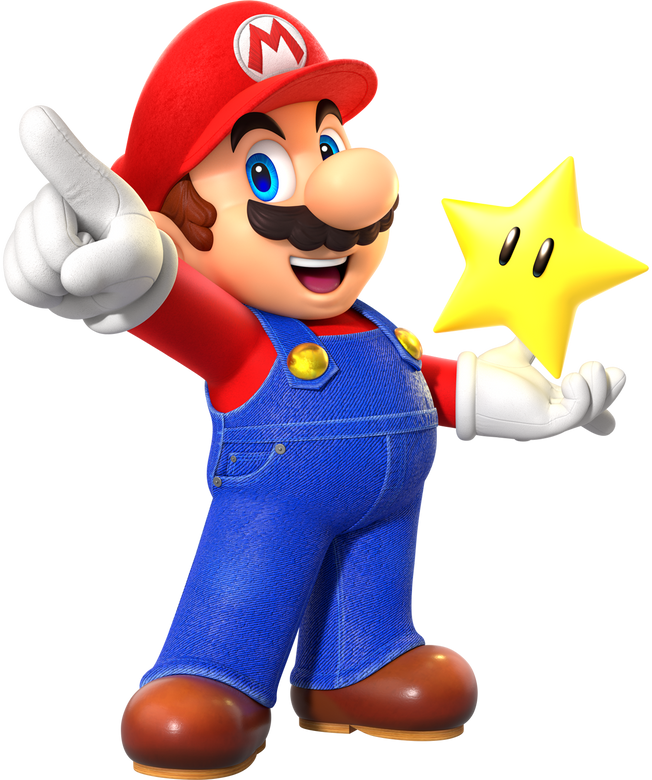

The Mario franchise (also known as the Super Mario franchise) is a media franchise consisting primarily of video games published and produced by the Japanese company Nintendo. Created by game designer Shigeru Miyamoto, the franchise centers on the fictional character Mario, an Italian plumber who serves as the hero of the Mushroom Kingdom. The franchise's first installment was the arcade game Donkey Kong, released on July 9, 1981. Mario went on to star in Mario Bros. (1983), the first game bearing his name, and the iconic Super Mario Bros. (1985), the side-scrolling platformer that established the franchise's central formula and became a cultural phenomenon.
The main series in the franchise is the Super Mario series of platform games, which typically follows Mario and his brother Luigi as they adventure through the Mushroom Kingdom to rescue Princess Peach from the villain Bowser and his army of minions. Beyond platforming, the franchise has expanded into racing (Mario Kart series), party games (Mario Party series), role-playing games (Paper Mario series, Mario & Luigi series), puzzle games (Dr. Mario series), sports games (Mario Tennis series, Mario Golf series, Mario Strikers), and numerous other genres. Several characters introduced in the franchise — including Luigi, Yoshi, Wario, and Donkey Kong — have spawned successful franchises of their own.
With over 300 titles and combined sales exceeding 950 million copies, the Mario franchise is the best-selling video game franchise of all time.[1] It is Nintendo's flagship franchise and one of the highest-grossing media franchises in the world. Many of its games — particularly within the Super Mario platformer series — are widely regarded as among the greatest video games ever made. The franchise has also been adapted into television series, anime, feature films, manga, and a theme park attraction.
1 Overview✎
The Mario franchise encompasses a vast library of games across nearly every genre in gaming. At its core is the Super Mario platformer series, but the franchise has branched into racing, sports, party, puzzle, and role-playing games, all unified by a shared cast of characters and the colorful setting of the Mushroom Kingdom. The franchise is notable for its accessibility, inventive game design, and the consistent involvement of Nintendo's internal development teams — particularly Nintendo Entertainment Planning & Development, led for decades by Miyamoto. While the majority of titles are developed and published by Nintendo, others have been created by partner studios such as Intelligent Systems, Camelot Software Planning, AlphaDream, Next Level Games, and Ubisoft Milan, typically under Nintendo's supervision.
2 Origins✎
2.1 Donkey Kong and the birth of Mario✎
The character who would become Mario originated in the 1981 arcade game Donkey Kong. After the commercial failure of Radar Scope, Nintendo president Hiroshi Yamauchi tasked Shigeru Miyamoto with designing a new arcade game to salvage the situation. Miyamoto created a game in which a small carpenter — initially called "Jumpman" — must navigate platforms, ladders, and rolling barrels to rescue a woman named Pauline from a giant ape. Donkey Kong was an early example of the platform game genre and a surprise commercial hit.
The character was renamed "Mario" in certain promotional materials for the game's overseas release. His namesake was Mario Segale, the landlord of Nintendo of America's warehouse. According to one popular account, Segale interrupted a meeting to demand overdue rent; a conflicting version from former warehouse manager Don James states that employees named the character after Segale as a joke because he was so reclusive that none of them had ever met him.[2]
Mario appeared again in 1982's Donkey Kong Jr. — this time as the game's villain — and in Donkey Kong 3 (1983), where the protagonist was instead a character named Stanley. Donkey Kong would eventually be spun off into its own distinct Donkey Kong franchise.
2.2 Mario Bros.✎
In 1983, Mario Bros. was released as an arcade game and became the first title to feature "Mario" in its name. It also introduced Mario's brother, Luigi, as a second playable character. Unlike later Mario games, players could not defeat enemies by jumping on them — instead, they had to bump enemies from below to flip them over and then kick them off the platform. The game featured a mechanism allowing players to exit one side of the screen and reappear on the other. Mario Bros. established the cooperative multiplayer dynamic between Mario and Luigi that would persist throughout the franchise.
3 Super Mario platformer series✎
The Super Mario series is the franchise's flagship, consisting of the mainline platform games that define the broader franchise's identity. The series began with Super Mario Bros. in 1985, packaged as the launch title for the Nintendo Entertainment System (NES). In the game, Mario travels through the Mushroom Kingdom to rescue Princess Peach (then known as Princess Toadstool) from Bowser, the king of the Koopas. The game sold over 40 million copies on the NES and Famicom alone and was the world's best-selling video game until 2009.[3]
Sequels followed rapidly. In Japan, a direct sequel with significantly harder levels was released in 1986 for the Famicom Disk System, but Nintendo of America deemed it too difficult for Western audiences and instead released a different game under the title Super Mario Bros. 2 (1988) — actually a reworked version of the unrelated Famicom title Yume Kōjō: Doki Doki Panic. Super Mario Bros. 3 (1988) and Super Mario World (1990, SNES launch title) followed and are widely considered among the greatest video games ever made. Super Mario World introduced Yoshi, a rideable dinosaur companion who became so popular he spawned his own franchise.
The series made the landmark transition to 3D with Super Mario 64 (1996), the launch title for the Nintendo 64. Its open-ended, explorable environments redefined 3D game design. Subsequent 3D entries include Super Mario Sunshine (2002, GameCube), the Super Mario Galaxy duology (2007 and 2010, Wii), Super Mario 3D Land (2011, 3DS), Super Mario 3D World (2013, Wii U), and Super Mario Odyssey (2017, Nintendo Switch).
In parallel, the New Super Mario Bros. subseries revived classic 2D side-scrolling gameplay for modern hardware, beginning with New Super Mario Bros. (2006, DS) and continuing through titles on the Wii, 3DS, and Wii U. Super Mario Bros. Wonder (2023) further refreshed the 2D formula with new mechanics on the Nintendo Switch. The Super Mario Maker games (2015, 2019) gave players tools to create and share their own Mario levels.
4 Spin-off series✎
4.1 Mario Kart✎
The Mario Kart series is a line of kart racing games and is arguably the franchise's most commercially successful spin-off. Beginning with Super Mario Kart (1992, SNES), the series has players compete in go-kart races as characters from the Mario franchise, using power-up items — such as shells, banana peels, and speed-boosting mushrooms — obtained from item boxes on the track. Each new installment has introduced innovations such as motorbikes, hang gliders, underwater driving, anti-gravity racing, and online multiplayer. The series has sold over 150 million copies worldwide.[4] Mario Kart 8 Deluxe (2017, Switch) has sold over 79 million copies, making it the best-selling game in the entire franchise.
4.2 Mario Party✎
The Mario Party series consists of multiplayer party games in which four characters compete on a virtual board game interspersed with minigames. The series began with Mario Party (1998, N64), originally developed by Hudson Soft. Development later transferred to NDcube after Hudson was absorbed by Konami. The series includes numbered sequels, handheld entries, and titles like Super Mario Party (2018) and Super Mario Party Jamboree (2024). The series has sold over 84 million copies.
4.3 Role-playing games✎
The first RPG in the franchise was Super Mario RPG: Legend of the Seven Stars (1996, SNES), a collaboration between Nintendo and Square (now Square Enix) that blended turn-based combat with platforming elements and pre-rendered 3D graphics.
The Paper Mario series, developed by Intelligent Systems, began with Paper Mario (2000, N64). These games feature a distinctive paper-craft art style and combine RPG mechanics with platforming. The series has evolved considerably across its entries — from the traditional RPG structure of Paper Mario: The Thousand-Year Door (2004), to the genre-bending Super Paper Mario (2007), to the more puzzle-oriented Sticker Star (2012) and Color Splash (2016), to Paper Mario: The Origami King (2020).
The Mario & Luigi series, developed by AlphaDream, focused on handheld RPGs with real-time action commands during turn-based battles. Beginning with Mario & Luigi: Superstar Saga (2003, GBA), the series spanned five main entries through Mario & Luigi: Brothership (2024, Switch).
4.4 Sports games✎
The franchise has produced extensive sports game lineups. The Mario Tennis series, developed primarily by Camelot Software Planning, began with Mario's Tennis (1995, Virtual Boy) and the more widely known Mario Tennis (2000, N64). The Mario Golf series, also by Camelot, debuted with Mario Golf (1999, N64). Both series continued across subsequent Nintendo platforms. The Mario Strikers series introduced arcade-style soccer, developed by Next Level Games, while the Super Mario Stadium games covered baseball. A crossover series with Sega's Sonic the Hedgehog, the Mario & Sonic Olympic Games titles, ran from 2007 to 2019.
4.5 Puzzle games✎
The Dr. Mario series began in 1990 on the NES and Game Boy. In these games, Mario takes on the role of a doctor who must eradicate viruses by matching colored capsules, in a mechanic similar to Tetris. The Mario's Picross series applied Mario branding to nonogram logic puzzles. The Mario vs. Donkey Kong series, beginning in 2004, combined puzzle-solving with platforming and featured miniature Mario toys.
4.6 Other spin-offs✎
The franchise's reach extends further into the Luigi's Mansion series action-adventure series (2001–), in which Luigi uses a vacuum-like device to capture ghosts; Captain Toad: Treasure Tracker (2014), an isometric puzzle game spun off from Super Mario 3D World; the Super Mario Maker level-creation games; and Mario + Rabbids Kingdom Battle (2017) and its sequel Mario + Rabbids Sparks of Hope (2022), tactical RPGs developed by Ubisoft Milan as crossovers with Ubisoft's Rabbids franchise. A handful of educational games were also produced in the early 1990s by third-party developers under Nintendo license.
5 Characters✎
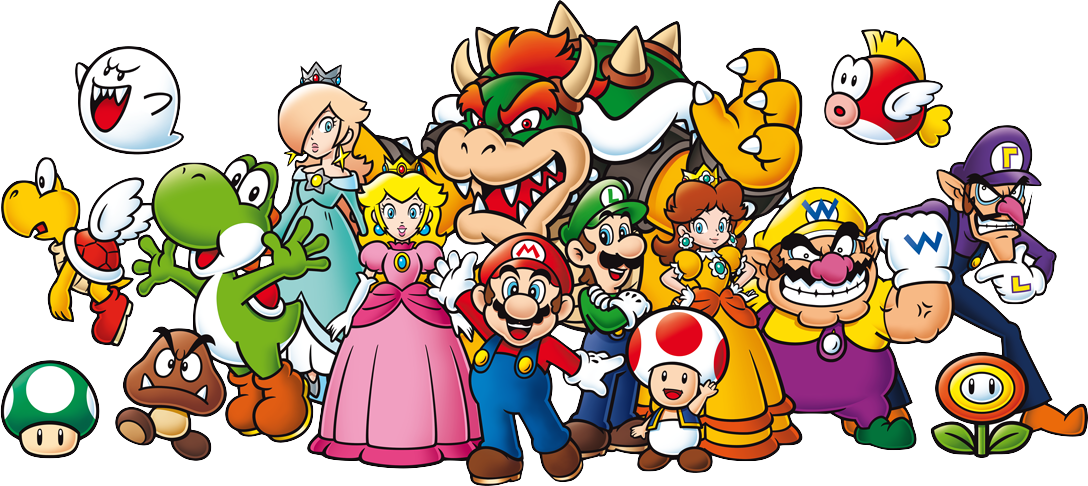
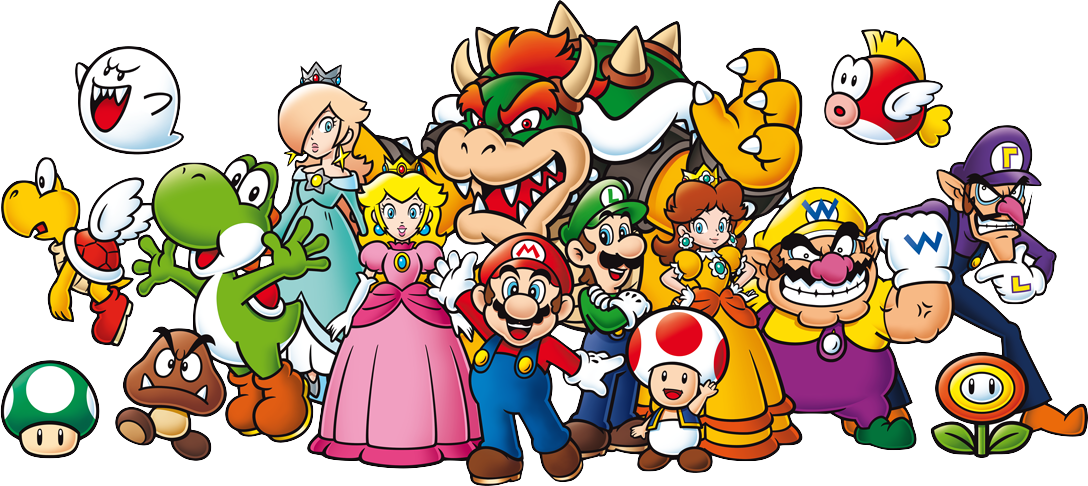
The franchise revolves around an extensive cast of recurring characters. Mario, the titular protagonist, is a fictional Italian plumber who defends the Mushroom Kingdom by traversing obstacle-filled stages. His younger but taller twin brother, Luigi, often accompanies him and has starred in his own games. Princess Peach, the ruler of the Mushroom Kingdom and Mario's love interest, frequently serves as the damsel in distress kidnapped by the primary antagonist, Bowser, the king of the Koopas. The Mushroom Kingdom's inhabitants, the Toads, often provide support to Mario on his quests.
Yoshi, a dinosaur-like creature introduced in Super Mario World, serves as a rideable companion and spawned his own franchise. Wario, Mario's greedy rival, debuted as the antagonist of Super Mario Land 2: 6 Golden Coins (1992) and went on to headline the Wario Land series and WarioWare series. Donkey Kong, originally Mario's first adversary in the 1981 arcade game, became the star of his own platforming series developed by Rare and later Retro Studios.
Other notable characters include Princess Daisy, ruler of Sarasaland; Waluigi, Wario's frequent partner in spin-offs; Rosalina, the cosmic guardian introduced in Super Mario Galaxy; Toadette, who has grown from a spin-off character into a playable protagonist; Bowser Jr., Bowser's son; the Koopalings, a group of seven boss characters; and Pauline, Mario's original damsel in distress who was later reimagined as a city mayor and singer.
The franchise features a distinctive roster of enemies — most serving Bowser as his minions. The most common are Goombas (mushroom-like traitors to the Mushroom Kingdom, typically defeated with a single stomp) and Koopa Troopas (turtle soldiers who retract into throwable shells). Other iconic enemies include Boos (shy ghosts), Piranha Plants (pipe-dwelling carnivorous plants), Bullet Bills, Bob-ombs, Chain Chomps, Lakitus, Hammer Bros, and the skeletal Dry Bones.
6 Other media✎
6.1 Television✎
Several animated television series based on the franchise aired in the late 1980s and early 1990s. The Super Mario Bros. Super Show! (1989) combined live-action segments with animation. It was followed by The Adventures of Super Mario Bros. 3 (1990) and Super Mario World (1991). Earlier, segments based on Donkey Kong and Donkey Kong Jr. appeared in Saturday Supercade (1983–1985), a Saturday morning cartoon on CBS featuring various arcade game characters.
6.2 Film✎
The franchise's first film adaptation was an anime theatrical release, Super Mario Bros.: The Great Mission to Rescue Princess Peach! (1986), produced in Japan. In 1993, a live-action Super Mario Bros. film was released, starring Bob Hoskins and John Leguizamo. The film diverged dramatically from the games' colorful world and underperformed at the box office.
In stark contrast, the 2023 animated film The Super Mario Bros. Movie, produced by Illumination and Nintendo, broke box office records and grossed over $1.3 billion worldwide. A sequel, The Super Mario Galaxy Movie, is scheduled for release on April 3, 2026.
6.3 Manga, comics, and print✎
The franchise has been adapted into numerous manga series in Japan, most notably the long-running Super Mario-Kun (1991–present). Western comics include the Nintendo Comics System (1990–1991) and Super Mario Adventures (1992–1993), serialized in Nintendo Power.
6.4 Theme parks✎
Super Nintendo World, a themed area based on the franchise, opened at Universal Studios Japan in Osaka in 2021. Additional locations have opened or are under construction at Universal theme parks in Hollywood, Orlando, and Singapore. The areas feature physical recreations of Mushroom Kingdom environments, interactive gameplay elements, and rides including a Mario Kart attraction.
7 Cultural impact and legacy✎
The Mario franchise is widely credited with revitalizing the North American home video game market after the video game crash of 1983. Super Mario Bros. was the pack-in title for the NES, and the game's success was instrumental in establishing Nintendo's dominance of the industry throughout the late 1980s and early 1990s. Mario himself became one of the most recognizable fictional characters in the world — in one widely cited survey, more American children could identify Mario than Mickey Mouse.
The franchise has been recognized as the best video game franchise by multiple publications, including IGN, which ranked it first in 2006. Multiple individual titles — particularly Super Mario Bros., Super Mario Bros. 3, Super Mario World, Super Mario 64, and Super Mario Galaxy — regularly appear on lists of the greatest video games ever made. Super Mario 64 in particular is credited with defining 3D game design and influencing virtually every 3D action game that followed.
During the 1990s, Mario was at the center of the "console wars" between Nintendo and Sega, with Mario and Sonic the Hedgehog serving as the rival mascots of the SNES and Sega Genesis respectively. Nintendo ultimately prevailed in terms of long-term sales, and the former rivals eventually collaborated on crossover titles such as the Mario & Sonic at the Olympic Games series.
The franchise has grossed an estimated $60 billion worldwide across video games, merchandise, films, and other licensing — making it one of the highest-grossing media franchises in history.
8 See also✎
- Mario
- Super Mario series
- Mario Kart series
- Nintendo
- Shigeru Miyamoto
- Donkey Kong franchise
- The Super Mario Bros. Movie
- Super Nintendo World
- Nintendo IR Information: Dedicated Video Game Sales Units (as of December 31, 2025). [https://www.nintendo.co.jp/ir/en/finance/hard_soft/index.html nintendo.co.jp/ir]. The core Super Mario platformer series alone has sold over 430 million copies.
- The original account appears in David Sheff, Game Over: How Nintendo Conquered the World (1993). Don James's conflicting version was given in an interview on Wired's Game
- Nintendo IR Information: Top Selling Title Sales Units. [https://www.nintendo.co.jp/ir/en/finance/hard_soft/index.html nintendo.co.jp/ir].
- Nintendo IR Information: Dedicated Video Game Sales Units. [https://www.nintendo.co.jp/ir/en/finance/hard_soft/index.html nintendo.co.jp/ir].