Loading history…
Black Desert/Node War
This is r1 (the current revision), saved by jack. Full history


|
Node War
guilds, nightly, for the map
| |
 i i
| |
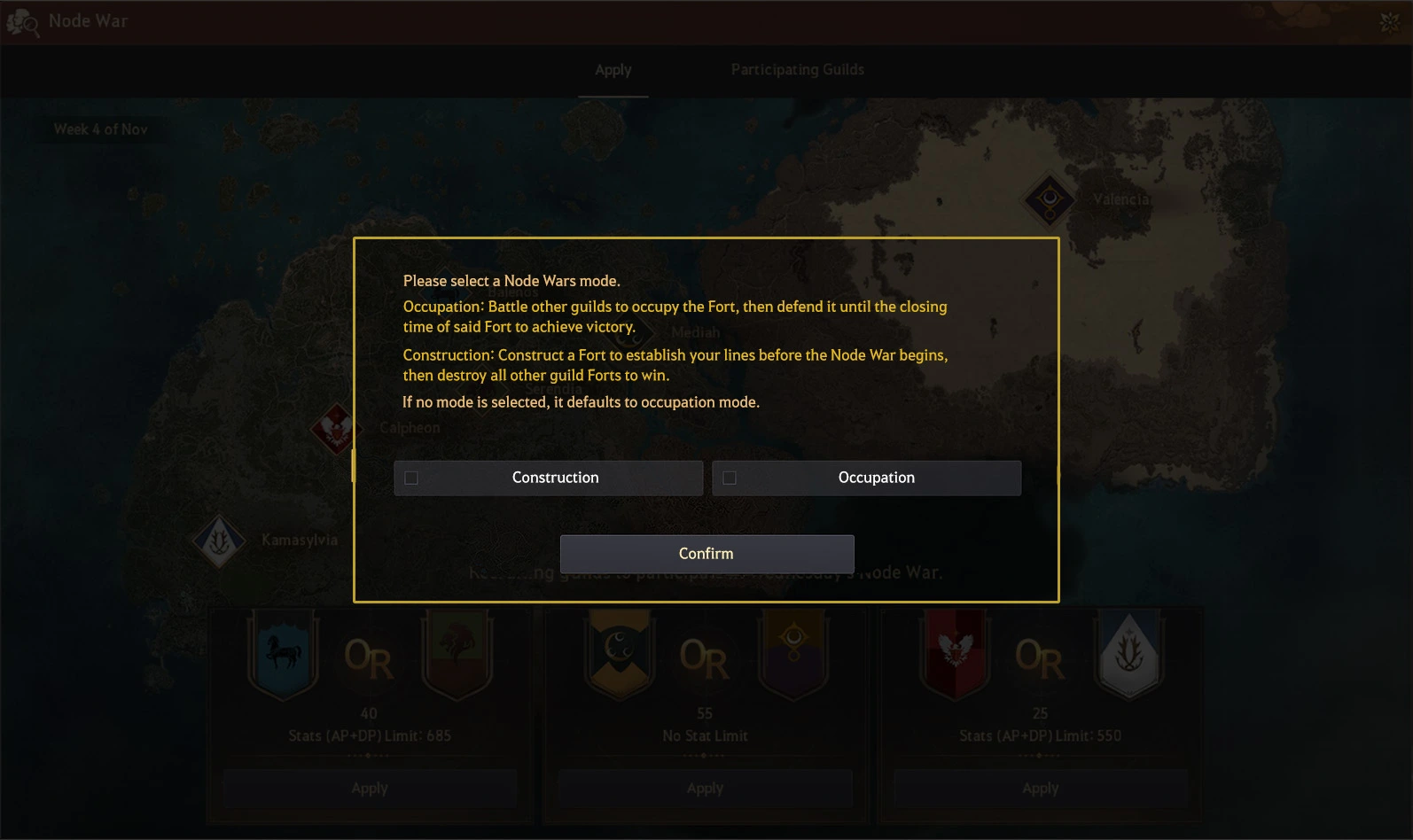
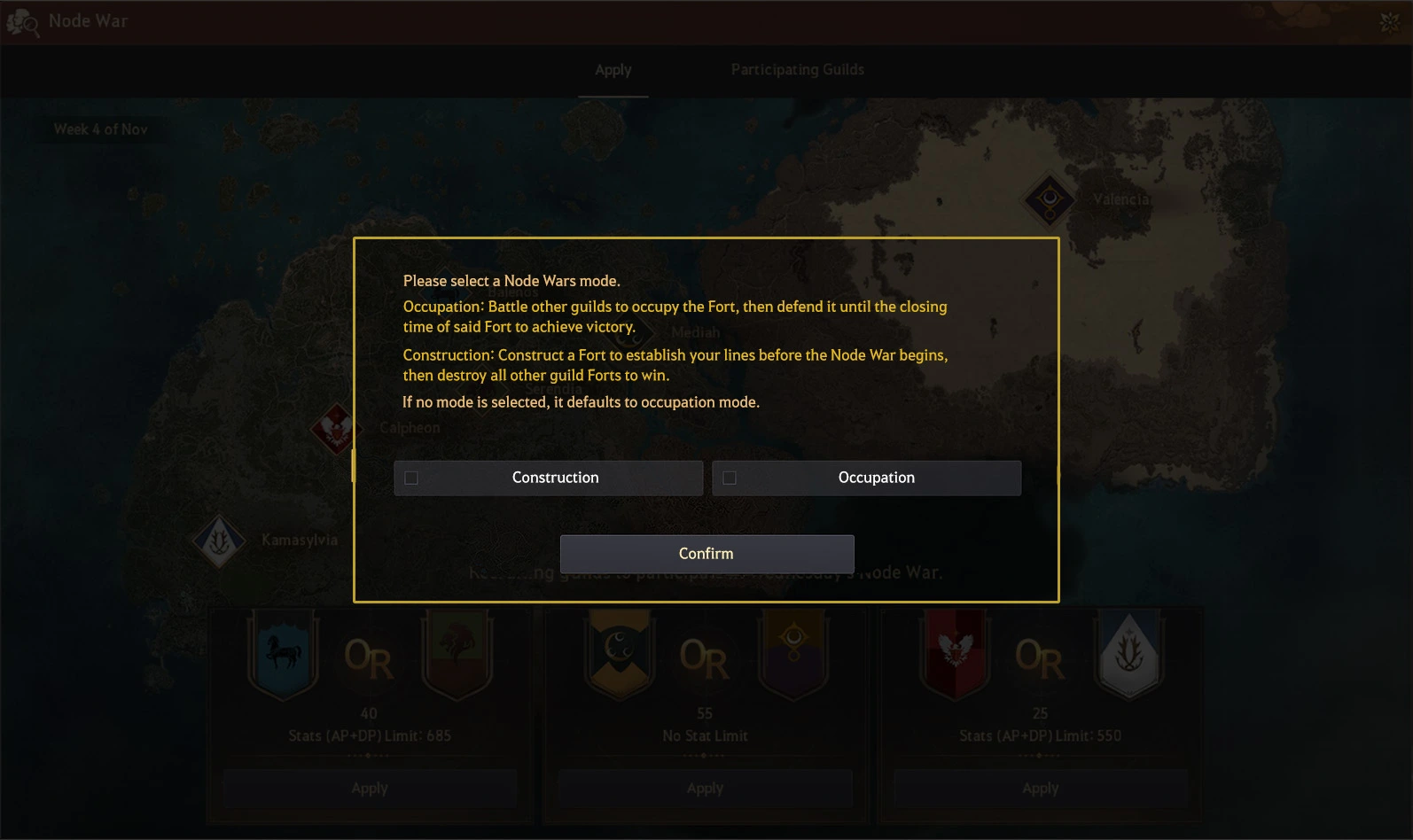
Choosing a mode in the Node War window From the Adventurer's Guide, Pearl Abyss
| |
| Fought by | Guilds, not individuals |
|---|---|
| Runs | Nightly, except Saturdays |
| Length | One or two hours, by mode |
| Contested in | Six territories, from Balenos to Edania |
| Brackets | Three tiers, capped by size and by gear |
| Prize | The node's tax revenue, paid to the guild |
| On Saturdays | Conquest War instead |
Node War is the nightly contest between guilds for control of the map in Black Desert. A node is put up for grabs, guilds sign up for it, and whoever holds the fort when the clock stops owns the node and collects its taxes.
It is scheduled rather than open. The war happens at a set hour every evening, applications close beforehand, and outside that window the same ground is as peaceful as anywhere else.
What makes it work as a system is the bracketing. Rather than one arena where the strongest guild wins everything, the territories are divided into tiers with limits on how many players a guild may field and how strong they may be.
1 The brackets✎
Six territories host node wars, running from Balenos and Serendia at the bottom through Calpheon and Ulukita to Valencia and Edania at the top.
The lower tiers cap both the size of the force a guild may bring and the equipment its members may wear. Those caps loosen as the tiers rise, until the highest has no gear restriction at all. A newer guild therefore has a bracket it can actually compete in, rather than being matched against the best-equipped players in the game.
Player limits rise with the tiers as well, from a couple of dozen at the bottom to several times that at the top.
2 The two modes✎
A war runs in one of two forms, and the choice changes both the length and the objective.
Occupation is the current standard and the simpler of the two. No building is required beforehand, a guild applies through the node war window, and victory means holding the fort when the hour ends.
Construction is the older arrangement and runs for two hours. A guild raises its own fort before the war begins, and winning means destroying every other guild's fort rather than holding one.
Guilds may also build annexes during a war — flame towers, a hwacha, an elephant nursery, a flag factory — in strictly limited numbers. None of it survives; every annex is demolished automatically when the war ends.
3 What the winner gets✎
The node's taxes transfer to the occupying guild, and the sums are large enough that holding good nodes is the main income of a serious guild rather than a bonus.
Individual members are paid separately, and not merely for turning up. A guild has to reach a set number of kills across its members and to have held a temporary fort at least once before its players qualify for the personal rewards.
4 Conquest War✎
Saturdays are different. Conquest War replaces the nightly node wars, is fought over whole territories rather than single nodes, and pays several times what a node does.
It also decides how the following week is played, because the winning guild chooses which of the two modes the next week's node wars will use.
5 See also✎
6 Further reading✎
Content available under CC BY-SA 4.0