Black Desert/Node


|
Node
the unit the world is divided into
| |
Nodes linked into a connected chain From the Black Desert Wiki, Pearl Abyss
| |
| Activated with | Contribution Points, at a node manager |
|---|---|
| Kinds | Towns, trade posts, gateways, danger zones and plain nodes |
| Beneath them | Production nodes, for farming, mining, lumbering, crafting and excavation |
| Worked by | Workers, sent from a town |
| Must be | Connected to an already-active node |
| If unconnected | Trade goods fetch a fraction of their value |
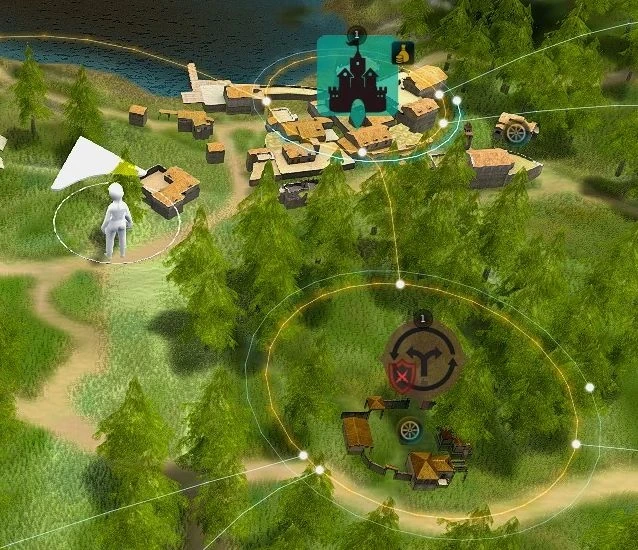


A node in Black Desert is a single point on the map that an adventurer can invest in: a farm, a mine, a stretch of forest, a hunting ground or a town. The whole economy is built out of them.
Nodes are what turn a large world into a working one. Territory is divided into them, workers are sent to them, and trade runs along the lines between them, so an adventurer's economic reach is best described as the set of nodes they hold.
Investment is made with Contribution Points rather than silver, and it is returned in full if the node is later released. Building a network costs an adventurer capacity rather than money.
1 Activating a node✎
Each node has a manager who has to be found before anything can be done with the node, and investment is then made through that NPC using contribution.
One rule shapes everything else: a node can only be invested in if it already connects to an active one, so networks grow outward from the cities rather than appearing wherever an adventurer likes. Reaching a rich node a long way from a town means paying for the chain of nodes in between as well.
2 Kinds of node✎
The nodes on the map itself come in several sorts. Towns and cities are the safe points with the full range of services, trade posts offer a narrower set, gateways sit on the frontiers near dangerous country, and danger zones are the monster grounds themselves. Plain nodes are simply places with a manager and little else.
Beneath those sit the production nodes, which are attached to a map node rather than standing on their own. Each specializes in one thing: farming, mining, lumbering, crafting or excavation.
3 Why connection matters✎
A connected chain is worth far more than the same nodes held separately.
Trade is the clearest case. Goods carried between connected nodes sell for their full value, and goods sold across a gap fetch about a third of it, which is enough to decide whether a route is worth running at all. Transport between linked nodes also costs less than transport across a gap.
Workers depend on it too, since a connected network lets them carry materials between towns, which is what makes a workshop in one city able to draw on a mine in another.
4 Workers and production✎
A production node does nothing on its own. Once contribution has been invested in it, a worker is assigned from a nearby town, and it gathers from that node indefinitely and deposits what it collects into the town's storage.
That arrangement is what makes the economy passive. An adventurer who has invested well accumulates ore, timber and crops without visiting any of the places they come from.