Ubuntu (operating system)
|
26.04 LTS · "Resolute Raccoon"
| |
 i i
| |
|
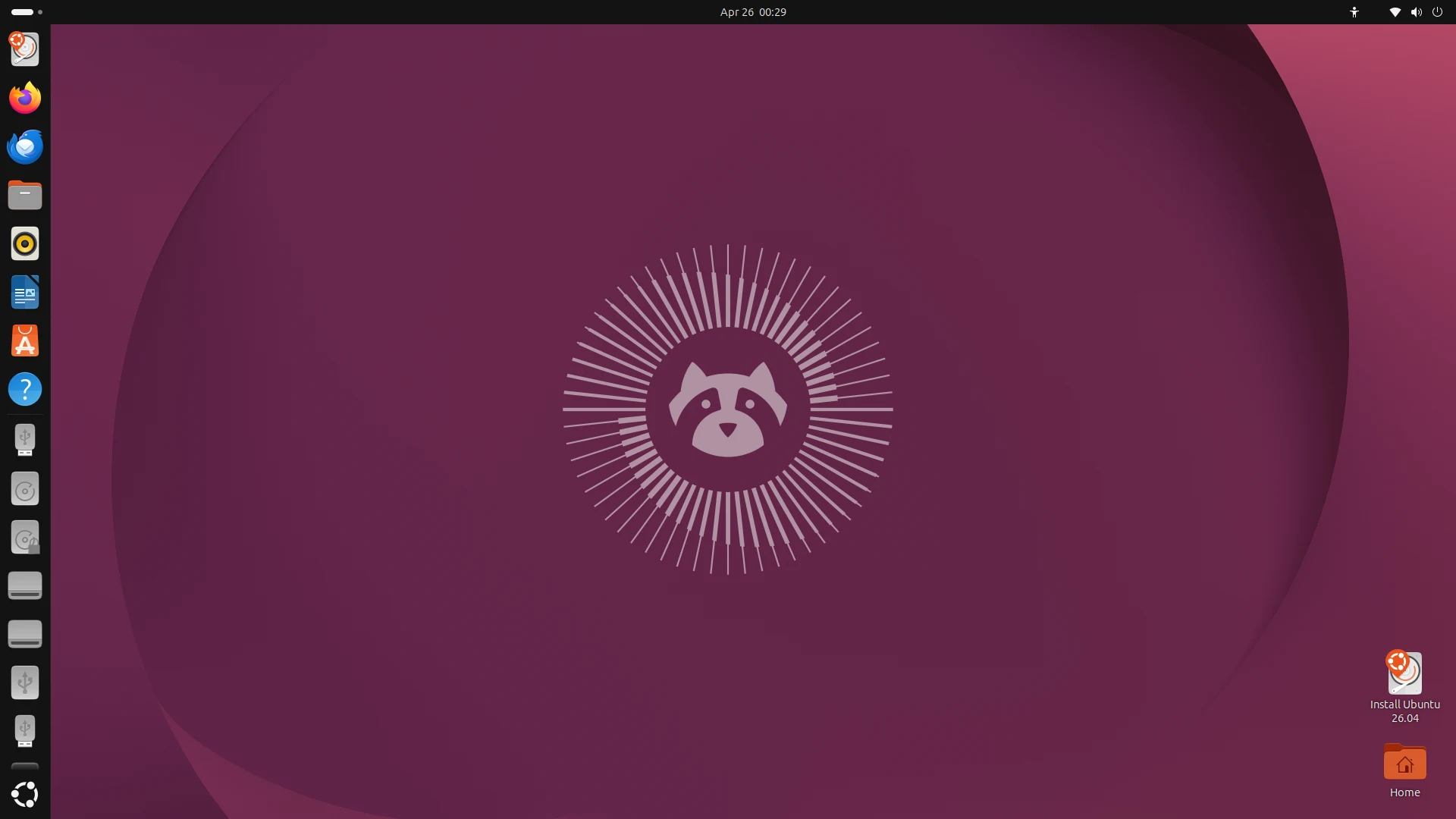
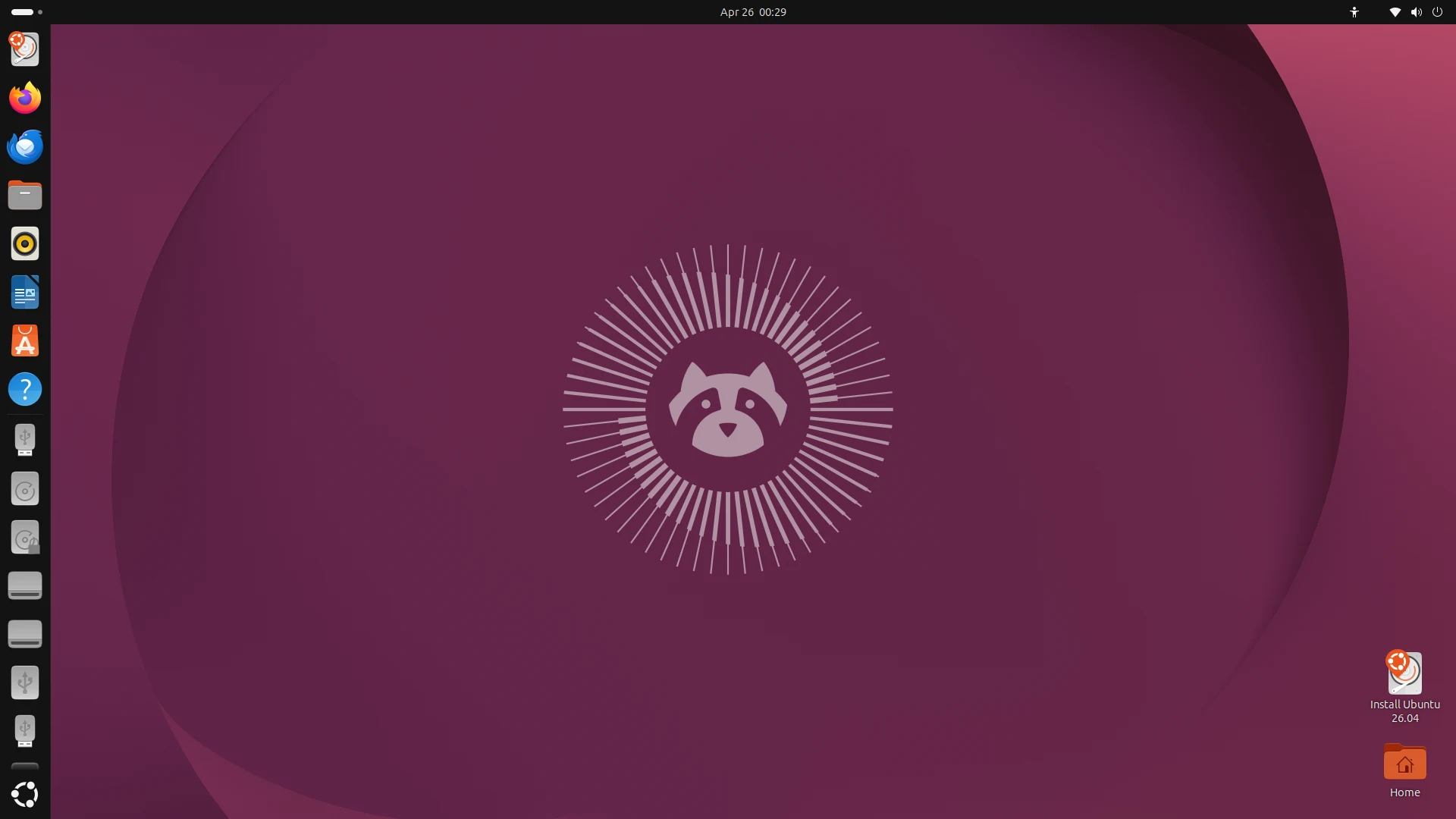
Ubuntu 26.04 LTS on the GNOME desktop
A live session, before installation
| |
| Developer | Canonical Ltd. and the Ubuntu community |
|---|---|
| Founder | Mark Shuttleworth |
| First release | 2004.10.20 (4.10, "Warty Warthog") |
| Latest LTS | 26.04 "Resolute Raccoon" (2026.04.23) |
| Latest interim | 25.10 "Questing Quokka" (2025.10.09) |
| Based on | Debian |
| Default desktop | GNOME 50, on Wayland only |
| Kernel | Linux 7.0 |
| Package management | APT and dpkg, with Snap alongside |
| Editions | Desktop, Server, Core, cloud images |
| Architectures | x86-64, ARM64, RISC-V, ppc64le, s390x |
| Support | 5 years for an LTS, 9 months for an interim release |
| License | GPL and other free software licenses |
| Source code | launchpad.net/ubuntu |
| Website | ubuntu.com |














Ubuntu is a Linux distribution published by Canonical Ltd., built from Debian packages and released on a schedule fixed years in advance. A new version appears every six months, and every fourth one carries long-term support, which is the version most organizations actually deploy. The name comes from the Nguni word for the idea that a person is a person through other people.
The project set out in 2004 to make a Debian system an ordinary person could install in under an hour. Free installation discs, mailed anywhere in the world, then gave it an audience no other distribution had. Two decades later it is the default assumption on servers and in cloud images, and the base for a long line of other distributions including Linux Mint. Commercial vendors that support Linux at all usually name it first.
Canonical funds the work by selling support, management tools and extended security updates. The system itself remains free to download and use. That arrangement has produced most of the project's public arguments, because the decisions that serve a paying customer do not always match what a desktop user wants.
1 History✎
1.1 Founding✎
Mark Shuttleworth had sold the certificate authority Thawte a few years earlier. In April 2004 he gathered a group of Debian developers to discuss a friendlier system built on their work. Version 4.10, "Warty Warthog", was published on 2004.10.20. The number simply records the year and month, a convention every release since has followed. Canonical Ltd. was founded to employ the developers, and an endowment set up the following year was meant to keep the project alive if the company ever failed.
Its first advantage was distribution in the literal sense. Anyone could request pressed discs at no cost, and Canonical shipped them anywhere in the world. That mattered enormously where bandwidth was scarce or expensive. The scheme ran until 2011, by which point broadband had made it unnecessary, and by then the name was already the one most people reached for when they meant Linux on a desktop.
1.2 Unity✎
Ubuntu shipped GNOME 2 for its first six years, then built its own interface. Unity arrived on netbooks in 2010 and became the default desktop in April 2011, moving the launcher to a vertical bar and the menus into the top panel. The design was divisive from the first day, and it appeared just as GNOME 3 was dividing the same audience for its own reasons.
The wider plan was convergence: one system and one set of applications running on phones, tablets and desktops alike. Canonical wrote its own display server, Mir, and a new version of Unity to reach it. A small number of Ubuntu phones were sold between 2015 and 2016. Shuttleworth ended the effort in April 2017, writing that the company had failed to persuade the industry to join it, and version 17.10 returned to GNOME.
1.3 The Amazon lens✎
Version 12.10 sent what the user typed into the desktop search box to Canonical's servers, which returned Amazon product listings alongside local files. The company argued that it was an affiliate arrangement funding development, and that the traffic was encrypted. Critics answered that a desktop search box is not a shopping site, and that a system typing your file names to a remote server by default had crossed a line.
The feature was disabled by default in 2016 and removed afterward. It is still the episode most often raised when the project's commercial decisions are questioned, and it is the reason later privacy settings shipped as an explicit question during installation rather than a default.
1.4 Snap✎
Canonical introduced Snap as a second packaging format, one that bundles an application with its dependencies so a single build runs on any distribution. The desktop gained it in 2016, and the number of applications delivered that way grew steadily afterward, including Chromium and then Firefox, which stopped being available as ordinary packages.
Two objections stuck. Snap applications start more slowly than their packaged equivalents, noticeably so on older hardware, and the server that hosts them is Canonical's own proprietary software, so the format has one store and no second implementation. Other distributions responded by refusing it: Linux Mint configures its package manager to block the daemon from being installed behind the user's back. Canonical added human review for new publishers in 2024, after fraudulent cryptocurrency wallets reached the store.
1.5 Recent releases✎
Version 24.04, "Noble Numbat", is the long-term support release most systems still run. It introduced an installer rebuilt in Flutter, along with hardware-backed disk encryption in preview. Version 25.10 made Ubuntu the first distribution to ship memory-safe reimplementations of two foundational tools by default: sudo-rs and the Rust uutils version of the core command-line utilities. Neither is a perfect drop-in replacement, and the traditional versions remain installable.
Version 26.04, "Resolute Raccoon", followed on 2026.04.23 as the eleventh long-term support release. It removes the X.Org session entirely, so the desktop runs only on Wayland, and it ships GNOME 50 on the Linux 7.0 kernel. Disk encryption backed by the machine's security chip is now offered in the installer proper. Confidential computing covers both major processor vendors, and rebootless kernel patching reached Arm systems for the first time. The codename honors Steve Langasek, a release manager for both Ubuntu and Debian, who died in early 2025.
| Release | Date | Notable changes |
|---|---|---|
| 4.10 "Warty Warthog" | 2004.10.20 | The first release; free discs mailed worldwide |
| 11.04 "Natty Narwhal" | 2011.04.28 | Unity becomes the default desktop |
| 17.10 "Artful Aardvark" | 2017.10.19 | Return to GNOME after Unity is cancelled |
| 22.04 "Jammy Jellyfish" | 2022.04.21 | Firefox moves to a Snap package |
| 24.04 "Noble Numbat" | 2024.04.25 | New installer; supported until April 2029 |
| 25.10 "Questing Quokka" | 2025.10.09 | Rust coreutils and sudo-rs by default
|
| 26.04 "Resolute Raccoon" | 2026.04.23 | Wayland only; GNOME 50; TPM disk encryption |
2 Editions✎
Ubuntu Desktop is the version most people mean by the name, and it carries GNOME, an office suite and a browser. Ubuntu Server ships without a graphical interface and is installed from a text-mode installer, which is the form running in most data centers. Ubuntu Core is a different system in the same family, assembled entirely from Snap packages on a read-only base. It is aimed at embedded devices that update themselves without a person present.
Cloud images are maintained for every major provider and are usually the default choice offered there. The system also runs inside Windows Subsystem for Linux, where Canonical publishes and maintains the images, which is how a large number of developers encounter it first.
3 Flavors and derivatives✎
A flavor is an official release with a different desktop, built by a community team from the same archive and released on the same day. Kubuntu uses KDE Plasma, Xubuntu uses Xfce, Lubuntu uses LXQt, and Ubuntu MATE, Ubuntu Budgie, Ubuntu Cinnamon and Ubuntu Unity each carry the desktop their name gives. Ubuntu Studio adds audio and video production tools, and Ubuntu Kylin is prepared for users in China.
Derivatives are a separate matter, since they are independent projects that take Ubuntu as a base and answer to nobody at Canonical. Linux Mint is the largest, followed by Zorin OS, Pop!_OS and elementary OS, each rearranging the desktop for a particular kind of user. The relationship is not always comfortable, as those projects routinely remove pieces Canonical adds.
4 The desktop✎
The interface is GNOME with a set of changes rather than a distinct desktop, which is a deliberate reversal of the Unity years. A dock sits on the left of the screen and can be moved or hidden, and an application grid replaces the menu of older systems. The Yaru theme sets the orange and aubergine colors the project has used since the beginning. Installation runs through a rebuilt installer that asks a short list of questions and offers full-disk encryption on the way past.
Version 26.04 removed the older X.Org session, so everything now runs on Wayland. The change brings per-monitor scaling and smoother animation, and it settles years of the two display systems being maintained side by side. Software written for the old system still runs, through a compatibility layer that most users never notice.
5 Software and packaging✎
The archive is divided into four parts, and the division is a support statement rather than a technical one. Main holds what Canonical maintains and patches itself, universe holds the far larger set maintained by the community, restricted holds proprietary drivers, and multiverse holds software whose license restricts redistribution. A personal package archive lets a developer publish builds outside all four, which is how most people install software that has not reached the archive yet.
Snap sits alongside the deb format rather than replacing it. Some applications ship only that way now, and the store also carries versions newer than the release's own packages. That is the argument for the format on a system whose base stays frozen for two years. Version 25.10 went further into replacement territory by defaulting to Rust reimplementations of sudo and the core utilities, a change made for memory safety rather than features.
6 Release model and support✎
Interim releases arrive in April and October and are supported for nine months, so a machine on that track is upgraded roughly twice a year. A long-term support release arrives every second April and is supported for five years, and the number in the version is simply its year and month. Codenames pair an adjective with an animal and advance through the alphabet, restarting after Z.
Extended security maintenance carries an LTS release beyond its five years. The subscription is free for personal use on a small number of machines, and paid for organizations. That extends coverage to ten years, and a further add-on reaches twelve, which is why systems installed a decade ago are still receiving patches. Hardware enablement updates bring newer kernels and graphics drivers to an LTS release during its life, so recent machines are supported without waiting for the next one.
7 Canonical✎
The company is privately held, based in London and staffed largely by people working remotely, and Shuttleworth remains its majority owner. Revenue comes from support contracts, the Ubuntu Pro subscription and systems management tools. Hardware and cloud partners also pay for engineering work to get their products supported. The system itself is never sold.
That model keeps the distribution free while making the company answerable to enterprise customers, and the tension shows up in the decisions users argue about. Snap, the Amazon lens and the subscription notices printed by the package manager all follow from a business whose paying customers are not the people running a laptop.