Parc.1
|
Parc.1
파크원
| |||||||||||||||||
 i i
| |||||||||||||||||
| Location | 108 Yeoui-daero, Yeongdeungpo District, Seoul | ||||||||||||||||
|---|---|---|---|---|---|---|---|---|---|---|---|---|---|---|---|---|---|
| Type | Mixed-use complex Offices, department store, hotel | ||||||||||||||||
| Architect | Richard Rogers Rogers Stirk Harbour + Partners | ||||||||||||||||
| Broke ground | June 2007 | ||||||||||||||||
| Completed | July 2020 | ||||||||||||||||
| Site area | 46,465 m2 | ||||||||||||||||
| Floor area | 629,047 m2 | ||||||||||||||||
[ More details ▾ ]
| |||||||||||||||||
| Location |
|---|
| Official links |
| Parc.1 | The Hyundai Seoul | Fairmont |
 i i
|
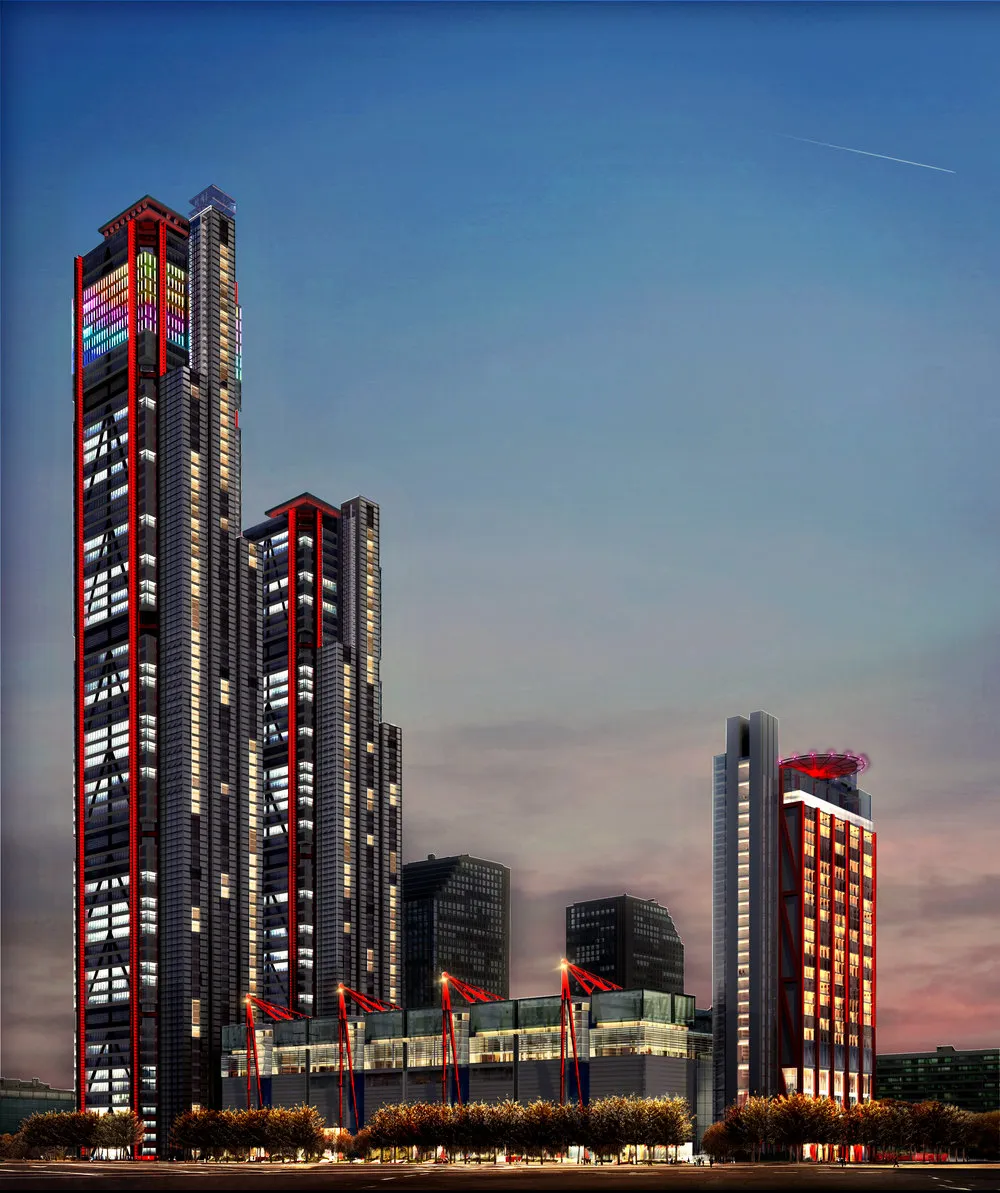

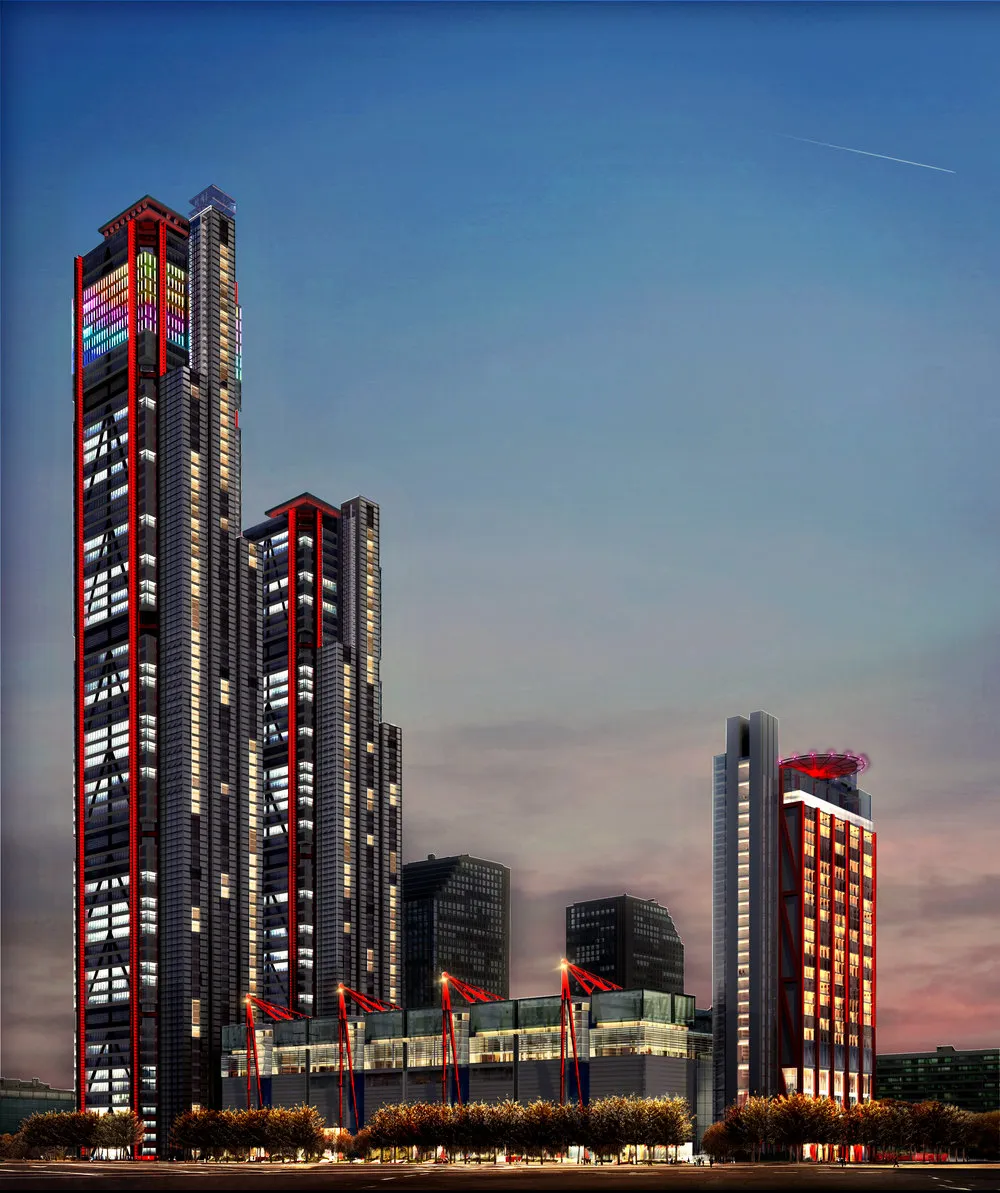
Parc.1 (파크원) is a mixed-use complex on Yeouido, the river island that holds one of Seoul's three main business districts. Four buildings share the site: two office towers, a department store between them, and a hotel at the eastern end. Together they cover 629,047 square metres, which makes Parc.1 one of the largest single developments ever built in the city.
The taller of the two office blocks, Tower 1, rises 333 metres over 69 floors. It is the tallest building on Yeouido, the second tallest in Seoul after the Lotte World Tower, and the fifth tallest in South Korea. Tower 2 reaches 256 metres over 53 floors and carries the name NH Financial Tower after the securities firm that anchors it.
The complex was designed by the British architect Richard Rogers and his practice, Rogers Stirk Harbour + Partners. Its most recognisable feature is structural: painted steel columns, trusses and cables run up the outside of the buildings in a strong red, chosen to echo the red timber columns of traditional Korean architecture.
Parc.1 took thirteen years to build. Work began in 2007, stopped in October 2010 when the landowner sued the developer, and did not restart until January 2017. The towers stood as an unfinished steel frame beside Yeouido Park for six of those years. Construction finished in July 2020, and the department store and hotel opened the following February.
1 History✎
1.1 The site✎
The land at 22 Yeouido-dong belongs to the foundation that holds the property of the Unification Church. The church bought it in the 1970s, when Yeouido was still largely empty, and intended to build its world headquarters there. Permission never came, and for decades the plot served as a car park known as the Tongil parking lot, along with a row of show houses for construction firms.
The church changed approach in the 2000s. Rather than sell, it leased. In 2005 it granted a 99-year surface right to Y22 Project Financing Investment, a company set up for the project with a Malaysian-backed developer, Skylan. A surface right is the legal right to build on and use land that somebody else owns. The annual rent was fixed at 5 per cent of the assessed land value. Seoul granted a building permit in July 2006.
1.2 First construction, 2007–2010✎
Preliminary design work had started as early as 2003. The scheme went through several versions, at one point reaching 72 floors, before settling near its final shape. Ground was broken in June 2007 and full construction began in February 2008, with Samsung C&T as main contractor and completion planned for 2013.
By October 2010 Tower 1 had reached its twelfth floor and Tower 2 its tenth. Then everything stopped.
1.3 Six years halted, 2010–2016✎
Short of money, Y22 had arranged to sell the two office towers to a pair of financial investors. The church foundation objected, arguing that selling the buildings breached the terms of the lease, and sued to have the surface right struck from the land register. Behind the dispute lay a succession fight among the sons of the church's founder, with rival brothers standing behind the foundation and the developer.
The case took nearly four years. Lower courts held that a foundation of this kind does not need government approval to grant a surface right, and the Supreme Court confirmed that ruling in July 2014. Y22 won, but the money did not follow. Steel that had stood exposed for four years had rusted, some concrete was damaged, and the banks that had once queued to lend were gone.
The rescue came from NH Investment & Securities, which agreed to act as financial adviser and then arranged project financing of 2.1 trillion won. Samsung C&T's contract was terminated in August 2016, and POSCO E&C took over as main contractor. Work resumed in January 2017.
1.4 Completion and opening, 2017–2021✎
The structure was finished in 2020. Tower 1 was lit at night for the first time in May, and the complex was completed in July, thirteen years after the ground-breaking ceremony. The delay cost it a record: had Parc.1 opened on schedule, Tower 1 would have been the tallest building in Korea, but the 555-metre Lotte World Tower was finished in the meantime.
The Hyundai Seoul opened on 26 February 2021, in the middle of the COVID-19 pandemic, and drew more than a million visitors in its first week. The Fairmont Ambassador Seoul had opened two days earlier.
2 Design✎
Rogers Stirk Harbour + Partners treated the site as a piece of city rather than a single building. The two office towers sit at the northern edge, facing west across Yeouido Park, so that they take the park and river views without casting shade over the rest of the site. The hotel sits at the opposite corner, and the low, wide department store fills the middle and ties the group together. Tree-lined avenues and plazas run between them.
The exterior expresses the structure instead of hiding it. Columns, trusses and bracing cables are carried on the outside of the buildings and painted a bright red, a signature of Rogers's work from the Pompidou Centre onward. Here the colour also carries a local meaning: red columns stand for dignity and refinement in traditional Korean architecture, and the same idea runs through the hotel interiors.
The department store's roofline was shaped after the pangp'aeyon, a Korean shield kite. Inside, the shops are arranged around full-height atria that bring daylight deep into a very large floor plate, and a triple-height indoor garden recreates something of the park outside.
The complex is rated Grade 1 under G-SEED, the Korean green building standard. It runs on a mix of geothermal energy, fuel cells, solar power and a combined heat and power plant, managed through a building-wide energy system.
One consequence of the exposed steelwork only became clear after opening. Snow settles on the projecting red members in winter and freezes into large icicles, which are dangerous when they fall from that height. Pedestrian routes around the building have been closed during cold spells, and a covered walkway was built on the Yeouido Park side.
3 The buildings✎
| Building | Floors | Height | Floor area |
|---|---|---|---|
| Tower 1 | 69 above ground, 7 below | 333 m | 213,958 m2 |
| Tower 2 (NH Financial Tower) | 53 above ground, 7 below | 256 m | 162,221 m2 |
| The Hyundai Seoul | 8 above ground, 7 below | 47 m | 193,935 m2 |
| Fairmont Ambassador Seoul | 30 above ground, 7 below | 101 m | 58,933 m2 |
Heights are measured to the top of the architectural structure. Tower 1's roof is at 318 metres and Tower 2's at about 246 metres; the red steelwork above accounts for the difference. All four buildings share a seven-level basement holding parking, plant rooms and a shopping arcade.
3.1 Tower 1✎
Tower 1 is a prime office building with a typical floor of about 1,724 square metres and 27 lifts. Tenants come mostly from finance and large corporate headquarters. LG Energy Solution, the battery maker spun out of LG Chem in 2020, registers Tower 1 as its head office, and POSCO group companies occupy space in the building their contractor built.
3.2 NH Financial Tower✎
Tower 2 was sold before it was finished. In November 2020 the Singapore investment manager ARA Asset Management bought it for about 1 trillion won on behalf of a fund, with NH Investment & Securities taking a 22 per cent stake. It was the largest single-building deal in Korea that year.
NH Investment & Securities had sold its old Yeouido headquarters and committed to lease more than a third of the new tower, which then took the name NH Financial Tower. ARA was itself acquired by the industrial group ESR in 2022, so the building now appears in ESR's Korean portfolio.
3.3 The Hyundai Seoul✎
The Hyundai Seoul is the largest department store in Seoul, with about 89,100 square metres of selling space across eight floors above ground and two below, and roughly 600 shops and restaurants. Hyundai Department Store opened it in February 2021 to mark the group's fiftieth anniversary.
The store was expected to struggle. It sits in an office district rather than a shopping district, and it opened without Hermès, Louis Vuitton or Chanel, the three names the Korean trade treats as necessary for a flagship. Instead it aimed at shoppers in their twenties and thirties, gave over an unusual amount of floor space to indoor gardens and rest areas, and ran a fast rotation of pop-up shops.
The strategy worked. The Hyundai Seoul passed 1 trillion won in annual sales at the end of 2023, two years and nine months after opening. That is the fastest any Korean department store has reached the mark, and it beat the previous record by more than two years. It took 1.29 trillion won in 2025 and 5.21 trillion won across its first five years. Shoppers in their twenties and thirties account for well over half of sales, roughly double the share at other Hyundai branches, and foreign visitors have become a large second market.
3.4 Fairmont Ambassador Seoul✎
The hotel opened on 24 February 2021 as the first Fairmont in South Korea, run as a joint venture between Accor and the Korean group Ambassador. It occupies a 30-floor building at the eastern end of the site and now lists 308 rooms and suites, having opened with 326. There are three restaurants, a rooftop bar on the 29th floor, a ballroom and ten meeting rooms, a spa and an indoor pool. The interiors pick up the red columns of the exterior.
4 Ownership✎
Ownership at Parc.1 is layered, which is a legacy of how the project was financed. The land still belongs to the Unification Church foundation, and every building on it stands under the 99-year surface right granted in 2005. Above that, the individual buildings have separate owners: Tower 2 is held by a property fund, while the department store and the hotel are operated by Hyundai Department Store and Ambassador respectively.
5 Access✎
Parc.1 stands on Yeoui-daero, between the Seoul International Finance Center and the LG Twin Towers. Yeouido Park is a minute's walk away and the Han River park about three.
An underground walkway with moving walkways links the complex to Yeouido Station, which is served by Seoul Metro Lines 5 and 9, passing through the finance centre on the way. The passage reaches the department store rather than the office towers, so people working in the towers have to come up to street level outside the store's opening hours.