Black Desert/Land of the Morning Light


|
Land of the Morning Light
the eastern islands
| |
A hall in the Land of the Morning Light Official expansion key art, Pearl Abyss
| |
| Location | Haso, across the northern sea |
|---|---|
| Reached from | Port Ratt |
| Setting | Korea's Joseon period |
| Home of | Musa, Maehwa and Lahn |
| Boss arena | Black Shrine |
| Later addition | Hanyang, the old capital |
| Built with | Around twenty Korean institutions |
| Added | June 2023; Hanyang in September 2024 |
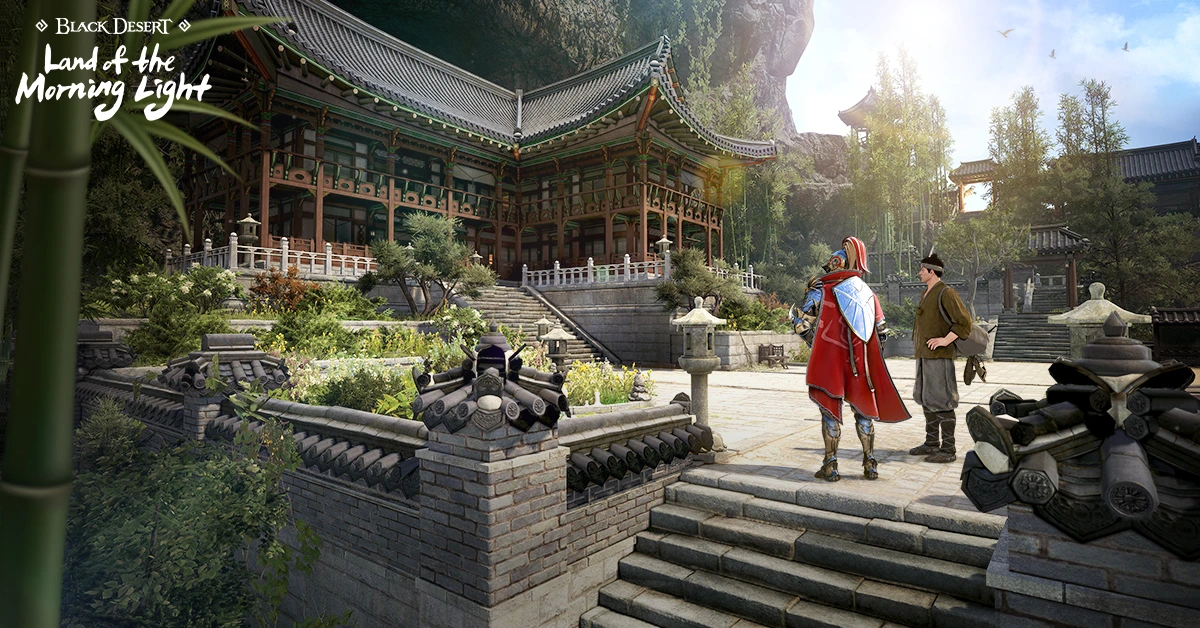


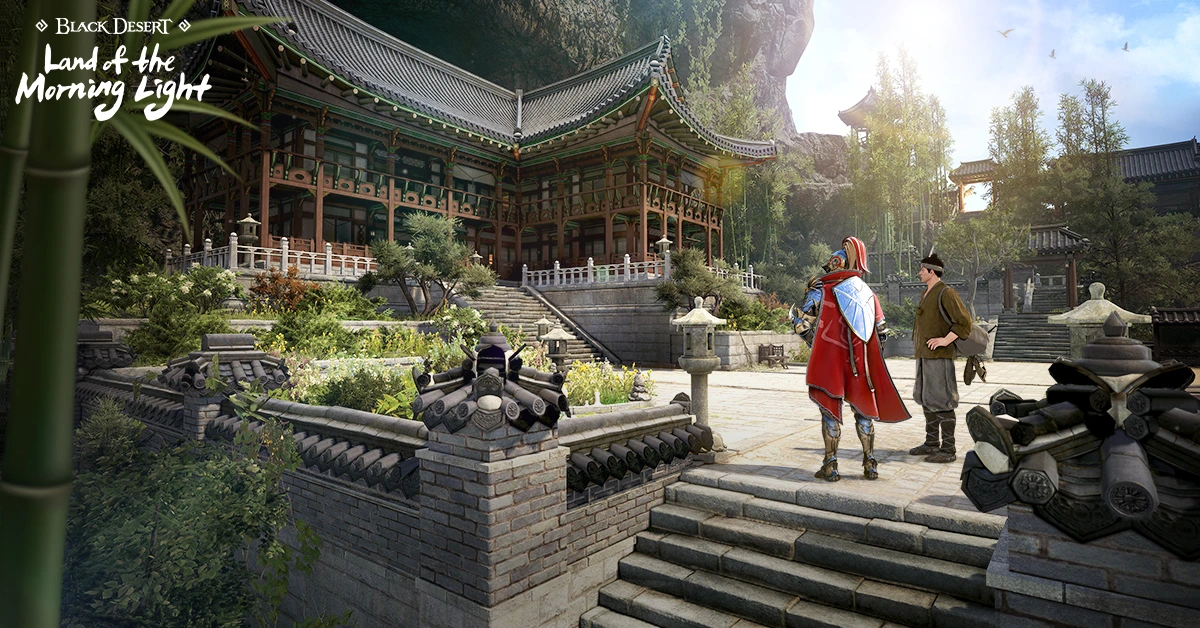
The Land of the Morning Light is the only region of Black Desert that does not sit on the main continent. It lies across the northern sea on the island of Haso, behind the trade town of Port Ratt.
The region departs from the medieval European setting the rest of the game uses. It draws on Korea's Joseon period for its architecture, dress, music and stories. It is also the homeland of the three eastern classes the game had carried for years without ever showing where they came from.
It is also the region built with the most outside help. Pearl Abyss developed it in cooperation with around twenty Korean institutions, the National Museum of Korea among them.
1 Geography✎
The region is reached by sea rather than by road. Port Ratt, the trade town at the far end of the ocean crossing, is the gateway, and the land behind it opens onto mountains, bamboo, terraced villages and tiled halls.
Nothing about the country connects to the western continent physically. That separation is the point: an adventurer arrives somewhere with its own history rather than at the next stretch of the same map.
2 A homeland for three classes✎
Musa, Maehwa and Lahn were in the game long before this region existed, and their weapons and dress had always pointed east without pointing anywhere in particular. The Land of the Morning Light gave them a place of origin.
That retroactive grounding changed how the classes read. A blade style that had been simply exotic now belongs to a country the player can walk through, with the buildings, the language and the customs to match.
3 Bosses and the Black Shrine✎
The region's bosses come out of Korean folk tales rather than out of the game's own mythology. Sangoon, a furious tiger-like mountain god, and the nine-tailed fox Gumiho are among them, alongside figures such as the virgin ghost that Korean audiences would recognize immediately.
They are fought at the Black Shrine, which works differently from the rest of the game. An adventurer picks the difficulty before entering rather than meeting whatever the world provides, so the same fight can be taken on at the level the player wants.
4 Story✎
The quest line is unusually large and deliberately non-linear. It carries roughly eighty cutscenes, forty shorter vignettes and about six thousand recorded lines, and it does not run in a fixed order.
The scale reflects what the region was for. It served as an alternative entry point to the game as well as an expansion, so the story had to stand on its own for a player who had never seen the western continent.
5 Hanyang✎
A second addition in September 2024 opened Hanyang, a version of the old Korean capital. It brought in Gyeongbokgung Palace, the ministries along Yukjo Street and the Gyeonghoeru pavilion.
Where the original region drew on the countryside and its folk tales, Hanyang is a city, and the shift gives the region a court and an administration to go with the villages.