Finland
|
Finland
Suomi · Finland
| |
|
National flag
Coat of arms
| |
| Capital | Helsinki |
|---|---|
| Largest city | Helsinki |
| Official languages | Finnish, Swedish |
| Government | Parliamentary republic |
| President | Alexander Stubb |
| Prime Minister | Petteri Orpo |
| Legislature | Parliament of Finland |
| Area | 338,491 km² |
| Population | 5,635,971 (2025) |
| Currency | Euro (€) |
| Demonym | Finnish, Finn |
| Time zone | EET (UTC+2) |
| Drives on | Right |
| Calling code | +358 |
| EU member | Since 1995.01.01 |
| Nickname | The Land of a Thousand Lakes |
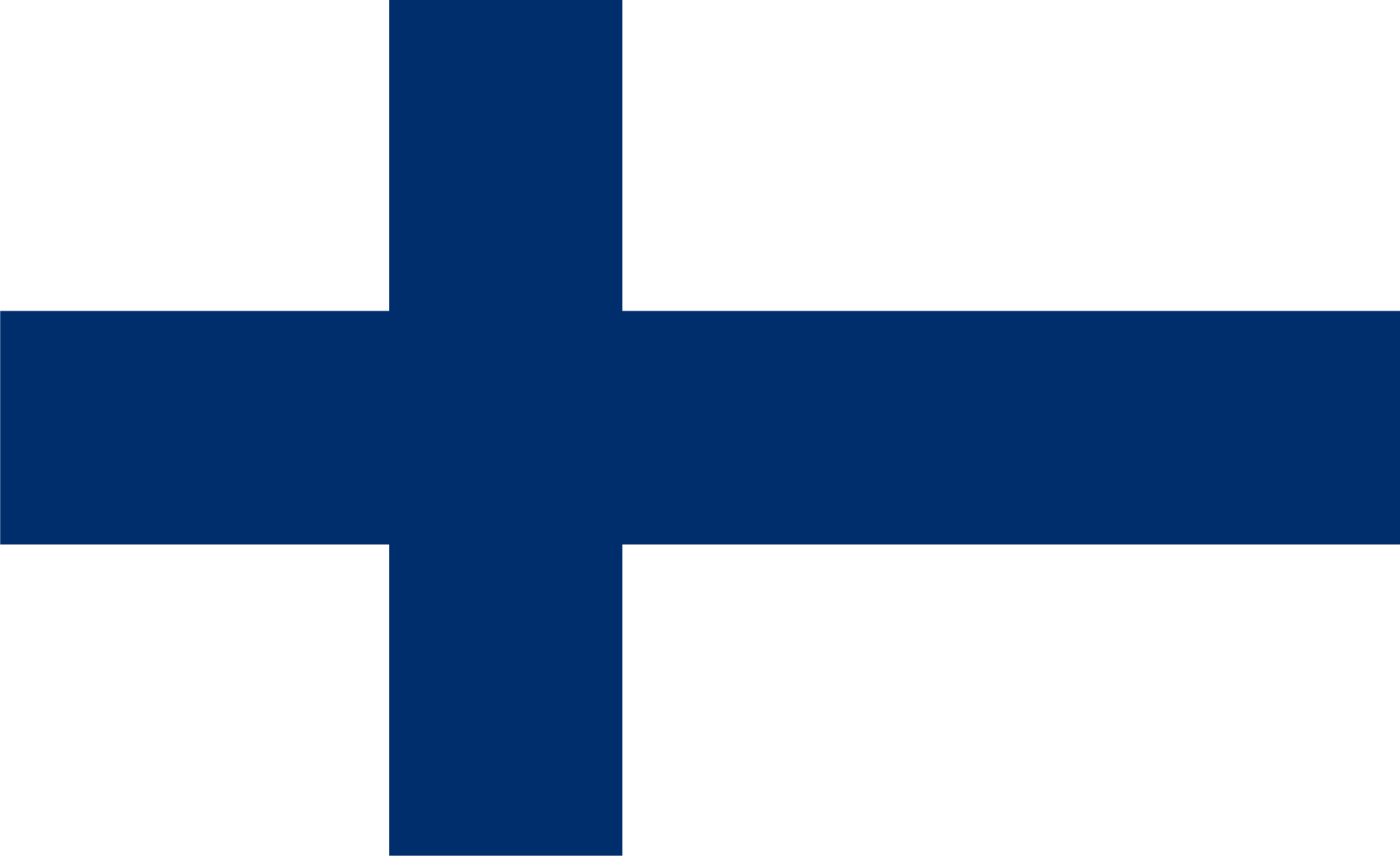
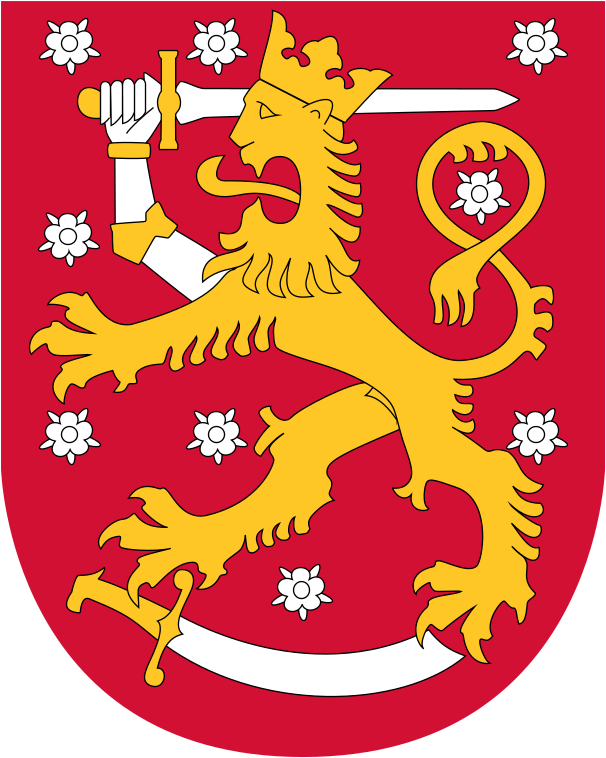
Finland, officially the Republic of Finland (Finnish: Suomen tasavalta; Swedish: Republiken Finland), is a Nordic country in Northern Europe. It borders Sweden to the northwest, Norway to the north, and Russia to the east, with the Gulf of Finland to the south and the Gulf of Bothnia to the west. The capital and largest city is Helsinki.
Finland has a population of about 5.6 million people across an area of 338,491 square kilometers, making it one of the most sparsely populated countries in Europe. Forests cover nearly two-thirds of the land, and inland lakes and rivers make up about a tenth of the country, giving Finland its nickname as "the land of a thousand lakes." The two official languages are Finnish and Swedish.
A parliamentary republic, Finland has a president as head of state and a prime minister as head of government. The country joined the European Union in 1995 and adopted the euro in 1999. Finland is consistently ranked among the world's happiest countries and is known for its strong welfare state, free education system, and high standard of living.
1 Etymology✎
The name "Finland" comes from the term for the Finnic peoples and entered English through Swedish. In Finnish the country is called Suomi, a name whose origin is uncertain. One theory connects it to the word suomaa ("swampland"), while others trace it to ancient tribal or geographic terms. The Swedish name Finland has been used since medieval times.
2 Geography✎
Finland is the eighth-largest country in Europe by area and the most sparsely populated country in the European Union. The terrain is mostly low and flat, shaped by glaciers during the last ice age, which left behind tens of thousands of lakes. The country is often divided into three main regions: the coastal lowlands, an interior lake district, and the upland and forested areas of the north.
Forests dominate the landscape, covering roughly two-thirds of the land. Lakes and rivers account for about 10 percent of the surface area, with Lake Saimaa being the largest lake. The northernmost part of Finland, known as Lapland, lies within the Arctic Circle and is home to the Sámi people.
2.1 Climate✎
Finland has a temperate climate in the south and a subarctic climate in the north. Winters are long and cold, especially in the north, where snow can persist for months. Summers are short but can be warm. Because of its northern latitude, Finland experiences the midnight sun in summer, when the sun does not set for weeks in Lapland, and the polar night in winter, when the sun does not rise. The northern lights are frequently visible in the north.
3 History✎
Human settlement in Finland dates back to the end of the last ice age, around 9000 BCE. For centuries the region was part of the Kingdom of Sweden, which spread Christianity and Swedish administration across the land.
In 1809, following a war between Sweden and Russia, Finland became an autonomous Grand Duchy under the Russian Empire. Finland declared independence on 1917.12.06, shortly after the Russian Revolution. A brief but bitter civil war followed in 1918.
During World War II, Finland fought the Soviet Union in the Winter War (1939–1940) and the Continuation War (1941–1944), managing to retain its independence. In the decades that followed, Finland rebuilt its economy and developed into a modern welfare state. It joined the European Union in 1995 and, after Russia's invasion of Ukraine, joined NATO in 2023.
4 Government and politics✎
Finland is a parliamentary republic. The president, directly elected for a six-year term, serves as head of state and leads foreign policy in cooperation with the government. As of 2024, the president is Alexander Stubb. The prime minister, currently Petteri Orpo, is the head of government and leads the cabinet.
The Parliament of Finland, known as the Eduskunta, is a single-chamber legislature with 200 members elected every four years. Finland is divided into 19 regions, including the autonomous archipelago of Åland, which has its own parliament and Swedish-speaking majority.
5 Economy✎
Finland has a highly developed, high-income economy. Historically based on forestry and agriculture, it has diversified into manufacturing, technology, and services. The forestry, technology, and metal industries remain among the most important sources of income. The country is a member of the Eurozone and uses the euro as its currency.
Finland is known for its innovation and education, producing globally recognized companies and consistently ranking high in measures of economic competitiveness and quality of life.
6 Culture✎
Finnish culture blends Nordic traditions with distinct national customs. The sauna is a central part of Finnish life, with millions of saunas across the country. Finland has a rich literary tradition, including the national epic Kalevala, and a strong design heritage associated with figures and brands recognized worldwide.
Finns place great value on education, equality, and connection to nature. Outdoor activities such as hiking, skiing, and ice swimming are popular, and the right to roam allows people to freely access forests and lakes.