 i i
| |
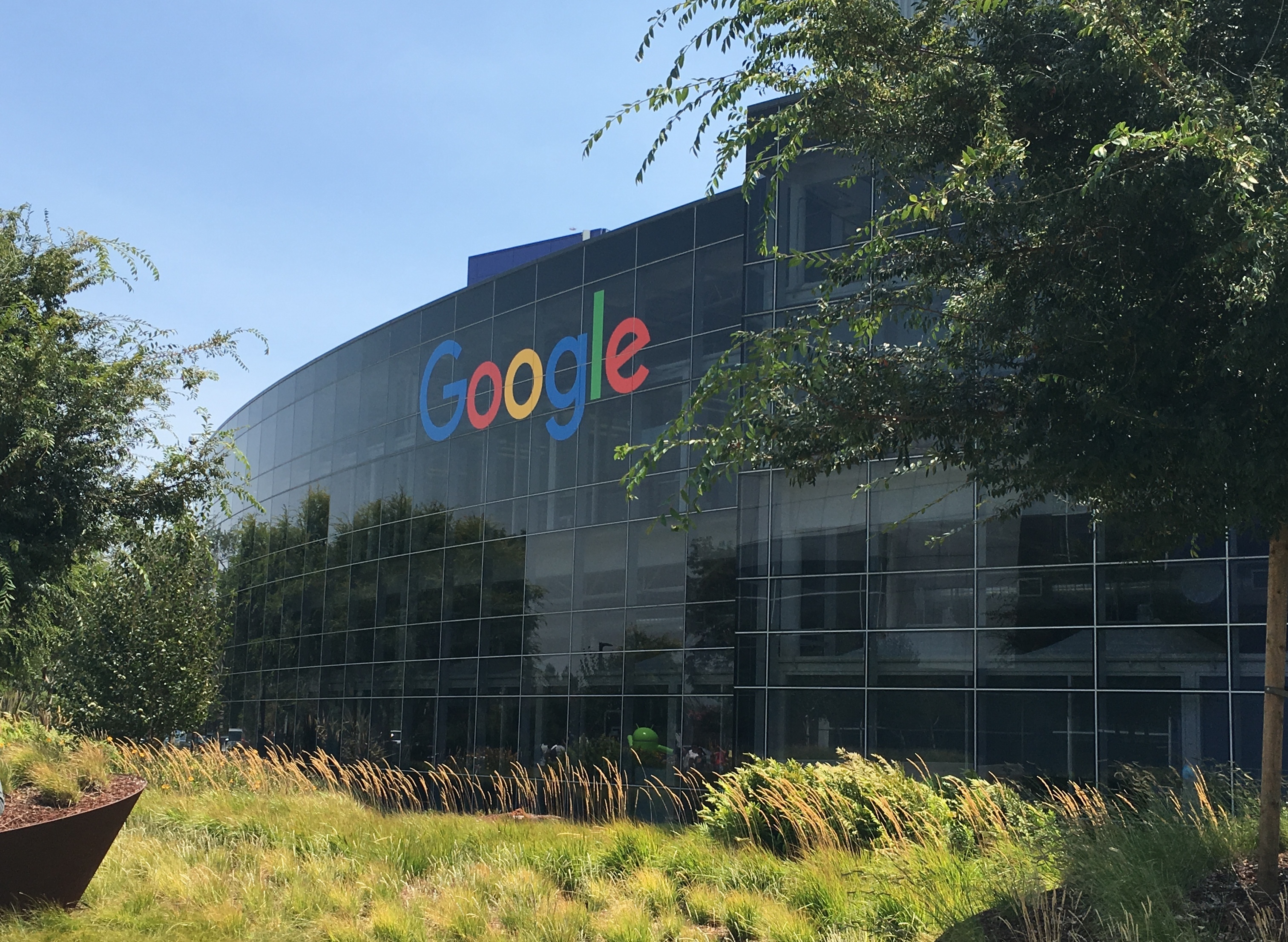
| The Googleplex, Google's headquarters in Mountain View, California | |
| Formerly | Google Inc. (1998-2017) |
|---|---|
| Type | Subsidiary |
| Traded as | Nasdaq: GOOGL / GOOG |
| Industry | Information technology · Online advertising · Cloud computing · Software · Hardware · Artificial intelligence |
| Founded | September 4, 1998 Menlo Park, California, U.S. |
| Founders | Larry Page · Sergey Brin |
| HQ | Googleplex, Mountain View, California, U.S. |
| Key people | Sundar Pichai (CEO) John L. Hennessy (Chairman) Ruth Porat (President and CIO) |
| Products | Google Search · Android · Chrome · Gmail · Maps · YouTube · Cloud · Pixel · Gemini |
| Employees | 187,000 (2022) |
| Parent | Alphabet Inc. |
| Website | about.google |
 i ia subsidiary of Alphabet |
|---|
[ Show/Hide ]
|
 i i
|
|---|
[ Show/Hide ]
|

1 Overview✎
Google LLC is an American multinational technology corporation focused on information technology, online advertising, search engine technology, cloud computing, software, quantum computing, consumer electronics, and artificial intelligence. Founded on September 4, 1998 by computer scientists Larry Page and Sergey Brin while they were PhD students at Stanford University, Google has grown from a research project into one of the most powerful and valuable companies in the world. The BBC has described it as "the most powerful company in the world."
Since 2015, Google has operated as a subsidiary of holding company Alphabet Inc., with Sundar Pichai serving as CEO of both Google and Alphabet. Page and Brin, the co-founders, retain about 14% of Alphabet's publicly listed shares and control 56% of stockholder voting power through super-voting stock.
Google Search and YouTube are the two most visited websites in the world. The company is the largest provider of search engines, email services, mobile operating systems, web browsers, mapping applications, online video platforms, and cloud storage as measured by market share. Google is ranked among the most valuable brands globally, listed second by Forbes as of 2022.
2 Name✎
The name "Google" is a misspelling of the word googol, the mathematical term for the number 10100 (a 1 followed by 100 zeros). Page and Brin chose the name to reflect their ambition to organize vast quantities of information. The company's headquarters, the Googleplex in Mountain View, California, takes its name from googolplex -- the number 10 to the power of a googol. By 2006, "google" had entered common usage as a verb meaning to search for something online, and was added to both the Merriam-Webster Collegiate Dictionary and the Oxford English Dictionary.
3 History✎
Google's history spans nearly three decades, from a Stanford research project to one of the most influential corporations in the world.
3.1 Origins and founding (1996-1998)✎
Google began in January 1996 as a research project by Larry Page and Sergey Brin, both PhD students at Stanford University. The project also involved an unofficial "third founder," Scott Hassan, who wrote much of the original code but left before Google was formally incorporated. Page and Brin theorized that a search engine which analyzed the relationships between websites -- rather than simply counting how many times search terms appeared on a page -- would produce better results. They called their algorithm PageRank, which ranked a website's relevance based on the number and importance of pages linking to it.
The search engine was originally nicknamed "BackRub" because it analyzed backlinks. Page and Brin eventually changed the name to Google, a misspelling of googol. In August 1998, Sun Microsystems co-founder Andy Bechtolsheim wrote them a check for $100,000 after a brief demonstration on a Palo Alto porch, and Google Inc. was incorporated on September 4, 1998. The founders set up their first office in the garage of Susan Wojcicki, who would later become YouTube's CEO. With additional investments from Jeff Bezos, Ram Shriram, and others, they raised roughly $1 million to get the company off the ground.
3.2 Early growth and IPO (1999-2004)✎
In June 1999, Google secured a $25 million funding round from venture capital firms Kleiner Perkins and Sequoia Capital, who each invested $12.5 million. The company moved from its Menlo Park garage to offices in Palo Alto and began growing rapidly. In 2000, Google started selling text-based advertisements associated with search keywords -- a model that would become its primary revenue engine. That same year, Google became the default search provider for Yahoo, then one of the most popular websites in the world.
In 2001, Page and Brin hired Eric Schmidt as chairman and CEO to provide experienced management. The company moved to its current home at 1600 Amphitheatre Parkway in Mountain View in 2003, leasing a complex from Silicon Graphics that became known as the Googleplex. By this time, Google was handling billions of search queries and had launched services including Google News (2002) and Gmail (2004).
Google went public on August 19, 2004, via an initial public offering on the Nasdaq at $85 per share. The IPO raised $1.67 billion and gave the company a market capitalization exceeding $23 billion, creating seven billionaires and roughly 900 millionaires among early stockholders.
3.3 Expansion and acquisitions (2005-2014)✎
Google launched Google Maps in 2005 and acquired YouTube in October 2006 for $1.65 billion in stock -- a purchase that would prove to be one of the most consequential acquisitions in tech history. In 2007, Google bought online advertising firm DoubleClick for $3.1 billion, and in 2008 it released the Chrome web browser, which would eventually become the most widely used browser in the world.
The company launched the Android mobile operating system, which grew to dominate the global smartphone market. In 2012, Google acquired Motorola Mobility for $12.5 billion, primarily for its patent portfolio. Other notable acquisitions included Waze ($966 million, 2013) and DeepMind Technologies (2014), a London-based AI company whose AlphaGo program would later become the first computer to defeat a top professional Go player.
3.4 Alphabet restructuring and AI era (2015-present)✎
On August 10, 2015, Google announced a major reorganization. A new holding company, Alphabet Inc., was created as the parent entity, with Google becoming its largest subsidiary handling all internet-related products and services. Sundar Pichai was appointed CEO of Google, replacing Larry Page, who became CEO of Alphabet. In December 2019, Pichai took on the CEO role at Alphabet as well.
The company faced internal and external challenges during this period. The 2018 employee walkout, in which over 20,000 workers protested the handling of sexual harassment complaints, highlighted tensions between Google's leadership and its workforce. The U.S. Department of Justice filed an antitrust lawsuit against Google in October 2020, alleging abuse of monopoly power in search and search advertising.
Google has increasingly pivoted toward artificial intelligence. Its DeepMind subsidiary achieved breakthroughs including AlphaFold, which solved the protein structure prediction problem. In 2023, the company launched Gemini, its multimodal AI model designed to compete with systems like OpenAI's GPT-4. Google has also developed its own AI chips (Tensor Processing Units) and the Willow quantum computing processor. AI capabilities have been integrated across Google's product suite, from Search to Gmail to Google Photos.
4 Products and services✎
Google offers a wide range of products and services spanning search, productivity, hardware, cloud computing, and AI.
4.1 Search and advertising✎
Google Search is the company's foundational product and remains the world's most used search engine by a wide margin. Google's advertising platforms -- Google Ads (formerly AdWords) and AdSense -- generate the vast majority of the company's revenue. Advertisements are primarily text-based and sold through a keyword bidding system.
4.2 Communication and productivity✎
Gmail, launched in 2004, became the world's most widely used email service. Google Workspace (formerly G Suite) includes Docs, Sheets, Slides, Drive, Calendar, and Meet, forming a cloud-based productivity suite used by businesses and individuals worldwide.
4.3 Platforms and operating systems✎
Android is the world's most widely used mobile operating system, powering billions of devices. Google Chrome is the dominant web browser, and ChromeOS powers the company's Chromebook laptops. YouTube, acquired in 2006, is the world's largest video-sharing platform.
4.4 Hardware✎
Google manufactures the Pixel line of smartphones, the Pixel Watch, Pixel Buds, and the Nest smart home product family. The company also acquired fitness wearable maker Fitbit in 2021.
4.5 Cloud and AI✎
Google Cloud Platform is one of the three largest cloud computing providers alongside Amazon Web Services and Microsoft Azure. Google's AI efforts include the Gemini chatbot and AI model family, the TensorFlow machine learning framework, Google DeepMind research lab, and Tensor Processing Unit chips. The Waymo subsidiary operates an autonomous vehicle service.
5 Criticism and controversies✎
Google has faced substantial criticism on several fronts. Privacy advocates have raised concerns about the company's collection and use of personal data. Google has been accused of censorship, particularly in connection with its brief consideration of a censored search engine for China (Project Dragonfly). The company has also faced antitrust actions in the United States and Europe, with regulators alleging that Google has abused its dominant market position. Other controversies have involved tax avoidance, content moderation on YouTube, and the treatment of employees who have raised internal concerns.
6 Legacy and impact✎
Google has fundamentally reshaped how people access and interact with information. Its search engine made the world's knowledge instantaneously accessible, while products like Gmail, Maps, Android, Chrome, and YouTube became essential infrastructure of daily digital life. The verb "to google" entered dictionaries in multiple languages, reflecting the company's ubiquity.
The company's early motto -- "Don't be evil" -- became a widely recognized statement of corporate ideals, though it has drawn increasing scrutiny as Google's scale and influence have grown. Alphabet Inc., Google's parent company, is among the most valuable publicly traded companies in the world, with the founders' original $100,000 investment having grown into a corporation valued at well over a trillion dollars.
Google has also been a significant force in advancing open-source software (Android, Chromium, TensorFlow, Kubernetes), funding fundamental scientific research through DeepMind and Google Research, and shaping the direction of AI development worldwide.