Loading history…
Debian
This is r2 (the current revision), saved by jack. Full history
|
The universal operating system
| |
 i i
| |
|
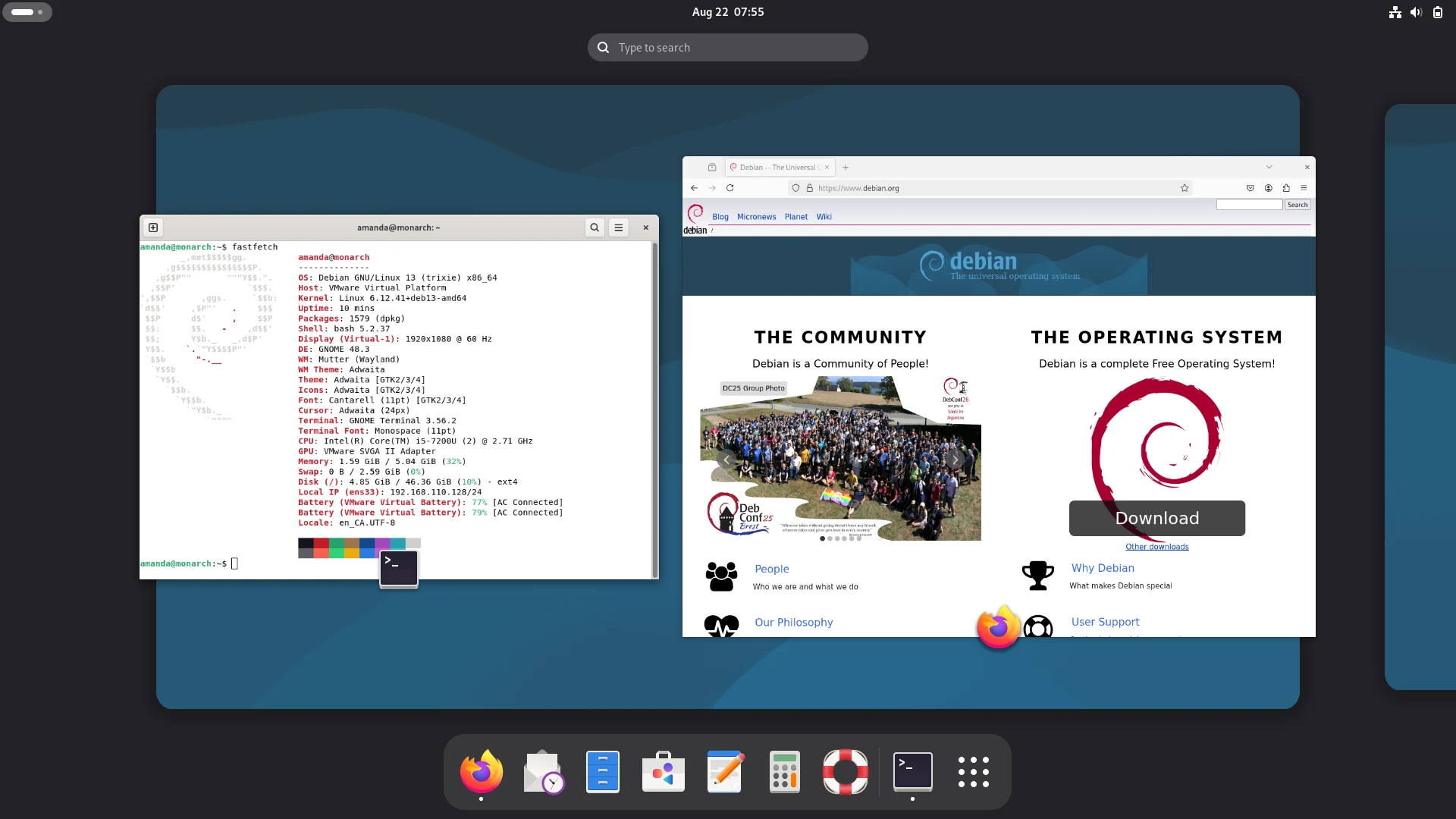
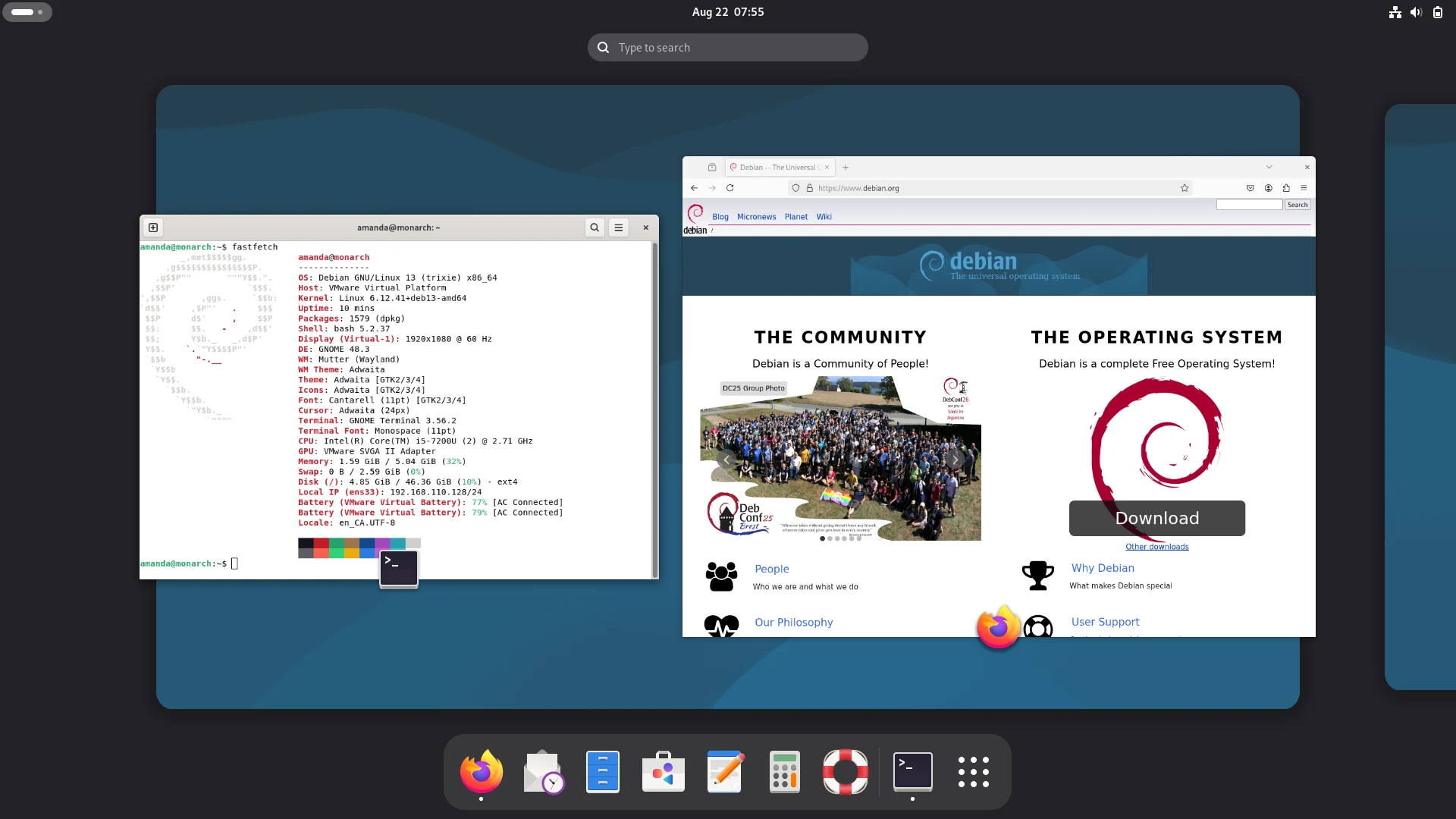
Debian 13 on the GNOME desktop
The activities overview, over a terminal and a browser
| |
| Developer | The Debian Project |
|---|---|
| Founder | Ian Murdock |
| Announced | 1993.08.16 |
| Latest release | 13.6 "Trixie" (2026.07.11) |
| Testing branch | "Forky", the next stable release |
| Project leader | Sruthi Chandran, elected April 2026 |
| Packages | 69,830 in the stable release |
| Default desktop | GNOME 48 |
| Kernel | Linux 6.12 LTS |
| Package management | APT and dpkg |
| Architectures | amd64, arm64, armhf, ppc64el, riscv64, s390x |
| Support | To 2028.08.09, then long-term support to 2030.06.30 |
| License | Free software licenses meeting the DFSG |
| Website | debian.org |










Debian is a Linux distribution built by a volunteer project rather than a company. Around a thousand developers maintain it, and they elect their own leader, write their own constitution and settle disputes by vote. The rules for what may enter the system are written down, and they have been amended only by the same voting process.
The project ships a new stable release when the work is finished, which has averaged about two years. That release then stays fixed, and packages receive security patches but not new versions. It is the usual choice for a machine that should behave the same in three years as it does today. The current release is version 13, "Trixie", first published on 2025.08.09 and updated to 13.6 on 2026.07.11.
Its influence is larger than its own user base. Ubuntu is built from Debian packages, Linux Mint descends from Ubuntu, and hundreds of other systems start here — including router firmware, storage appliances and the software on the Raspberry Pi. The tools it invented for packaging, chiefly dpkg and APT, are used far beyond the project itself.
1 History✎
1.1 Founding✎
Ian Murdock announced the project to a Usenet newsgroup on 1993.08.16, unhappy with the distributions then available. The name joins Debra, his wife at the time, with his own. His manifesto argued that a distribution should be maintained openly, in the manner of Linux and the GNU tools themselves, rather than assembled privately and released as a finished object.
The Free Software Foundation paid for the work during 1994 and 1995, which gave the young project a year of full-time attention. Early releases were numbered without names. Version 1.1, published in June 1996, was the first called after a character from Toy Story, a convention introduced by Bruce Perens, who then worked at the studio that made the film.
1.2 The social contract✎
In 1997 the project wrote down what it stood for. The Social Contract promises that Debian will remain entirely free software, that it will give back what it develops, and that it will not hide problems. Attached to it are the Free Software Guidelines, a short test that decides whether a license is acceptable, and that same test was later borrowed as the definition of open source.
A constitution followed in 1998, describing who may decide what. The leader is elected each year by the developers and appoints delegates for specific jobs. Any developer can call a general resolution, and a vote of the whole membership can overturn nearly any decision, including the leader's. Software in the Public Interest, a nonprofit founded in 1997, holds the money and the trademarks, because the project itself is not a legal entity.
1.3 Arguments and forks✎
The rules make disagreements formal rather than quiet. The longest one concerned systemd, adopted as the default startup system in 2014 after a technical committee vote and a general resolution that followed it. Developers who wanted the older arrangement founded Devuan, a fork that removes systemd and tracks Debian otherwise.
Firmware caused a similar argument for years, because a machine that cannot see its own wireless card is not usable, yet the files that drive it are rarely free. A vote in 2022 settled it by creating a separate archive area for firmware and putting it on the installation images. Version 12 was the first release to ship that way.
1.4 Recent releases✎
Version 11, "Bullseye", arrived on 2021.08.14, and version 12, "Bookworm", on 2023.06.10 with the firmware change. Version 13, "Trixie", followed on 2025.08.09 with 69,830 packages, of which more than fourteen thousand were new. It added 64-bit RISC-V as an officially supported architecture and moved every architecture except one to a 64-bit time value, which is what stops clocks failing in 2038.
The same release ended official support for 32-bit x86 machines, which no longer receive a kernel or an installer. Point releases have followed roughly every two months, reaching 13.6 on 2026.07.11, and they collect security fixes rather than new features. Security work on version 12 passed to the long-term support team in July 2026, and the next release, "Forky", is in preparation as the testing branch.
| Release | Date | Notable changes |
|---|---|---|
| 1.1 "Buzz" | 1996.06.17 | First release with a Toy Story codename; 474 packages |
| 11 "Bullseye" | 2021.08.14 | Persistent systemd journal; exFAT support |
| 12 "Bookworm" | 2023.06.10 | Non-free firmware on the installation images |
| 13 "Trixie" | 2025.08.09 | riscv64 added; 32-bit x86 dropped; 64-bit time_t |
| 13.6 | 2026.07.11 | Latest point release of the stable branch |
| 14 "Forky" | in testing | The next stable release |
2 The three branches✎
Three versions of the system exist at once, and a package moves through them in order. Unstable, always called "Sid", is where a new version of a package arrives first. If nothing serious is reported for a few days, and if it has been built on every architecture, it moves automatically into testing.
Testing is what the next stable release is made of. Some months before a release the project freezes it, meaning only fixes may enter, and when the release managers judge the remaining bugs acceptable the branch becomes stable and receives a new codename. The names come from Toy Story, and Sid — the boy who breaks toys in the film — has been the name of the unstable branch since the beginning.
Two additional archives soften the edges of a frozen release. Backports carries newer versions of selected packages rebuilt for the current stable system, for people who need a recent kernel or desktop without leaving it. Security updates come from a separate archive that every installation follows by default.
3 The archive✎
The archive is divided by license rather than by subject. Main holds software that satisfies the Free Software Guidelines, and it is the only part the project considers part of Debian proper. Contrib holds free software that needs something non-free to be useful. Non-free holds the rest, and non-free-firmware, created by the 2022 vote, holds the driver blobs that hardware needs to work.
A package enters through a maintainer, a developer who is responsible for it and answers bug reports about it. Uploads are signed, and the web of trust behind those signatures is maintained by developers meeting in person, which is one reason the annual conference matters to the project's machinery. Reproducible builds — checking that the same source produces the same binary — have been a long-running effort here, and most of the archive now passes.
4 Release model and support✎
Debian releases when the release team says it is ready, which has settled into roughly two years between versions. A stable release then receives full support for three years and long-term support for two more, so five years in total, with the later period run by a separate team and covering fewer architectures. Point releases gather the fixes issued in between, and installing one is simply a matter of updating.
Nothing forces an upgrade, and skipping a release is unsupported rather than impossible. The upgrade path the project tests and documents runs from one stable version to the next, and the release notes for each version describe it in detail.
5 Architectures✎
Six architectures are officially supported: 64-bit x86, 64-bit ARM, 32-bit hard-float ARM, 64-bit POWER, 64-bit RISC-V and IBM mainframes. The breadth is a deliberate policy rather than an accident, and a package that fails to build anywhere holds up its own progress into testing.
Architectures leave when the hardware does. Version 13 was the last to support 32-bit x86 kernels, and older ARM support ended in November 2025. Ports to systems beyond Linux exist as well, running the same packages on a FreeBSD or Hurd kernel, though neither has ever been part of a stable release.
6 Derivatives✎
More systems are built on Debian than on anything else. Ubuntu is the largest, and it in turn carries Linux Mint and a long list of others, so a majority of desktop Linux installations trace back here through one or two steps. Kali Linux, Tails, Raspberry Pi OS, Proxmox VE and MX Linux all take the archive directly.
The project maintains a census of these systems and asks them to send their changes back, with mixed success. Some contribute patches and maintain packages upstream, while others simply consume the archive, which the license permits and the project accepts as the cost of being useful.
7 See also✎
Content available under CC BY-SA 4.0