Loading history…
SK hynix
This is r1 (the current revision), saved by jack. Full history
|
SK hynix Inc.
SK하이닉스 주식회사
| |
 i i
| |
| Formerly | Hyundai Electronics (1983–2001) Hynix Semiconductor (2001–2012)[1] |
|---|---|
| Type | Public company[2] |
| Traded as | KRX: 000660 Nasdaq: SKHY (American depositary shares)[2] |
| Founded | February 1983, as Hyundai Electronics[1] |
| Headquarters | Icheon, Gyeonggi Province, South Korea[3] |
| Industry | Semiconductors[3] |
| Products | DRAM NAND flash memory High Bandwidth Memory Solid-state drives[3] |
[ More details ▾ ]
| |
| Headquarters |
|---|
 i i
|
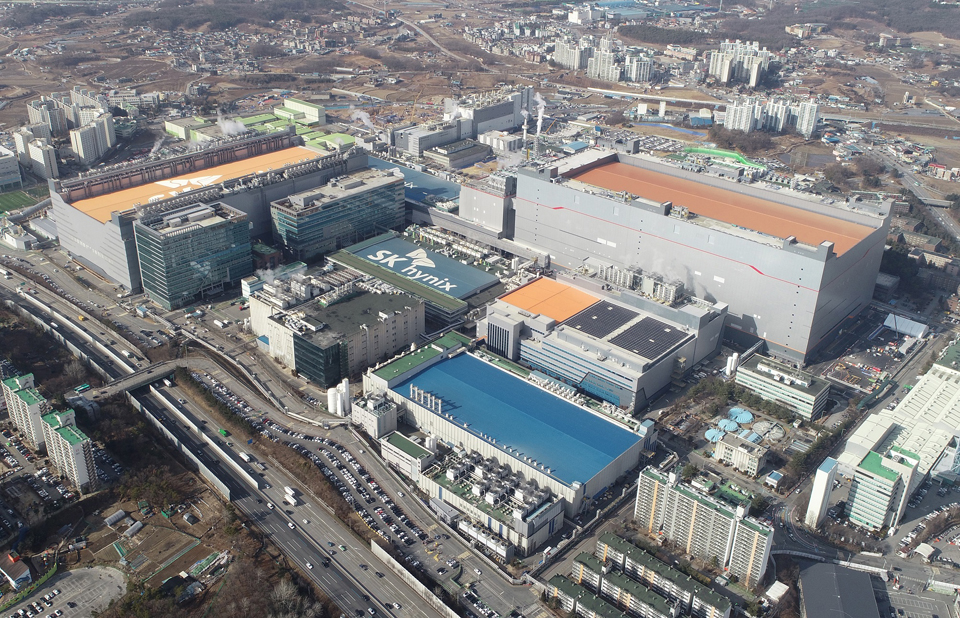
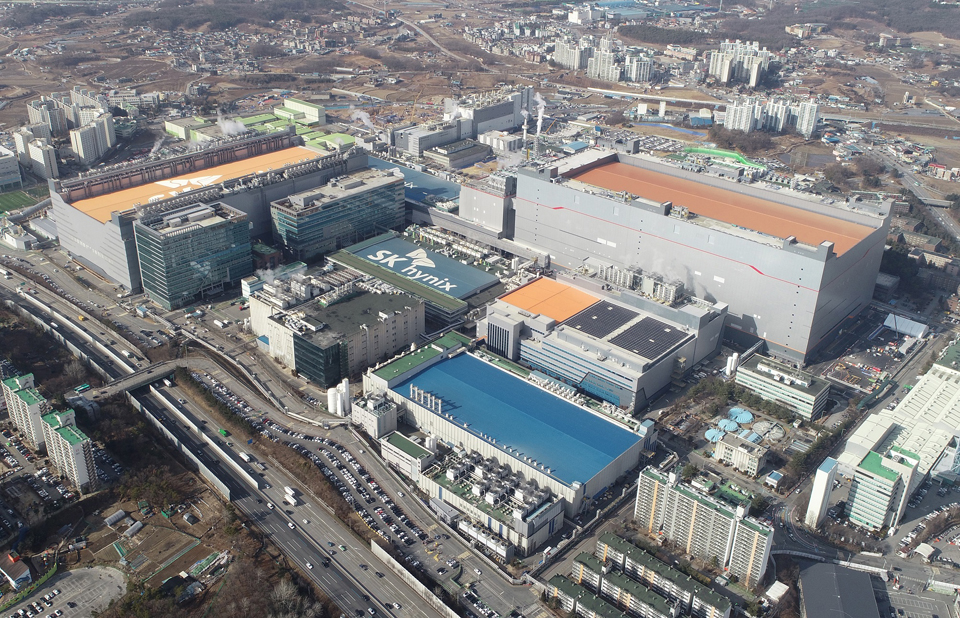
The Icheon campus in Gyeonggi Province — the company's original 1983 site and its headquarters
|
| Official links |
| Homepage | Newsroom | Products & Solutions | YouTube | Instagram | LinkedIn[9] |
|
SK Group | ||||||||||||||||
[ Show / Hide ]
|

|
World's 10 largest semiconductor companies
by 2025 revenue · Gartner, January 2026
| ||||||||||||||||||||||||||||||||||||||||||||
[ Show / Hide ]
| ||||||||||||||||||||||||||||||||||||||||||||

















SK hynix Inc.[note 1] (SK하이닉스 주식회사) is a South Korean semiconductor company that makes computer memory. It is part of SK Group, one of the country's largest business groups, and its head office is in Icheon, south-east of Seoul.[3][2]
The company makes three main kinds of memory. DRAM is the working memory a computer uses while it is running. NAND flash memory stores data permanently, so files survive when the power goes off. High Bandwidth Memory, or HBM, is DRAM built in stacked layers rather than laid out flat; it moves data far faster, which is what artificial intelligence (AI) systems need. Three companies — SK hynix, Samsung Electronics and Micron Technology — supply almost all of the world's memory between them.[3][2]
The name is written SK hynix, with a lowercase h. [note 2][3][2] News outlets often write "SK Hynix" with a capital H, but that is their house style, not the company's. The name hynix came from Hyundai Electronics (Hynics → hynix). The company left Hyundai more than twenty years ago, but it still uses the name that came from there.
SK hynix was founded in February 1983 as Hyundai Electronics. In 1999 it absorbed its domestic rival LG Semicon in a merger arranged by the government, renamed itself Hynix Semiconductor in 2001, and then spent most of a decade under the control of its creditor banks, after the debt from that merger nearly destroyed it.[1][10] SK Telecom bought a controlling stake in February 2012, and the company took its present name a month later.[1][11]
The company built the first HBM chip in 2013 and has been first to market with every generation since.[1][12] That early lead became extremely valuable once the AI boom began in 2023. In 2025 SK hynix reported revenue of ₩97.15 trillion and an operating profit of ₩47.21 trillion. That made it the most profitable listed company in South Korea for the year, and marked the first time it had out-earned Samsung Electronics.[6][13] On 10 July 2026 it also listed shares on the Nasdaq in the United States, raising US$26.5 billion.[2]
1 History✎
1.1 Hyundai Electronics (1983–1999)✎
Hyundai Electronics was founded in February 1983 as the semiconductor arm of the Hyundai Group; the company's own later filings give the founding name as Hyundai Electronics Industries.[1][14] Construction of the Icheon plant began in October of the same year. A pilot line produced its first chips in December 1984, and 64K DRAM went into mass production in May 1985.[1]
1.2 The LG Semicon merger and the Hynix name (1999–2001)✎
After the 1997 Asian financial crisis, the Korean government pushed the country's big business groups into a round of forced mergers known as the "Big Deal", under which Hyundai and LG were to combine their chip businesses.[15] The final agreement was signed on 20 May 1999: Hyundai acquired 59% of LG Semicon — 91,223,594 shares — for ₩2.56 trillion, payable over the following three years.[14] Hyundai took control in July 1999, and the two companies were legally merged that October.[1]
The purchase brought in the Cheongju plants the company still operates. But it was funded with borrowed money, and memory prices collapsed soon afterwards. The company renamed itself Hynix Semiconductor in March 2001 and completed its separation from the Hyundai Group that August, selling off its mobile phone, network equipment and flat-panel display businesses along the way.[1]
1.3 Under creditor control (2001–2012)✎
Merger talks with Micron Technology opened in December 2001 and reached a tentative agreement in April 2002, but the Hynix board rejected the terms the following month as too low.[10] With no buyer, the creditor banks approved a rescue on 30 December 2002: they swapped ₩1.9 trillion of debt for equity, wrote down the existing shares at a ratio of 21 to 1, and extended the repayment schedule on a further ₩3 trillion. The banks emerged owning roughly 86% of a company that still carried ₩8.6 trillion of debt.[16][10]
Other countries hit back. The United States, the European Union and Japan all imposed tariffs on Hynix chips, arguing the bailout amounted to a disguised government subsidy. A World Trade Organization panel ruled against Japan's measures in 2007, and the American duties were lifted in 2008.[1][10] Hynix sold its non-memory division in October 2004 — it became MagnaChip — and emerged from creditor administration ahead of schedule in July 2005, though the banks remained its largest shareholders for another seven years.[1]
1.4 The SK takeover (2011–2012)✎
SK Telecom agreed in November 2011 to buy a controlling stake, and closed the deal on 14 February 2012, paying ₩3.37 trillion for 21.05% of the shares at ₩23,099 each. It was the largest acquisition in SK Telecom's history.[11] Chey Tae-won, chairman of SK Group, took the chair of the semiconductor company, and in March 2012 it was renamed SK hynix.[1]
The holding structure changed once more in November 2021, when SK Telecom spun off its non-telecom investments into a new company, SK Square, which inherited the SK hynix stake.[17]
1.5 The AI memory era (2013–present)✎
SK hynix developed the first HBM chip in 2013 and brought it to market with AMD the following year. At the time, most of the industry saw stacked memory as a niche product for graphics cards.[1][18] It has held that lead ever since. It was first to mass-produce HBM2E in 2020, first to develop HBM3 in 2021, and first to supply HBM3 to NVIDIA in 2022. In 2024 it shipped both the 8-layer and 12-layer versions of HBM3E ahead of everyone else.[19][20][21]
The company bought its way to scale in NAND at the same time. In October 2020 it agreed to acquire Intel's NAND and solid-state drive business for a headline US$9 billion, in two stages. The first, in December 2021, brought over the drive business and Intel's fab in Dalian, China, which was rebranded Solidigm. The second, in March 2025, transferred Intel's NAND designs and research staff.[22][23][24] SK hynix also holds a stake in the Japanese memory maker Kioxia, having committed ¥395 billion in 2017 to the investor group that bought Toshiba's memory unit.[25]
The AI build-out that began in 2023 turned HBM into the centre of the business. SK hynix completed development of HBM4 in September 2025, unveiled a 16-layer, 48GB version at CES in January 2026, and shipped the first HBM4E samples in June 2026.[12][26][27] On 29 October 2025 the company announced that customers had already bought its entire planned DRAM and NAND output for the whole of the following year.[28]
2 Products✎
2.1 DRAM✎
DRAM is the larger half of the business. Chipmakers compete by shrinking the circuit patterns printed on each wafer, since smaller patterns mean faster, cheaper and more efficient chips; each shrink is known as a process node. SK hynix reached the 1a nm node in July 2021, 1b nm in 2023 and 1c nm in August 2024. In 2025 it also became the first company anywhere to put a High-NA EUV scanner — the most advanced and expensive chipmaking machine built — into commercial production, at its M16 fab in Icheon.[29][30][31]
The product range covers most uses of DRAM. DDR5 modules go into servers, GDDR7 into graphics cards, and the low-power LPDDR family into phones and, increasingly, into AI systems.[32][33] A newer category sits between them: SOCAMM2, a 192GB low-power server module built for NVIDIA's Vera Rubin platform, entered mass production in April 2026.[34]
2.2 High Bandwidth Memory✎
HBM is built by stacking DRAM dies on top of one another and connecting them with tiny vertical wires that run straight through the silicon. It is much harder to manufacture than flat memory, but it moves data at far higher rates, which is precisely what AI accelerators need. Since HBM2E, SK hynix has reached volume production ahead of its rivals every time. The company credits its MR-MUF packaging method, which fills the gaps between stacked dies in a single step rather than one layer at a time.[18][21]
The company's own record of the line runs as follows.[1][12][27]
| Generation | Milestone | Date |
|---|---|---|
| HBM | First stacked HBM developed | 2013 |
| HBM2E | Mass production | July 2020 |
| HBM3 | Development; first supply to NVIDIA | October 2021; June 2022 |
| HBM3E (8-layer) | Volume production | March 2024 |
| HBM3E (12-layer) | Volume production | September 2024 |
| HBM4 | Development completed, 2,048 I/O | September 2025 |
| HBM4E | Samples shipped | June 2026 |
Every HBM stack sits on a base die that controls it. In April 2024 SK hynix agreed that TSMC would manufacture the base die for HBM4 — an unusual arrangement, since each memory maker had until then produced its own.[35]
2.3 NAND flash and storage✎
The NAND business combines SK hynix's own memory chips with Solidigm's enterprise solid-state drives for data centres. NAND is also built in layers, and more layers mean more capacity in the same area. In November 2024 SK hynix became the first company to mass-produce a NAND chip with more than 300 layers, at 321; a denser version storing more data per cell followed in August 2025.[36][37]
In October 2025 the company set out an "AI NAND" roadmap splitting future storage into three lines: AIN P for speed, AIN D for capacity, and AIN B for bandwidth. The last is built on a new design called High Bandwidth Flash, which SK hynix is developing into an industry standard together with SanDisk.[38]
3 Factories✎
Chip factories are known in the industry as fabs. SK hynix operates two large campuses in South Korea and three sites in China, and is building its first American plant.
- Icheon, Gyeonggi Province — the original 1983 site and the corporate headquarters, home to the M10, M14 and M16 fabs. M16, completed in January 2021 at a cost of ₩3.5 trillion, was the company's first EUV fab and now houses its High-NA scanner.[39][31]
- Cheongju, North Chungcheong Province — the campus inherited from LG Semicon, now the centre of NAND production and of HBM packaging. The M15X fab was approved in April 2024 as a ₩5.3 trillion project within a longer programme worth more than ₩20 trillion, and began processing its first wafers in early 2026.[40][2]
- Yongin, Gyeonggi Province — a new cluster with room for four fabs on a 4.15 million square metre site. The board approved ₩9.4 trillion for the first fab in July 2024 and added ₩21.6 trillion in February 2026, bringing that fab alone to roughly ₩31 trillion. Its first clean room is due to open in February 2027.[41][42]
- West Lafayette, Indiana, United States — a US$3.87 billion HBM packaging plant and research site at Purdue Research Park, agreed in April 2024, under construction since April 2026, with production planned for the second half of 2028. It received up to US$458 million in federal funding under the CHIPS and Science Act.[43][44]
- China — DRAM at Wuxi, assembly and testing at Chongqing, and NAND at Dalian, the fab acquired from Intel.[1][2]
The Chinese fabs became a regulatory problem in 2025. American export rules govern which chipmaking equipment may be sold to factories in China. SK hynix had held a standing permit covering its Chinese sites, but the United States revoked it with effect from 31 December 2025, replacing it with an annual approval process.[45][2]
4 Ownership and management✎
SK hynix sits at the bottom of a three-step chain: SK Inc., the holding company of SK Group, controls SK Square, which together with its affiliates held 20.5% of SK hynix as of May 2026. The National Pension Service, South Korea's state pension fund, held 8.1%, and BlackRock 5.1%.[8] That 20% is not a coincidence. Korean competition law requires SK Square to keep at least a fifth of the shares, so the 2026 American share sale was sized to leave its stake just above that floor.[2]
Kwak Noh-Jung has been president and chief executive since 2022. Since March 2026 the board has been chaired by Ko Seung-Beom, an independent director — someone who is not an employee of the company. Six of the board's ten seats are held by independents.[5]
The main subsidiaries are Solidigm, the American drive maker built from Intel's storage division; SK keyfoundry in Cheongju and SK hynix system ic, both foundries — factories that make chips designed by other companies. SK hynix bought SK keyfoundry from MagnaChip in 2022 and renamed it at the start of 2024; it set up SK hynix system ic in 2017, with a plant in Wuxi.[1][46] In January 2026 the company announced that the Solidigm legal entity would be reorganised into an American AI solutions arm backed by a US$10 billion commitment, while the drive business continued under the Solidigm brand in a newly created company.[47]
5 Finances✎
Figures are as reported by the company. One trillion won is roughly US$700 million.[6][48]
| Period | Revenue | Operating profit | Net income |
|---|---|---|---|
| FY2024 | 66.19 | 23.47 | 19.80 |
| FY2025 | 97.15 | 47.21 | 42.95 |
| 1Q 2026 | 52.58 | 37.61 | 40.35 |
2025 was a record on every line. The ₩47.21 trillion operating profit exceeded Samsung Electronics' ₩43.53 trillion — the first time SK hynix had out-earned its larger domestic rival, and the highest operating profit reported by any Korean listed company for that year.[6][13] The first quarter of 2026 was stronger still, with an operating profit equal to 72% of revenue.[48] Capital spending has risen sharply with the AI cycle, from ₩8.3 trillion in 2023 to ₩27.5 trillion in 2025.[2]
Shareholder returns for 2025 came to ₩14.3 trillion: ₩2.1 trillion in dividends, and ₩12.2 trillion spent buying back and cancelling 15.3 million shares.[6]
6 Market position✎
Gartner ranked SK hynix the third-largest semiconductor company in the world for 2025, with revenue of US$60.6 billion, behind only NVIDIA and Samsung Electronics and ahead of Intel.[49]
The DRAM lead has changed hands twice in recent years. SK hynix overtook Samsung Electronics in early 2025 to lead the market for the first time in its history and held the position for three quarters. Samsung regained it at the end of 2025 and extended its lead through early 2026, when TrendForce put the split at Samsung 38.5%, SK hynix 28.8% and Micron 22.4%.[50][51] The swing reflects what each company sells rather than how well it performed. Contract prices for ordinary DRAM roughly doubled in early 2026 while HBM prices softened, which favoured the supplier with less HBM in its mix.[51]
In HBM itself SK hynix has led since the market became important, with reported shares ranging from about a half to about two thirds depending on the quarter and on the method of counting; Counterpoint Research put it at 57% of HBM revenue in the third quarter of 2025.[52] That success has left the company heavily dependent on one customer: NVIDIA accounted for around 27% of its revenue in the first half of 2025, up from 16% in 2024.[53] In July 2026 SK Group and NVIDIA announced an expanded partnership covering AI infrastructure in Korea, including a two-gigawatt AI facility that SK Telecom will operate from 2027 using SK hynix memory.[54]
In NAND, SK hynix and Solidigm counted together are consistently the second-largest supplier, behind Samsung Electronics.[55]
7 Nasdaq listing✎
SK hynix shares have traded in Seoul for decades. On 10 July 2026 the company also listed in the United States, on the Nasdaq Global Select Market, under the ticker SKHY. American investors do not buy the Korean shares directly; they buy American depositary shares, certificates issued by a bank, with ten certificates representing one Korean share.[2][56]
The company sold 177.9 million of these certificates at US$149.00 each, raising US$26.51 billion — the largest share sale ever made in the United States by a foreign company.[2][57] Demand ran at more than seven times the shares on offer, and the price rose sharply on the first day of trading. The newly issued Korean shares behind the sale were listed in Seoul on 29 July 2026.[57][56]
The listing capped an extraordinary run. In June 2026 SK hynix had overtaken Samsung Electronics to become the most valuable listed company in South Korea for the first time.[58] It did not hold. On 13 July, three days after the American debut, the shares fell about 15% in a sell-off across the Korean market severe enough to halt trading.[59]
Speaking on the day of the listing, Kwak Noh-Jung said the industry was heading into the tightest memory shortage on record, with demand running ahead of supply "even beyond 2030".[60]
8 See also✎
|
SK Group | ||||||||||||||||
[ Show / Hide ]
|
|
World's 10 largest semiconductor companies
by 2025 revenue · Gartner, January 2026
| ||||||||||||||||||||||||||||||||||||||||||||
[ Show / Hide ]
| ||||||||||||||||||||||||||||||||||||||||||||
- "History." SK hynix (official). skhynix.com/company. Retrieved July 2026.
- SK hynix Inc., Form 424B4 (final prospectus), filed with the U.S. Securities and Exchange Commission, July 9, 2026. sec.gov. Retrieved July 2026.
- "About Us." SK hynix (official). skhynix.com/company. Retrieved July 2026.
- SK hynix Inc., Form F-6 registration statement, filed with the U.S. Securities and Exchange Commission, July 1, 2026. sec.gov. Retrieved July 2026.
- "Corporate Governance — Board of Directors." SK hynix (official). skhynix.com/sustainability. Retrieved July 2026.
- "SK hynix Announces FY25 Financial Results." SK hynix Newsroom (official), January 28, 2026. news.skhynix.com. Retrieved July 2026.
- "SK hynix Fact Sheet." SK hynix Newsroom (official). news.skhynix.com. Retrieved July 2026.
- "Shareholder Status." SK hynix Investor Relations (official). skhynix.com/ir. Retrieved July 2026.
- "SK hynix." SK hynix (official) — site footer channel links. skhynix.com. Retrieved July 2026.
- Cooper, William H. Hynix Semiconductor: Trade Dispute with the United States, CRS Report RL31238. Congressional Research Service. everycrsreport.com. Retrieved July 2026.
- "SK Telecom completes Hynix takeover." The Korea Times, February 14, 2012. koreatimes.co.kr. Retrieved July 2026.
- "SK hynix Completes World's First HBM4 Development and Readies Mass Production." SK hynix Newsroom (official), September 11, 2025. news.skhynix.com. Retrieved July 2026.
- "SK Hynix beats Samsung on 2025 profit as AI memory demand surges." CNBC, January 29, 2026. cnbc.com. Retrieved July 2026.
- "Hyundai and LG Sign Definitive Agreement on Acquisition of LG Semicon by Hyundai Electronics Industries." SK hynix Newsroom (official), May 20, 1999. news.skhynix.com. Retrieved July 2026.
- "Hyundai and LG Semicon to merge chip ops." EE Times, September 1998. eetimes.com. Retrieved July 2026.
- "Creditors approve bailout for chip giant Hynix." The Irish Times, December 31, 2002. irishtimes.com. Retrieved July 2026.
- "SK Telecom Completes Company Split." SK Telecom Newsroom (official), November 2021. news.sktelecom.com. Retrieved July 2026.
- "The Story of SK hynix's HBM Development." SK hynix Newsroom (official). news.skhynix.com. Retrieved July 2026.
- "SK hynix Starts Mass Production of High-Speed DRAM, HBM2E." SK hynix (official, via PR Newswire), July 2, 2020. prnewswire.com. Retrieved July 2026.
- "SK hynix to Supply Industry's First HBM3 DRAM to NVIDIA." SK hynix (official, via PR Newswire), June 8, 2022. prnewswire.com. Retrieved July 2026.
- "SK hynix Begins Volume Production of the World's First 12-Layer HBM3E." SK hynix Newsroom (official), September 25, 2024. news.skhynix.com. Retrieved July 2026.
- "SK hynix to Acquire Intel NAND Memory Business." SK hynix (official, via PR Newswire), October 19, 2020. prnewswire.com. Retrieved July 2026.
- "SK hynix Completes the First Phase of Intel NAND and SSD Business Acquisition." SK hynix Newsroom (official), December 30, 2021. news.skhynix.com. Retrieved July 2026.
- Intel Corporation, Form 8-K, filed with the U.S. Securities and Exchange Commission, March 27, 2025. intc.com. Retrieved July 2026.
- "SK hynix Inc.'s Board Approved a Plan to Invest in Toshiba Memory Corporation." SK hynix Newsroom (official), September 28, 2017. news.skhynix.com. Retrieved July 2026.
- "SK hynix Showcases Next-Generation AI Memory Innovations at CES 2026." SK hynix Newsroom (official), January 5, 2026. news.skhynix.com. Retrieved July 2026.
- "SK hynix Ships Samples of 12-Layer Next-Gen HBM4E." SK hynix (official, via PR Newswire), June 17, 2026. prnewswire.com. Retrieved July 2026.
- "SK hynix Announces 3Q25 Financial Results." SK hynix Newsroom (official), October 29, 2025. news.skhynix.com. Retrieved July 2026.
- "SK hynix Starts Mass Production of 1anm DRAM Using EUV Equipment." SK hynix Newsroom (official), July 12, 2021. news.skhynix.com. Retrieved July 2026.
- "SK hynix Develops Industry-First 1c DDR5." SK hynix Newsroom (official), August 29, 2024. news.skhynix.com. Retrieved July 2026.
- "SK hynix Introduces Industry's First Commercial High-NA EUV." SK hynix Newsroom (official), September 3, 2025. news.skhynix.com. Retrieved July 2026.
- "SK hynix Enhances Leadership in Graphics Memory With Introduction of Industry-Best GDDR7." SK hynix Newsroom (official), July 30, 2024. news.skhynix.com. Retrieved July 2026.
- "SK hynix Develops 1c LPDDR6." SK hynix Newsroom (official), March 10, 2026. news.skhynix.com. Retrieved July 2026.
- "SK hynix Begins Mass Production of 192GB SOCAMM2." SK hynix Newsroom (official), April 19, 2026. news.skhynix.com. Retrieved July 2026.
- "SK hynix Partners With TSMC to Strengthen HBM Technological Leadership." SK hynix Newsroom (official), April 19, 2024. news.skhynix.com. Retrieved July 2026.
- "SK hynix Starts Mass Production of World-First 321-High NAND." SK hynix Newsroom (official), November 20, 2024. news.skhynix.com. Retrieved July 2026.
- "SK hynix Begins Mass Production of 321-Layer QLC NAND Flash." SK hynix Newsroom (official), August 24, 2025. news.skhynix.com. Retrieved July 2026.
- "SK hynix Presents Next-Generation NAND Storage Product Strategy at OCP 2025." SK hynix Newsroom (official), October 26, 2025. news.skhynix.com. Retrieved July 2026.
- "SK hynix Announces the Completion of M16 Plant Construction." SK hynix (official, via PR Newswire), February 1, 2021. prnewswire.com. Retrieved July 2026.
- "SK hynix to Produce DRAM From M15X in Cheongju." SK hynix Newsroom (official), April 24, 2024. news.skhynix.com. Retrieved July 2026.
- "SK hynix Board Approves Yongin Semiconductor Cluster Plan." SK hynix Newsroom (official), July 26, 2024. news.skhynix.com. Retrieved July 2026.
- "New Facility Investment for Yongin Semiconductor Cluster." SK hynix Newsroom (official), February 25, 2026. news.skhynix.com. Retrieved July 2026.
- "SK hynix Signs Investment Agreement of Advanced Chip Packaging With Indiana." SK Group (official), April 3, 2024. eng.sk.com. Retrieved July 2026.
- "SK hynix — Indiana (West Lafayette)." National Institute of Standards and Technology, CHIPS Program Office (official). nist.gov. Retrieved July 2026.
- "Revocation of Validated End-User Authorizations in the People's Republic of China." Federal Register, September 2, 2025. federalregister.gov. Retrieved July 2026.
- "Key Foundry Changes Its Name to SK keyfoundry." SK keyfoundry (official, via PR Newswire), January 2024. prnewswire.com. Retrieved July 2026.
- "SK hynix to Establish AI Solutions Arm in US." SK hynix Newsroom (official), January 28, 2026. news.skhynix.com. Retrieved July 2026.
- "SK hynix Announces 1Q26 Financial Results." SK hynix Newsroom (official), April 22, 2026. news.skhynix.com. Retrieved July 2026.
- "Gartner Says Worldwide Semiconductor Revenue Grew 21% in 2025." Gartner, January 12, 2026. gartner.com. Retrieved July 2026.
- "SK hynix Takes Top Spot for First Time on Continued HBM Demand." Counterpoint Research, April 9, 2025. counterpointresearch.com. Retrieved July 2026.
- "Global DRAM Revenue, 1Q26." TrendForce, June 1, 2026. trendforce.com. Retrieved July 2026.
- "Global DRAM and HBM Market Share." Counterpoint Research, 2026. counterpointresearch.com. Retrieved July 2026.
- "NVIDIA Reportedly Drives 27% of SK hynix Revenue in 1H25." TrendForce, August 18, 2025. trendforce.com. Retrieved July 2026.
- "SK Group and NVIDIA Expand Strategic Partnership Across AI Factories and Next-Generation Memory." SK Group (official, via GlobeNewswire), July 25, 2026. globenewswire.com. Retrieved July 2026.
- "NAND Flash Revenue Ranking, 4Q25." TrendForce, March 3, 2026. trendforce.com. Retrieved July 2026.
- "SK hynix Lists ADRs on Nasdaq." SK hynix Newsroom (official), July 2026. news.skhynix.com. Retrieved July 2026.
- Roush, Tyler. "SK Hynix Surges In Record-Setting US Debut." Forbes, July 10, 2026. forbes.com. Retrieved July 2026.
- "SK Hynix overtakes Samsung Electronics as Korea's most valuable firm." KED Global, June 22, 2026. kedglobal.com. Retrieved July 2026.
- "SK Hynix shares plunge by record, deepening Korea selloff." Advisor Perspectives, July 13, 2026. advisorperspectives.com. Retrieved July 2026.
- "SK hynix says 2027 will be the worst year for memory shortage." Tom's Hardware, July 10, 2026. tomshardware.com. Retrieved July 2026.
Content available under CC BY-SA 4.0