Loading history…
Black Desert/Great Valencian Desert
This is r1 (the current revision), saved by jack. Full history


|
Great Valencian Desert
the Black Desert · the Red Desert
| |
 i i
| |
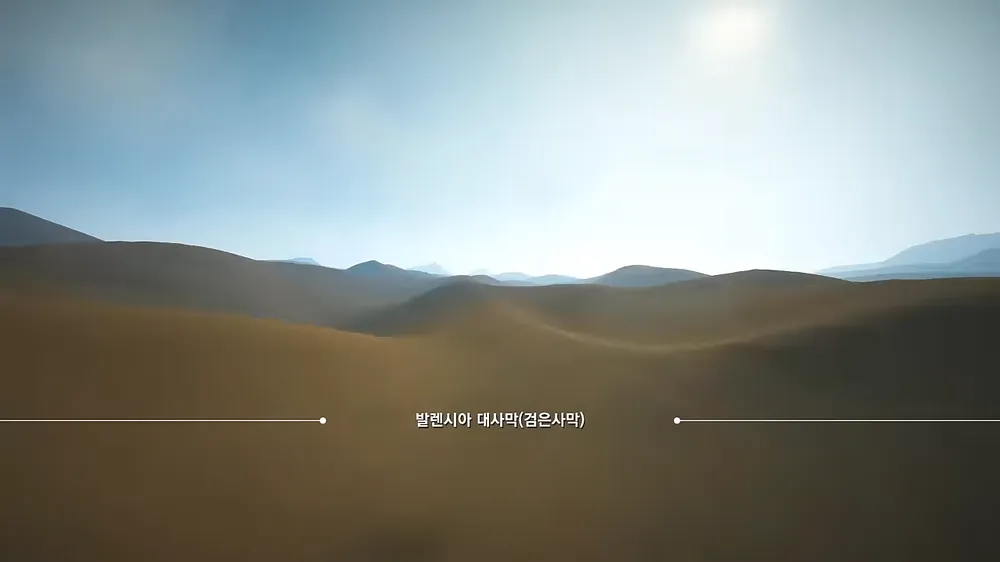
The Great Valencian Desert From the Valencia trailer, Pearl Abyss
| |
| Type | Desert |
|---|---|
| Region | |
| Ruled by | |
| Settlements | |
| Known for | Black stones, buried under the sand
|
| Hazards | Heatstroke, hypothermia, sandstorms, no world map
|
| Player rules | Lawless zone |
| Added | 2016, with the Valencia expansion
|
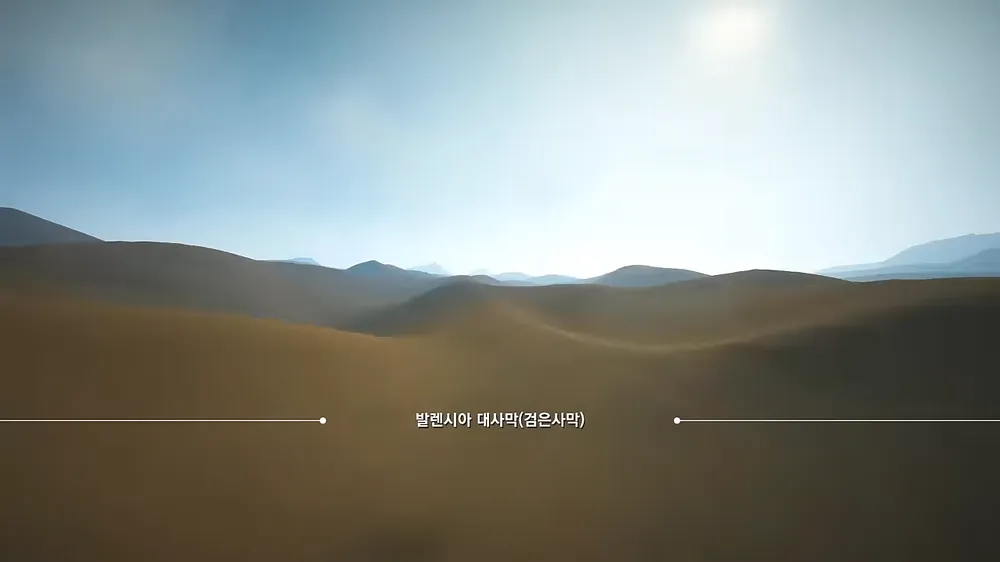
The Great Valencian Desert, better known as the Black Desert, is the vast desert that covers most of the Valencia region and is held by the Kingdom of Valencia.
Although the official name is the Great Valencian Desert, hardly anyone calls it that. Calpheon coined the name Black Desert, after the black stones buried under its sand, and the game Black Desert takes its own title from it. Valencia's court calls it the Red Desert, for the blood its soldiers spilled holding on to it.
The desert is the harshest place in the game world. The map does not work inside it, the heat of the day and the cold of the night will both kill an unprepared traveler, and other players are free to attack without warning. It is also one of the richest places to hunt, and the buried stones that started a war are still what the whole economy of enhancement runs on.
1 Names✎
The desert carries three names, and which one a person uses says which side of the war they stand on.
- Great Valencian Desert — the formal name. It belongs to Valencia, which holds the territory in law.
- Black Desert — Calpheon's name, coined once the republic learned what lay under the sand. Calpheon went to war to take the ground, and the game takes its own title from this name.
- Red Desert — Valencia's answer, naming the land for its own dead.
Neither of the two names in common use is a neutral one, which is why the formal name survives at all.
The game's map divides the sands further. The Great Desert of Valencia, the Cantusa Desert, the Red Desert and the northern and southern dunes are each labeled separately. An adventurer crossing the region passes through several named stretches rather than one flat expanse.
2 Geography✎
The desert fills the eastern half of the world map, beyond the highlands of Mediah. Travelers coming from the west enter through the Barhan Gateway and leave the last green country behind within minutes.
Almost everything people live in sits on the edge of the sand rather than in it. Valencia City stands in the southeast, with the port of Ancado Inner Harbor below it and the coastal town of Arehaza further west. The Sand Grain Bazaar and the village of Shakatu serve as the last stops for supplies before the deep desert, and the mining settlement of Muiquun lies in the north.
The one reliable break in the interior is the Ibellab Oasis, which has water, shade and a bonfire, and which experienced players treat as the halfway point of any long crossing. The rest is dunes, wind-cut rock, canyons and ruins.
3 The black stones✎
Black stones are found in greater quantity here than anywhere else in the world. An earlier civilization used them as a power source, and the reactions they forced out of the stones destroyed the minds of its people and brought that civilization down. What it left behind is scattered across the desert: sunken structures at the Crescent Shrine, buried artifacts in the Hystria Ruins, and ancient constructs still wandering the sand.
The stones did not stop attracting people. The cultists of the Cadry Ruins eat black stone powder in the belief it grants eternal life, and worship Kzarka, whose return they expect. For adventurers the stones are far more ordinary: black stones are the standard material for strengthening weapons and armor, which makes the desert's history a daily part of the game's progression.
4 The war with Calpheon✎
Calpheon wanted the stones and invaded to get them. The desert became the main battleground of the long war between the western alliance and the Kingdom of Valencia. The sand did much of Valencia's work for it, and one Calpheonite force was buried whole by a sandstorm.
Valencia won. Calpheon withdrew without the stone fields, and the resentment left over from that defeat still runs underneath the game's main story. The rivalry between the two nations is the frame the whole setting hangs on.
5 Surviving the desert✎
The desert is the only major stretch of land, apart from the open ocean, where the game switches the map off. Adventurers navigate by landmark and by the shape of the ground unless they carry an Ancient Explorer's Compass, which restores the minimap and automatic navigation. Three compass parts bought on the Central Market can be combined into a temporary one that lasts three days.
Temperature is the second problem. Daytime heat brings on heatstroke and the freezing nights bring hypothermia, and both drain health steadily until they are treated. Purified water answers the day and star anise tea answers the night. The tea is made by simple cooking, from purified water and a star anise flower gathered at farms near Valencia City and at Shakatu. An adventurer caught out with neither can reach the Ibellab Oasis instead, where the bonfire clears hypothermia and the water clears heatstroke.
Sandstorms are the third. They do heavy damage to anyone caught inside, so the sensible response is to ride away from one early, or to pitch a desert tent bought from a stable keeper and sit it out.
Travel itself is slower here. Horses and carriages lose speed on sand and horse skills are limited, so camels and elephants — both suited to the terrain — are the usual mounts. A short quest at the Sand Grain Bazaar stable hands out a first camel.
6 Hunting grounds✎
The desert holds more hunting grounds than any other region, running from zones a fresh level 50 can manage up to two of the hardest areas in the open world. The last two are underground.
| Ground | What is there |
|---|---|
| The Bashim, a demibeast tribe said to be as old as Valencia itself. They keep their own language, avoid outsiders and attack anyone who comes close. | |
| Desert Naga, the ancestors of the Naga found in the swamps of Serendia. | |
| Desert Fogans settled around fresh running water, named after their chief. Their numbers fell when much of the tribe migrated west. | |
| A former Valencian temple taken over by cultists who eat black stone powder and worship Kzarka. | |
| Ruins of the ancient Valencian civilization, mostly buried. The Argos Saunil who hold it are said to perform blood rites at every crescent moon. | |
| Bandits under Gahaz Tuval, a known figure on the black market, who has lately taken a black dragon captive. | |
| Desert waragon, a branch of the species that builds bird-like nests in canyon shade to survive the heat. | |
| A roaming herd ground on open sand, and one of the tougher mid-range zones. | |
| Basilisks, and a noticeable step up in difficulty from the zones around it. | |
| A working sulfur mine. Its lower levels also hold the prison where fugitives are locked up. | |
| A Valencian prison, and one of the two hardest grounds on the surface. | |
| Underground. The Aakman are rumored to be gathering in secret to bring the ancient giants back. | |
| Underground, and the hardest ground in the desert. The artifacts of the ancient Valencian civilization are buried here. |
7 Lawless ground✎
Most of the world is safe: another player cannot attack you unless you agree to it. The desert is one of the exceptions, and it is the reason the region has a reputation among players that has nothing to do with its monsters.
Killing another adventurer here through forced player-versus-player combat marks the killer as a Villain for thirty minutes. The mark shows above the character name even under a camouflage set, and it carries the same penalties as bad karma, which means the killer can be attacked in turn regardless of their own standing. An adventurer who dies as a fugitive in Valencia is jailed underground at the Roud Sulfur Mine.
The rule set has since been reused. When Pearl Abyss added Ulukita as the game's highest-requirement region, it announced that the Valencian desert rules would apply there too.
8 See also✎
9 Further reading✎
Content available under CC BY-SA 4.0