Loading history…
Naruto/Body Replacement Technique
This is r2 (the current revision), saved by jack. Full history


|
NINJUTSU · ACADEMY BASIC
Body Replacement Technique
変わり身の術 · Kawarimi no Jutsu
| |
 i i
| |
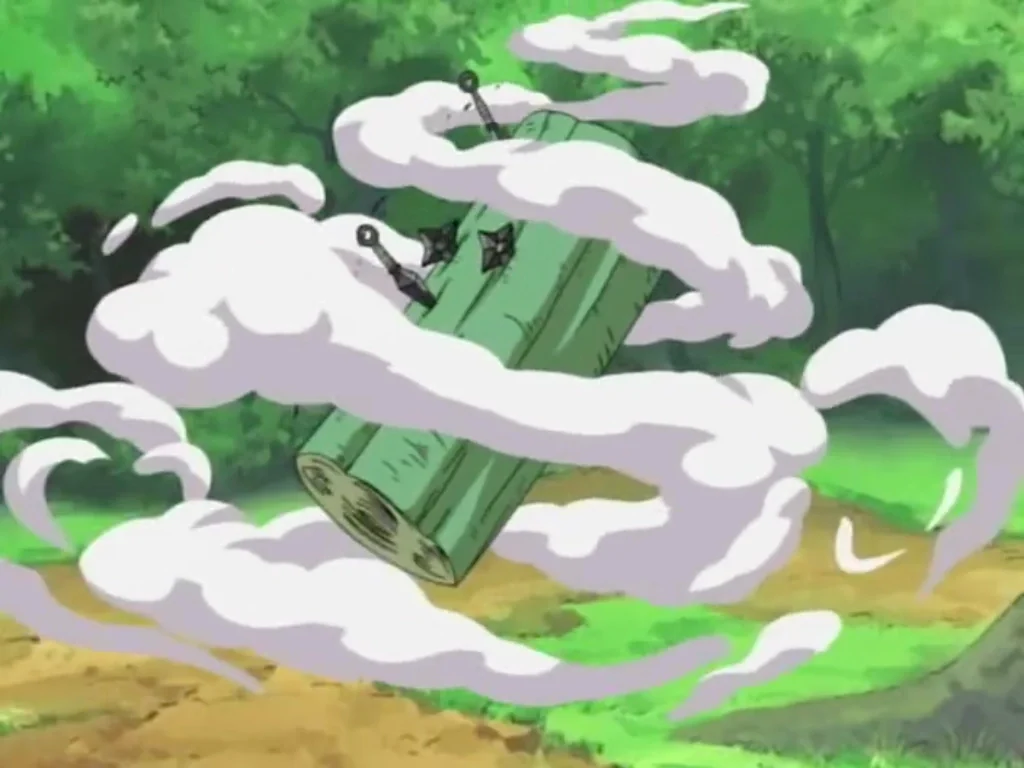
A log left to take the weapons meant for the ninja
| |
| English | "Substitution Jutsu"[1] |
|---|---|
| Classification | Ninjutsu — supplementary |
| Rank | E-RANK (Academy basic)[2] |
| Parent skill | |
| Debut | Manga: vol. 1, during the bell test[3] Anime: episode 4, "Pass or Fail: Survival Test"[4] |
| Known users | Academy students and virtually every trained ninja[2] |
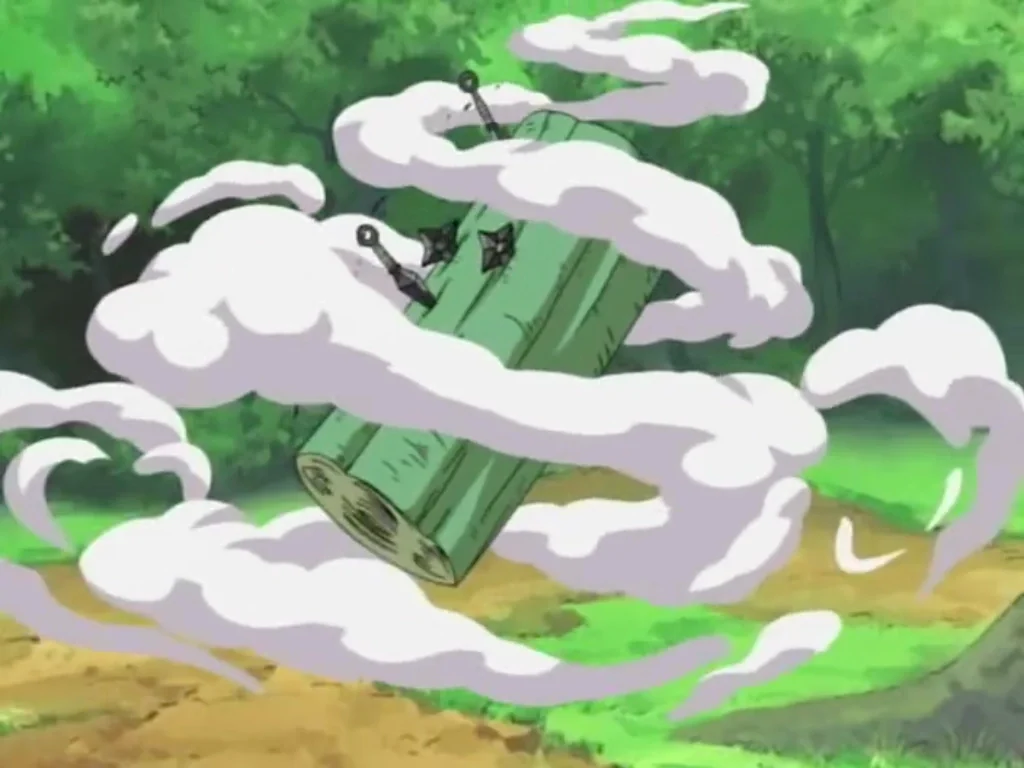
Body Replacement Technique (変わり身の術, Kawarimi no Jutsu), the Substitution Jutsu of the English-language anime,[1] is a basic ninjutsu — a ninja technique — in Naruto. The user's body is exchanged for a nearby object as an attack arrives, and the object takes the blow. What the technique produces is a deception rather than a defence, since the attacker is left believing the strike landed.[2] Every Academy student in the Village Hidden in the Leaves learns it, and the official guidebook grades it E-rank, the bottom of the scale used to rank techniques. The shredded log left behind is among the most recognisable images in the series.
1 What it does✎
The technique costs very little chakra — the energy behind every technique — and produces one thing: an opening. The guidebook names both ways of spending it. A user quick enough attacks while the enemy is still admiring the hit, and a user who is not simply leaves the fight.[2]
Almost always the substitute is a cut log, though the series is not fussy about it. Ninja have swapped with ordinary objects, with animals, with puppets in the case of Sunagakure fighters, and with objects rigged in advance with explosive tags, which turns the decoy into the attack.[5] Nothing about the exchange wounds anyone or ends a fight by itself.
2 Why the log appears after the hit✎
Panels routinely show a character being struck and turning into a log only afterward, which reads as a swap arriving too late to be any use. The character is unharmed, though, and the guidebook calls the successful hit an optical illusion.[2] An illusion of being hit is not a description of being hit, so whatever absorbed the blow was in place before it arrived.
The guidebook's own picture caption confirms the reading from the other side. Beside a shot of Kakashi Hatake substituting, it observes that Naruto saw nothing except his teacher being struck.[2] That is a remark about the observer. The panels record what the attacker believed, in the order the attacker believed it, and the reveal is timed for the reader rather than for the fight.
Translations of the guidebook entry differ over whether the exchange falls just before contact or at it, and the gap narrows in the original language. Japanese phrases of the form "the instant X happened" mean at that very instant rather than afterward, and the verb for receiving an attack describes coming under one rather than being wounded by it.[6]
3 What the guidebook leaves out✎
The entry describes the effect and stops. How the user gets clear, and how a particular object arrives in the space they left, is not addressed. Two neighbouring entries in the same book narrow the field.
| Body Flicker Technique | Body Replacement Technique | |
|---|---|---|
| Relationship | Parent skill | Filed beneath it |
| Rank | D-rank | E-rank |
| Described effect | The body is driven at extreme speed by chakra | The body is exchanged for a nearby object |
| What the enemy believes | That the user teleported | That the attack struck home |
| Stated in the guidebook | Explicitly not teleportation — real movement | Mechanism not addressed |
The Body Flicker Technique, the parent skill, is described as looking like teleportation to an untrained eye while being nothing of the kind. The body is charged with chakra and moved at a speed the eye cannot follow.[2] That rules teleportation out for the family this technique belongs to. The Transformation Technique is meanwhile a change the user works on themselves, into a person, an animal, a plant or an object, and nothing in it turns a separate object into somebody else.[2]
4 How readers explain it✎
The common reader account takes the parent skill at its word and adds nothing supernatural. The ninja moves, at a speed that beats the eye, and puts an object where they were standing on the way out. On this reading the technique needs a moment when the opponent's attention breaks, which is why it works constantly among Academy graduates and rarely among veterans who do not look away.[7] The account fits the decline in the technique's use across the series, and it explains the recurring log without requiring the log to resemble anyone.
A second reading, common in Korean-language commentary, has the user disguise an object as themselves and steer it in the manner of a clone.[5] It sits badly with the guidebook, which does not grant the Transformation Technique any power over separate objects, and with the occasions when the substitute is a shadow clone that already wears the user's face.
5 In the story✎
The technique is introduced properly in Kakashi Hatake's survival exercise, the bell test that decides whether the newly formed Team 7 becomes ninja at all.[3] Naruto opens by burying his instructor under shadow clones, and Kakashi leaves the pile by substitution, so that the clones are left brawling with each other. The lesson is deliberate. Kakashi spends the morning teaching three graduates that a hit they were certain of means nothing, which is the first real gap the series draws between Academy grades and field work.
6 Across the series✎
After the bell test the technique becomes part of the ordinary grammar of a fight. Ninja use it so routinely that the manga often shows only the aftermath: a shredded log, an empty patch of ground, a voice arriving from the wrong direction. Its effect on the storytelling is large, because no fight can end on a single surprise blow while both sides are capable of it.
Its use thins out as the series goes on. Part II fighters increasingly work by producing shadow clones in an opponent's blind spot, and the substitution that carried so many early skirmishes falls quietly out of fashion.[5] It returns at the very end for one of the war arc's better reversals, when Madara escapes a sealing technique by substituting with a shadow of his own.[8]
7 Origins✎
Japanese ninja fiction used the word kawarimi long before Naruto, in a form arranged well in advance. The ninja disguised a log or a straw dummy as themselves, left it where an attack would find it, and struck the opening once the enemy had wasted the blow. Modern manga compresses that whole arrangement into a single instant for the sake of the staging, which is where the sudden puff of smoke comes from. Abilities of the same kind in other series often carry the name utsusemi, the empty cicada shell.
Kishimoto keeps the timing and drops the disguise. His substitutes are plain logs, and the deception rests on speed rather than on the decoy looking like anybody.
8 Related techniques✎
The Body Replacement Technique sits alongside the Clone Technique and the Transformation Technique as one of the skills the Academy expects of every graduate. All three are cheap, all three are graded E-rank, and all three work by misdirection rather than force.[2] They combine easily, and the series uses the combinations often. A ninja can substitute a shadow clone for their own body, and Naruto once faked a replacement outright by transforming himself, at the moment he was struck, into an object his opponent was carrying.[6]
Where the Shadow Clone Technique grows into a fighting style of its own, the replacement stays exactly what the Academy taught, in the hands of beginners and elites alike.
9 See also✎
- Body Flicker Technique
- Clone Technique
- Transformation Technique
- Shadow Clone Technique
- Kakashi Hatake
- Naruto, episode 4: "Pass or Fail: Survival Test" English-language broadcast (VIZ Media, 2005).
- Naruto: Hiden — Rin no Sho, Character Official Data Book (Shueisha, 2002), jutsu section, in the English transcription hosted by The Narutoversity. narutoversity.wordpress.com/first-databook-jutsu-files. The original Japanese has not been consulted for this article. Retrieved August 2026.
- Naruto, vol. 1 (Shueisha / VIZ Media).
- "Pass or Fail: Survival Test." NARUTO OFFICIAL SITE (official). naruto-official.com/en/anime/naruto1/list/01_228. Retrieved August 2026.
- "Body Replacement Technique." Namuwiki (namu.wiki), Korean-language entry. Retrieved August 2026.
- "変わり身の術." Pixiv Encyclopedia (dic.pixiv.net), Japanese-language entry. Retrieved August 2026.
- Reader discussion of the technique's mechanics, r/Naruto. Retrieved August 2026.
- "Techniques of NARUTO." Enpedia (enpedia.org), Japanese-language entry. Retrieved August 2026.
Content available under CC BY-SA 4.0